
Down a set and a break in the Indian Wells final to Del Potro, Rafael Nadal dashes to his far right of the court, gets his racket on the ball, and sends it back to Del Potro. The Argentine takes another strike, belting a forehand into the far left of the court. Nadal scurries across and once more sends the much-abused ball back to his opponent. Del Potro strikes again. This time the forehand just misses the line.
Del Potro had gone for too much. But he had had to. Unable to hit through the ‘hard’ court, unable to withstand his opponent’s defense, it was all or nothing. He had to go for the lines to strike winners and he had to strike winners to beat his opponent. While his defensive game has improved, he was never going to win a grinding battle against Nadal. The only game that was going to win him this match was the one built around getting into position and assaulting his opponent with that forehand, one of the most varied and potent in tennis. That game had worked for the first set and a half. He had been able to thwart his opponent’s defense, that mighty forehand tearing it down. But the longer Nadal is on the court, be it clay, hard or grass, the better his chances are. The more he runs, the more pumped-up he gets. And the tougher the battle gets, the harder he bites, and those teeth are sharp.
It was at a set and a break up in favor of Del Potro when the Argentine had to put Nadal away or else face the pain that is a fighting Nadal. Though Del Potro went for the lines, the ball just kept coming back and Del Potro started to miss. The kind of form that it takes for a big hitting giant like Del Potro to hit through these slow hard courts is, after all, temporary. On the other hand, the kind of class a player like Nadal has is permanent. Despite his seven month absence from the top flight of tennis, despite an opponent on the back of beating his big match nightmares Murray and Djokovic, despite not winning a hard court tournament since 2010, Nadal not only managed to get the balls back but also to attack when the moment arose, showcasing the hard court prowess that saw him win two hard court slams and multiple masters titles.
At 2-3 down in the second set, Del Potro serving, Nadal took matters in hand, defending and attacking in equal measure. And once he had broken back, once that forehand of his was on form and he had the Argentine on the run, unable to hit forehand winners, the chances of Del Potro winning the match shortened. Nadal, after all, is a matter of the tennis match, working his way into the game and then getting a grip on the momentum once he has swung it his way. Once Nadal broke Del Potro, the Argentine’s chances were all but gone. Counting him out would have been foolish considering his comeback win against Djokovic in the semi-finals but this was the Indian Wells’ final against one of the greatest competitors in the game. Finals and semi-finals are different beasts for players like Nadal, they bring out their very best when the trophy is courtside ready to be engraved with their names, and the third set saw a Nadal as consistent as ever, those ground strokes as unrelenting and that attitude as competitive as it had been before his disappearance from the tour last June.
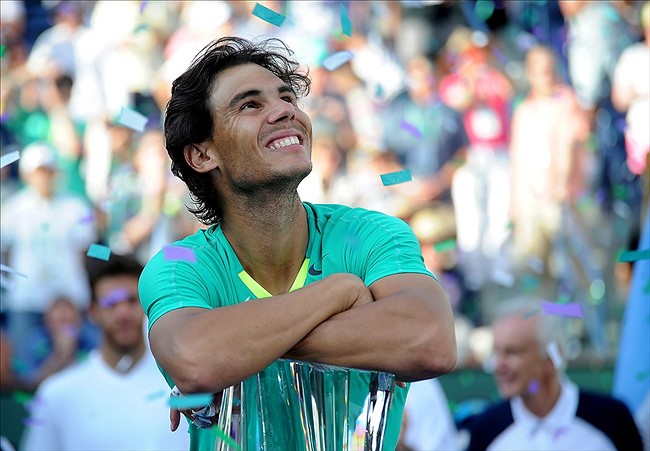
Nadal put Del Potro under pressure as the third set got underway, making him fight for more than ten minutes to win his opening service game of the third set. It was now a case of how long Del Potro could stay in the match as he misfired his forehand and his legs began to wilt from covering all the corners of the court in the midday heat. With his game now collapsing, there would only be so many epic service games he could survive. With Del Potro looking vulnerable, Nadal did not let up. Nadal kept getting him on the run, took his chances and lapped up his opponent’s errors, pumping his fist and firing himself up. The Spaniard broke Del Potro at 1-1 with a forehand winner into the open court. Nadal’s muscle memory is not limited to his limbs alone. His brain had not forgotten to win as much as his hitting perfect topspin forehands had not escaped his arms. In front and having played himself into the match, Nadal kept his form and won the match with some fine attacking tennis in the final game, moving forward when the chance arose to hold two championship points. One was enough. Hitting deep, loopy forehands to Del Potro’s forehand side, the Argentine, not in the mood to trade forehands, went for a shot down the line but the ball went wide and Nadal fell onto his back.
It was his 22nd Master’s title, putting him back at the top of the all time Masters 1000 leader board. More will likely come this Spring when Nadal next plays on the red clay courts of Europe, a chance to extend his lead at the top of the Master’s leader board and engrave his name even deeper into the hall of all-time Greats.
 thetennisreview