
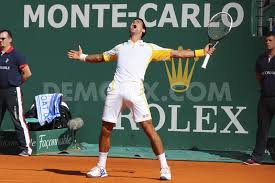
The championship match in Monte Carlo between eight time defending Champion Rafael Nadal and world number one Novak Djokovic would answer an important question for tennis fans worldwide : was Rafael Nadal, the winner of three of his last four tournaments since his comeback from a seven month lay-off, really back to his best?
Pre-Monte Carlo, the answer we had come to was definitely more yes than no. He beat Nalbandian and Ferrer in his South American swing adventure, and he defeated Federer and Del Potro in Indian Wells, all impressive wins for someone out so long. However, they were also wins marked with astericks: Nalbandian is past his best, Ferrer, on clay at least, has never posed him problems, Federer had a bad back and Del Potro was knackered. The only way we would know if he was really back to his best would be if he could defeat the player, a monster in his eyes, who he had, in part, created: Novak Djokovic.
Nadal’s superb defense and ability to turn it into attack are what Djokovic had to better if he wanted to become a world number one and multi slam winner. And that is what he did. The Serbian hit the gym, rested in his egg machine and flew out of the gates in 2011 a new, improved player. He went on to beat Nadal, the then number one and holder of three Majors, in seven consecutive finals, three of them Majors and two of them on clay courts. That run was finally ended, here, in Monte Carlo, a year ago, when a vengeful and improved Nadal armed with a revamped forehand beat Djokovic in straights. Nadal would go on to beat Djokovic in the Italian and Roland Garros finals before his knee injury sidelined him from the tour and denied tennis fans further encounters in what was shaping up to be a rivalry once more.
While Nadal was away nursing his knee, Djokovic was busy making the US Open final, winning Beijing and the London WTF, securing YE No.1, and winning in Australia and Dubai. That’s a lot of winning. And, rested after an early defeat in Miami, the world number one came out in yesterday’s final ready to go. The courts, dampened by the rain that delayed the match by nearly an hour, meant it would play not unlike the courts in the third set of last season’s Roland Garros final where Djokovic dominated Nadal before play was postponed. Just as he had then, Novak Djokovic took advantage of the fluffier balls, hitting low and flat, to jump into a 5-0 lead against an opponent who, denied the ball rising into his strike zone, was denied the topspin he so loved, and so needed.
All Nadal could do in these conditions was look on as the winners flew past him. But while it was turning into a nightmare for the Spaniard, it was not so for the spectator. Watching Djokovic’s backhand in top form and being treated to the odd drop shot and drop volley, plus the occasional forehand down the line winner was a pleasure indeed. Aware that only his A game would suffice, this was a different Djokovic to the one we have seen grind match after match against the Federers and Murrays. This was more like the aggressive, explosive Djokovic who we saw go unbeaten in ’11 until the French Open.
For Nadal to even win games against this Djokovic he had to make his first serves, hitting them out wide and on the line. Anything less was punished by the number one. Finally, at 0-5, Nadal worked hard to save set points and win a game and as the Novak purple patch wore off, the Serbian made a few errors at the net to drop his next service game. Serving at 2-5, things were looking better for Nadal. The longer Nadal could keep this set going the more he would be able to work his way into the match and the greater his chances would be of winning it. Alas for the Spaniard, his serve was not good enough and his brief comeback came to an end as he double faulted on the Serbian’s eighth set point.
In the second set, as the clay warmed up, so did Nadal’s game. Nadal needs the courts to be hot so the balls can sit up and he can brush them with spin in the same way that bread needs an oven to be on high in order to rise. Once the balls were sitting up, Nadal tore into them like hungry hands ripping up warm bread to gorge on. Now Nadal had the balls bouncing as he wanted, and, feasting on the spin he had been starved of, he no longer fed into the hands of Djokovic but fed himself instead, earning a break to lead 4-2.
But Djokovic was as hungry as Nadal, hungrier even. With Monte Carlo being, along with Cincinnati, the only Masters missing from his collection, and only too aware of the psychological advantage a win here would give him, Novak was not about to go away. Now that Nadal seemed to be in the ascendancy, Djokovic went back to grinding, to see if Nadal really was back to his best and discovered that he was not. The Spaniard was going for too much too often and, out of practice competing against the tour’s toughest opponent, lacked the match play that would, were he at his best, have seen him make the lines. Novak broke back to love. His man on the ropes, Novak began to attack once more, knowing he had to finish Nadal quickly or go into a third set on cooking courts against one of the best match players in the game. However, Djokovic’s attacking game, having been out of action for a few games, had lost its rhythm and did not allow him to break away from the Spaniard. Instead he made three backhand down the line errors, a shot which had previously promised winners, to help Nadal stay in the match.
With both players edgy and erroneous, the match went with serve to a tiebreak. A crapshoot. For one man victory and history was seven points away. For the other, a position of a set all and the prospect of a tired opponent and a ninth trophy. Nadal, willing to take the risks needed to win a breaker but not good enough on the day to see them pay off, overcooked a forehand and Djokovic had a mini-break for 2-0. It was not the last of the overdone Nadal forehands as Nadal’s weapon blew up in his face to see him go down 0-3. Another well-intended cross-court forehand out and the eight time champion was down 1-5.
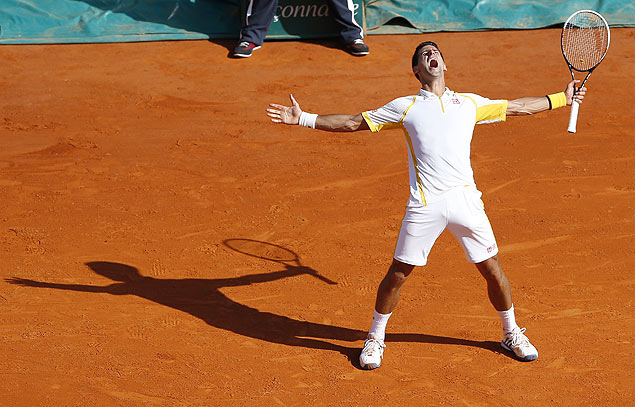
Djokovic was not missing his forehand though. His own recent return to aggression had seen him back into the rhythm of hitting winners and a fiercely struck forehand return down the line drew a backhand error from Nadal to give Djokovic five championship points. He needed only one. A replica forehand winner, his twenty fifth winner of the match, and Djokovic had a much desired win, the roar he let out telling us all we needed to know as to how much it meant to him.
It was a roar that answered our question; echoing in its yes was a loud no. Nadal was not back to his best. Djokovic certainly is though. More answers as to Nadal’s form will be provided in the lead up to Roland Garros, a lead up that, on the back of this Djokovic win, certainly looks more interesting than it has the last eight years when Nadal has opened up his clay court dominance on the court principale of Monte Carlo, a court where yesterday he performed the much unrehearsed role of runner-up, a role we will be curious to see if he is cast in come June the 9th.
 thetennisreview
Leave a comment