
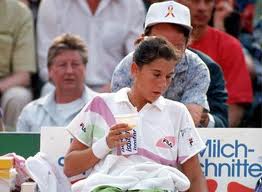
Hamburg, April 30, 1993.
Twenty years ago today Monica Seles let out a scream that bloodcurdlingly eclipsed the scream we were used to, that infamous scream which she unleashed along with her two handed strokes. This scream would become even more notorious, ripping through the stadium as devastatingly as her ground strokes ripped through the courts. And it was a scream that still echos around the history of tennis as loud and heavy as the elephant in the room that is the question of what would have happened had that scream been kept where it belonged, on the court, punctuating a stream of winners.
While the scream she let out when striking the ball was a carefully executed one that refined her rhythm on those terrifying strokes, this scream was the release of pure terror itself. It was a scream that did not need to be heard unless one had to see and hear for oneself the horror of what had happened. If the news itself were not enough. The news that had to be heard over and over to be believed. For months after it still did not ring true. Players just do not get stabbed on court. The images of Seles reaching for her back, being carried off the court, her attacker being tackled by security guards was the stuff of nightmares, stuff that could not be real. But it was real. Very real.
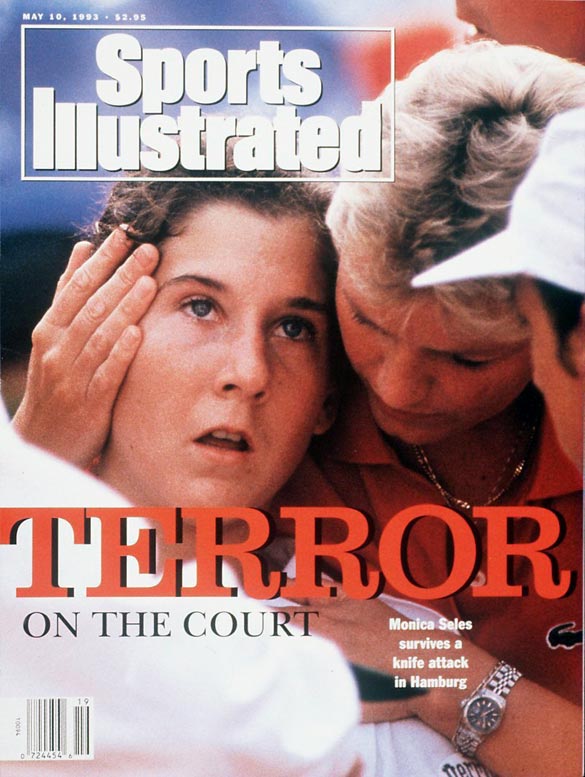
(thanks to imageslides.com)
The fact was that Monica Seles had been stabbed on court by Gunter Parche, a Steffi Graf fanatic from Germany. The shock shook not only the tennis community but anyone who heard the news. Even myself, a hard core Steffi Graf fan who had watched through gritted teeth as his heroine had fallen to Seles in Major finals, felt stunned and saddened that sporting history had been so derailed.
Seles, the 19 year old world number one and 8 time Major winner, was well on her way to making history in the spring of 1993, looking set to cement herself in the pantheon of tennis Greats, perhaps even as the greatest. Earlier that season she had added another Major, the Australian Open, to her haul, beating her chief rival Steffi Graf in a three set final. And, now, back on the Clay, the surface where her talents were best suited, she was playing herself into form for what would likely be a fourth Roland Garros title.
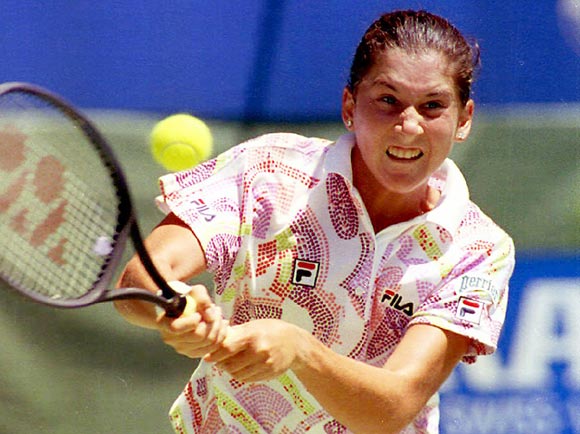
(thanks to sportsillustrated.com)
Sitting down on a changeover in a quarter-final in Hamburg against Maggie Maleeva, Seles was leading by a set and a break. It looked to be a routine win for the teenager. Toweling herself down, taking a breather from another intense performance, Seles would likely have been considering how to tackle the next point. What would happen next, however, would take far longer to tackle than a few seconds, an act of violence that would change the way Seles looked at the court, the world, herself, forever more.
Seles’ attacker struck, knifing her back with a 23 cm blade, inflicting a physical wound half an inch in depth but an emotional wound of a depth unfathomable. Seles was grimacing, reaching for her back. Officials ran to assist the victim while security restrained the perpetrator. Seles was carried off the court and was taken to hospital, where she was visited by a tearful Graf, the only time she would hear from her German rival during her absence. On being released from hospital, Seles departed Germany, never to play a professional match there again, a personal protest at the justice system that failed to imprison Parche, another blow that made her attack even harder to come to terms with.
In Seles’s absence, Graf did just as Sele’s assailant had desired. She returned to number one, a controversial move where every WTA player apart from Sabatini voted for Seles not to have her ranking maintained. And if Parche’s wishes had not been fulfilled enough, Graf won 6 of the next 10 Slams as the realization of a mad man’s dreams played out.
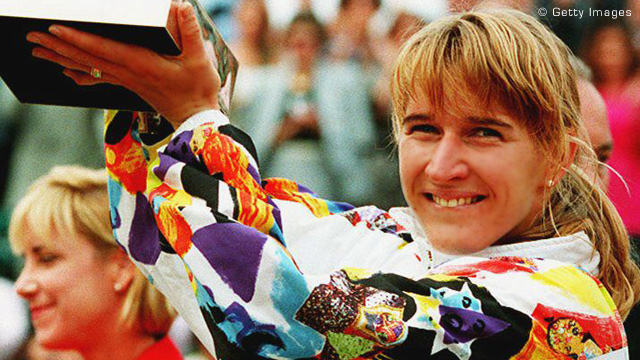
Steffi Graf with the ’93 French Open trophy
But though Graf’s trophy cabinet grew more cramped, the victories were whispered by some, shouted by others, to be hollow. Had Seles not been stabbed, the whispers went, it would have been Seles, not Graf, smiling and posing with the Major trophies. After all, before the stabbing, Seles had won 8 of 12 Majors and had beaten Graf in 3 Major finals. Graf, meanwhile, had only been able to manage two Major victories, both at Wimbledon, (one of which included a thrashing of her rival), since losing to Seles in the ’90 French Open final, a defeat that put an end to her run of eight of the previous nine Majors. Nevertheless, Graf could only play who was in front of her and as Seles’s departure from the tour went on, Graf’s major count tallied up, putting her close to the top of the all-time Major leader board. But the asterisks next to her name was the WTA’s elephant in the room.
It was an elephant they hoped would soon get moving. And an elephant that refused to budge. Seles remained out of the game for 2 and a half years. Reported sightings filled up inches in the tennis gossip columns. Fans pined for her return. Non-fans, too. But Seles stayed away and the elephant got bigger.
The injury itself had kept her off the court much longer than it had taken to heal due to the psychological damage being much deeper than the physical one. The tennis court had been Seles’ sanctuary and now it had been violated and she simply did not feel safe to return. Instead she chose to stay at home and eat junk food and dwell on the terrible act that she had been a victim of.
But as the months added up, and the sessions on the psychiatrist’s couch, so did the desire to return. Fans and the tennis establishment encouraged her, too, but it took one of the game’s legends to finally convince her to come back. Martina Navratilova got Monica Seles back on court in July 1995 in Atlanta when the two of them played an exhibition. The beaming Seles returned to the court to great fanfare much to the relief of the tennis establishment and, more importantly, to herself. The fear she had had of stepping onto the court had been faced and conquered and a new installment to her career lay ahead.
Seles returned to professional tennis at the ’95 Canadian Open. It was a return received with much greater warmth than she had known in her heyday, a time when her grunting and pop-star like posing had led to much tutting and head shaking. Humbler and now with the endearing glaze of tragedy veiling her, she was cheered on all the way to the US Open final a week later where she met her nemesis, the player who had inspired the un-imprisoned Parche, Steffi Graf. It was a classic match, a match that delighted us as it made our hearts sink, the greatness of what could have been as loud as the sounds of the balls being thwacked in thunderous rallies. Graf won but it was tennis that really won that night as what could have been was very much being and the future looked, after a long period of bleakness, very very bright indeed.
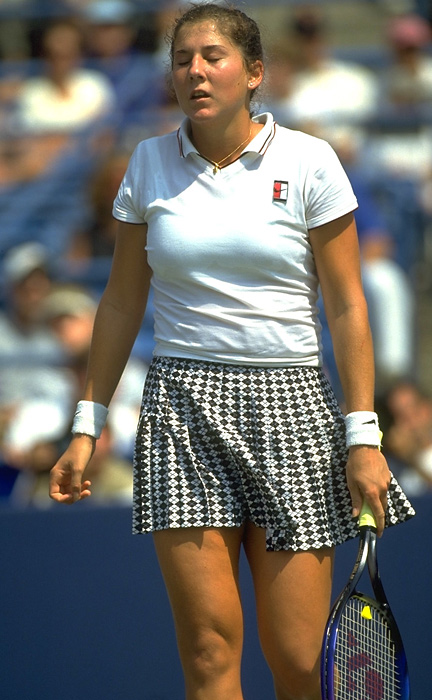
(thanks to imageslides.com)
Seles went on to win the Graf-less Australian Open in ’96. Despite the pain of her past being evident on her thighs, she was still too much for the likes of Rubin and Huber. It was to be her last Major though. A step slower than her prime, she was knocked out early in subsequent Majors. An appearance in the ’96 US Open final, where she was bettered by the much fitter Graf, was the highlight of the next few years until a runner-up spot in the ’98 Roland Garros final. That run seemed to inspire her. Slimmed down, she played her part in what would come to be known as the Golden Age of women’s tennis, age in which she took to playing the part of supporting actress with all the venom and passion she had shown playing its leading lady.
In 2003, a surprise loss to Nadia Petrova in the early rounds of the French Open would be Seles’ last professional match. Though she did not let on for several years. Fans and the media speculated on whether or not she would return but as the years went by a return became less and less likely. Finally, in 2008, Seles announced her retirement. Fifteen years on from the stabbing and aged 34, she had made peace with her past and done her best to silence the should-have-beens and voice, instead, what was. Behind her she left a legacy as inspiring for her initial dominance and ground-breaking game as her comeback from what still, to this day, remains to be the greatest tragedy of Open tennis, and perhaps, of any sport. The robbing of an athlete in her prime of achieving what her whole life had been spent preparing for is an unforgivable act. Somehow Seles found it in herself to forgive and move on, elevating herself onto more than just a greatest list of tennis players but a greatest list of human beings.

 thetennisreview
Leave a comment