
John Isner looked like he might have finally solved the conundrum that was long five setters. It has become a problem that seemed unlikely after his 70-68 win over Mahut at Wimbledon. But tough losses to Matthieu at Roland Garros ’12 and Falla at Wimbledon ’12 only too brutally highlighted the major flaw in his game, the return of serve. But against Harrison in the second round in this year’s French Open, Isner came back from two sets to love down and won 10-8 in the fifth, breaking at 9-8, his return game for once not weighing down his overwhelming strength, that killer serve that bolts down from six foot nine and a very long arm.
In the third round on Saturday, Isner went two sets to love down again against veteran Tommy Haas. He managed to reduce the deficit to 1-2 but in the fourth set, serving to stay in the match, he was match points down. On his serve this predicament is not so troublesome and an unflustered Isner saved it with a characteristic huge serve. Isner is cool as ice when saving big points on serve and his weapon does not let him down. That was a welcome strength against Haas whose flair and strong return saw him reach match point no less than 11 times on the Isner serve in a ten minute game. It was the Haas backhand that was doing the trick, devouring the angle of the Isner kick serve and using it to go down the line for a winner to give him the opportunity to take the match. But a match point on the Isner serve is an opportunity as inviting as snatching diamonds from an alligator’s jaw. Each time the American bolted down another huge serve which either gleaned a service winner or gifted him a short ball for him to step in on and punish with weapon number two, the forehand. Back and forth the two went in this fashion: Haas finding the angle on the return or finding the open court to hit down the line winners to earn match point, Isner unleashing the serve to level matters at deuce. Finally, serving into the deuce court, Isner found a winner on his serve and had game point. A trusty huge delivery and it was 6-6.
Losing 11 match points is hard to recover from. But Haas did well and got another match point and on his serve. Losing match points on Isner’s serve is, considering the fierce quality of the delivery, forgivable. Losing them on your own serve is less so. Haas missed the first serve. And then he missed the second serve. His twelth match point thrown away on a double fault. Isner’s serve did not let him down now, and neither did his return, going on as he did to take the tiebreak.
Two sets apiece, the puzzle seemed to be cracked indeed as Isner began to make the game look ridiculously simple. The big serves went in and earned him service winners or short balls or balls into his hitting zone. The return was working, too. At 1-0 with Haas serving, Isner played smart at 30-30. He hit the returns back into the court and with angle, away from Haas who made some errors. Isner broke and held again to lead 3-0.
A historic win was on the cards. But while the Isner game when on looks so simple and effective, it does not take much on clay for a man of Haas’ skills and talent to dismantle. It just takes one glitch. At 4-2, 30-30, Isner dumped a volley into the net. He saved the break point with another volley attempt, brave after the failed one before, and fortune favored him. Such play is the mark of Isner. His problems are not mental, far from it. They are technical, the weaknesses in his game as devastating as the strengths. And those weaknesses are even more vulnerable against a man of the strengths of Haas, a former world number two and one of the last of the all-courters. Haas worked his way to another break point opportunity and won it with a forehand cross court winner that whizzed past a net approaching Isner.
At 5-4, Haas serving, Isner, disgruntled by the clicking of cameras during play, managed to block out the distraction to return smartly, again hitting an angled forehand to get an error for 0-30, and earned a match point as Haas errored on the forehand. But Haas worked out way out of trouble, that forehand coming to his rescue, booming through the court for a winner.
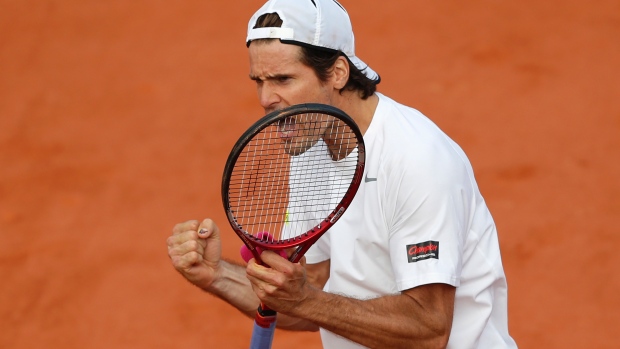
With both men having had their chances and lost them, and with the match going deep into the fifth, it was now a battle of stamina. And of the two men, Haas is the superior, and so it proved. While Isner survived break points at 5-5, the longer the fight, the more the man who had battled from 0-2 in the previous round was less likely to repeat that feat. At 8-8, Haas once more returned the Isner serve down the line for winners to break a fatigued Isner. It did not take much now for Haas to serve out for the match. Isner’s returns were now as wretched as his back seemed to be and Haas won his thirteenth match point as an Isner return went wide to see Haas win what may turn out to be the match of the tournament. Haas, at 35 years old, now has a fourth round encounter with Mikhail Youzhny to look forward to while Isner has a few weeks to work out why when it seemed the puzzle piece had been found and fitted it was his greatest strength that went missing.
 thetennisreview
Leave a comment