
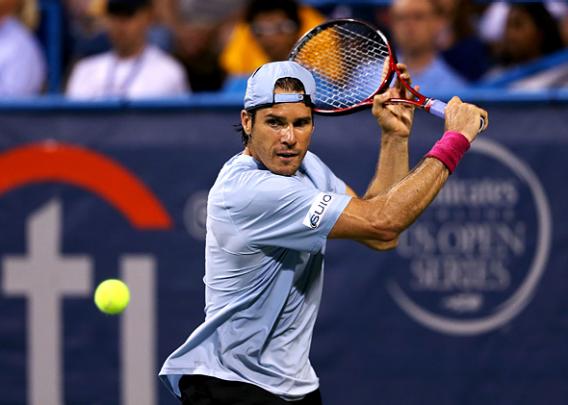
Review of the first week of the US Open.
The first week of the 2013 US Open was a case of out with the new and in with the old. Never has the triumph of experience over hope, on a tour more difficult on the body and mind than ever, been more clearly illustrated.
The first few rounds saw the men’s supposed next generation of future Major winners get knocked out one by one; the most high profile casualties being Nishikori, Tomic and Dimitrov. Briton’s Dan Evans took out the first two but at aged 23 this was his first win in the main draw of a Major outside Wimbledon at an age by which most players who are going to make a splash have got everyone pretty soaked. Dimitrov, meanwhile, lost to a Sousa, a 24 year old playing in only his fourth main draw of a Major. Evans and Sousa were new, to the main draws of Slams anyway, while their higher ranked and younger opponents have been winning matches in Majors for a while now. These three men are touted as the next big things but are not ones reflecting the sun of late, vanishing instead in the shadows of lesser-ranked opponents in the early rounds.
One man, the youngest of the current Major winners in the game’s top ten, Juan Martin Del Potro, on the cusp of turning 25, looked like he might be able to repeat his 2009 US Open victory only to be knocked out of the tournament by the 2001 Champion, the 32 year old Lleyton Hewitt. The former world number One proved to be the fitter of the two, taking the final set 6-1 in a match where Del Potro’s fitness issues, his wrist in particular, were all too evident in the never-ending languid slices he limped in on his backhand.
Hewitt went on to beat another up and comer in Donskoy(23) and will play one of his fellow veterans, Russia’s Mikhail Youzhny (31), in the last sixteen. The 2006 and 2010 New York semi-finalist beat Tommy Haas (35) in the last thirty-two. The thirtysomethings were anything but alone in the later stages of a Major. In the last 16 Robredo (31) beat 32 year old Federer (32), Nadal (27), who has been winning Majors for close to a decade, beat Kohlschrieber (29), and Ferrer (31) beat Tipsarevic(29). Meanwhile other last sixteeners such as Djokovic, Murray, Istomin, Berdych and Wawrinka, all aged 26 and 27, have all been professionals for nearly ten years.
The only breath of fresh air in the fourth round was 22 year old Milos Raonic but he was beaten in five sets by the tours oldest up and comer, Richard Gasquet, who, though has grown into a more consistent performer, at 27 looks less and less likely to deliver on the promise of his nickname Baby Fed.
The women’s game is not looking too fresh, either. Serena Williams beat 19 year old Voskoboeva in straights in the second round and thrashed 20 year old Sloane Stephens in the last sixteen. The other great hope of the girls yet to turn 21, Laura Robson (19), was dismissed in straights by 31 year old Li Na, who then beat 28 year old Jankovic in the fourth round. Joining Ni La in the last eight are Pennetta (31), Vinci (30) and Hantuchova (30), Makarova (25) and Suarez-Navarro (25). The youngest of the last eight will either be Ana Ivanovic (25) or Azarenka (24). It is on the former’s shoulders that the future of the game as far as consistent leaders and Major winners rest. Only Azarenka has shown the ability to be consistent and win Majors of her generation and this US Open is a timely opportunity for her to win her first title and establish herself as a middle-aged, tennis wise at least, top player.
Indeed, the days are long gone when, as in 1992, two teenagers fight for a place in the final, as a 14 year old Capriati and 16 year old Seles did, or twenty year olds win the men’s title, as Safin and Hewitt did in ’00 and ’01. On a tour which demands more of the body, the slow hard courts such as those of the US Open taking their toll on the knees and legs, a tour which also asks more of the mind, the media demands and length of the season leaving little time for family or home-life, it is the veterans who are surviving. Their bodies are already broken, the pain already a part of daily life. Their minds are already strengthened by experience and hardened to the loneliness of a life playing for the public. It is a life which rewards them should they go far but a life in which the sacrifices no longer seem to be just their childhoods. For those with the stomach for it, in a game where 28 was once considered over the hill, their final days of youth, in a game where success comes to those who wait, are sacrificed, too.
The spectacle the veterans have provided in a sport once the game of the young in the first week of this year’s open is certainly inspiring and thought-provoking. The sight of the likes of Williams and Robredo making it to the last sixteen leaves no question as to whether tennis can be played at its highest level into your thirties but among the cheers from appreciative spectators can be heard an eerie question which may go unanswered for some time: where have all the young guns gone?
 thetennisreview
Leave a comment