

Novak Djokovic celebrated his 142nd week on top of the ATP Rankings (beating Rafael Nadal’s 141 weeks) on Sunday April 19th 2015 by becoming the first man in ATP history to win Indian Wells, Miami and Monte Carlo in the same season. The Tennis Review looks at seven factors contributing to the eight time Grand Slam champions history-making success.
1. Fitness
Djokovic is the fittest player on the ATP tour-fact. That was not always the case, however. In his early career he was infamous for retiring from matches due to sickness. But in 2010, he worked hard in the gym, got fit, became gluten free and became the player most capable of dealing with the trying playing conditions of the ATP tour.
Djokovic’s fitness allows him to compete on an eleven month tennis circuit, take part in 18 tournaments a year (and reach the later stages of 80-90% of them), and gives him the stamina to compete for hours in some brutally hot conditions. See his six hour 2012 Australian Open final against Rafael Nadal to appreciate the extent of his fitness.
Watch the Video of Novak Djokovic’s 2012 Australian Open defeat of Rafael Nadal below
Impressively, Djokovic is as fit at the start of the tennis season as he is at the end of it- winning the Australian Open in January five times and the WTF in November four times.
2, Court surfaces and game style
Djokovic’s feat of winning both the Australian Open and the WTF multiple times is helped by the fact that both the Australian Open and the season ending event in London are played on similar surfaces- slow, high bouncing ones. He also benefits from the general homogenization of the ATP surfaces, mostly medium slow- slow courts, which have helped him win the Indian Wells- Miami double three times (2011, 2014, 2015) and compile impressive winning streaks from Beijing in September to the WTF in November.
The slow high bouncing surfaces complement Djokovic’s aggressive baseline game which can switch to defense when needed, and he is the best player on the tour at turning offence into defense. He does that through his biggest weapon, his backhand, which he can hit cross-court at a variety of lengths and angles, pulling his rival wide, and opening up the court, and he is a master at changing direction of the ball and going down the line. Those slow surfaces give him plenty of time to get to the ball and set up his favorite shot.
He has also added variety to the game, coming to the net more, which gives him the edge against other baseline players such as Murray and Nadal, and added an element of surprise to his predominantly baseline style.
3. Open-mindedness
Djokovic’s increased play at the net was courtesy of Boris Becker’s influence. Djokovic hired the five time Slam champion as his coach at the end of 2013, and his risky decision paid off.
However much success Djokovic had had with his team – he had won six slams with them before hiring Becker- change was needed. In 2013, Djokovic lost his No.1 ranking, and the Wimbledon and U.S Open finals, and that U.S Open final loss to Nadal was his fifth loss in his last six Slam finals.
The results did not come immediately with Becker. Djokovic lost the Australian Open final, losing on a missed volley on serve match point down to Wawrinka in the last eight. But things took a turn for the better when he won Indian Wells and Miami back to back and beat Nadal in the Rome final. However his slam final record took another blow when he lost the Roland Garros final to Nadal.
At Wimbledon, though, everything clicked. Djokovic finally won another slam, and against his biggest rival at the time, Roger Federer.
4. Mental toughness
That much longed for Slam win was down to Djokovic’s improved mental toughness. In that final, Djokovic served for the Championship in the fourth set only to be broken and taken to a fifth set. He did not break down, though, under the pressure. Instead he held serve to 5-4 returning and then broke for the title.
Djokovic displayed great mental toughness in that match, the quality which has been a key aspect of his game when he won three slams in 2011. That toughness had diminished in 2012, when he lost the French Open final, double faulting match point down, and the U.S Open final that same season to Murray.
But most worrying was his 2013 Wimbledon final loss to Andy Murray in which he appeared tired and at times defeated before the final ball, a shadow of the player who in 2011 was almost unbeatable in big matches.
Djokovic certainly tried at Wimbledon 2015 though, and managed to stave off a resurgent Federer. Holding his serve with greater ease than the Swiss was a key factor. There were to be no double faults on key moments in this final thanks to a much improved second serve.
5. The Second serve
It is an old cliche, but in tennis, you are only as good as your second serve. Djokovic can tell you about that. He lost the French Open final 2012 on a double fault. Becker cleaned up the action, though, and gave Djokovic arguably the best second serve in men’s tennis. That serve held up in the Wimbledon 2014 final- Djokovic won 65 percent of his second serves in that match, compared to Federer’s 44, and his second serve has been the deciding factor in many a close match.
Add that to the best return in the game, and you have an eight time slam champion No.1.
6. Timing
Djokovic’s rise has also timed with his rival’s demise. Nadal is slumping, Murray has not been the same player since surgery, and while Federer is able to beat him on faster surfaces in best of three, the Swiss, now aged 33, has not been able to impress in best of five at slams, going to the finals once since winning Wimbeldon 2012.
The next generation have also failed to impress at the highest levels of the game due to the slower surfaces not rewarding their youthful speed and the lack of mental toughness early breakthroughs provide.
But while all around him have either been failing to progress or have been losing their games, Djokovic has been maintaining his, improving it even, and reaping the rewards.
7. Heart
Heart is something Djokovic is not short of, and it has helped him fight through tough matches and motivated him to improve. Who can forget his saving match points against Tsonga at the French Open 2012, his five set win over Murray at the Australian Open that same year, or when he edged Roger Federer in a final set tiebreak at Indian Wells 2014.
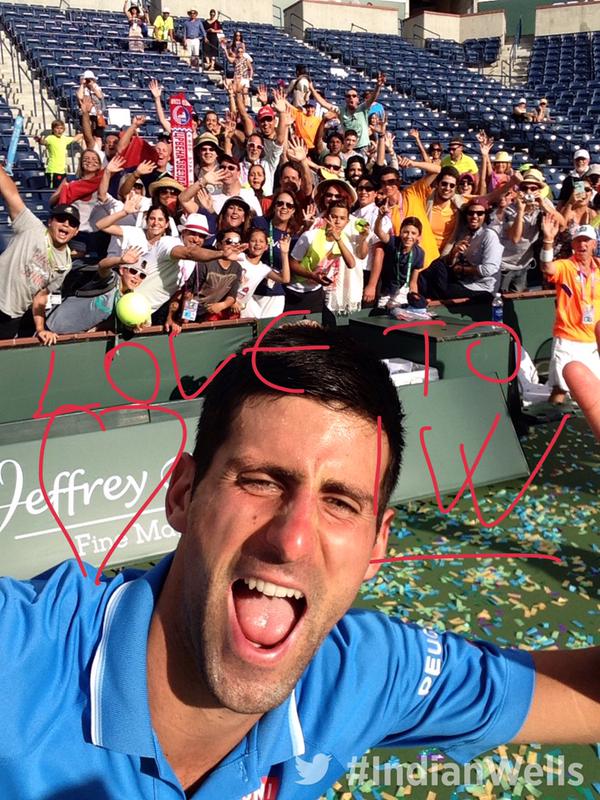
That heart comes from his love of the game- he loves what tennis has done for him and his family, and he loves the fans his game has earned him. Few player show their love as much as he does either or receive it from the fans with such passion. Check out the Nole family to see one of the tour’s biggest and most vocal fan clubs.
Djokovic even gives his heart to the fans who do not support him, and there are many when he plays other greats, most notably Federer. But whatever the crowd do, from booing his challenges or shouting out between his serves at crucial moments, the world No. 1 finds it inside himself to dig deep and win, as he did at Indian Wells this year, and he always thanks the crowds and tells them he loves them.
One day, when Federer and Nadal are gone, and Djokovic is still giving it his all at the top of the game, challenged by a new generation, he will get that love back, too.
Not that that is why he gives his love, though.
Djokovic gives love to the game and its fans for one reason only- his heart. And quite a heart it is ,too- the heart of an eight time Grand Slam champion with the sixth longest reign on the top of the ATP rankings.
Commentary by Christian Deverille @thetennisreview
Follow The ATP Tour with The Tennis Review
What do you think about Djokovic’s factors for Success? Please share your thoughts below.
Liked this article? Please share it 🙂
 thetennisreview
Leave a comment