
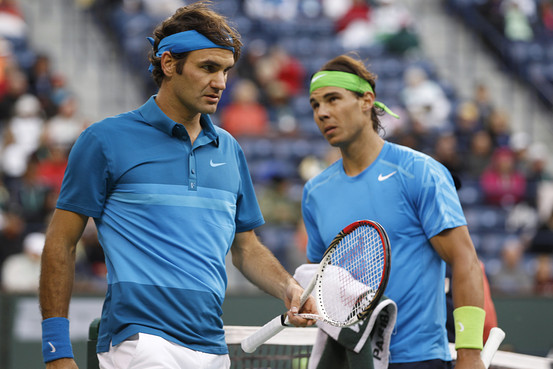
The Federer- Nadal rivalry has been one of the most enthralling in tennis, a clash of contrasts that has spanned 11 years and 33 matches on the world’s biggest stages. There is one notable exception though – the US Open. The tennis review looks at how the rivalry might have turned out had they met on the game’s most neutral, surface-wise, and passionate, fans-wise, stages.
The Federer Nadal rivalry is a complex one for fans. For some a lopsided rivalry led by one party 23-10 is anything but a rivalry. For some, the head to head is misleading as no less than 18 of those matches have come on clay, a surface which favours Nadal. (Of the matches played on grass, Federer leads 2-1, on outdoor hard, Nadal leads 5-3, and on indoor hard Federer has a 4-1 advantage.)
Those 33 contests have taken place on every great tennis stage bar one – the US Open. The Flushing Meadows Deco Turf surface may be the most neutral of the Slams, but it should favour Federer’s game style and the head to head might read differently if they had competed there as often as they have at Roland Garros.
Federer dominates, Nadal capitulates
The year Federer won his first US Open, 2004, was the same year he first faced and first suffered defeat to Nadal, in the fourth round of the Sony Open, Miami.
That 6-3, 6-3 loss was a blimp in a 3 slam winning year in which Federer defeated Roddick in the Flushing Meadows final while it was a highlight for Nadal who went slamless and lost in the second round of the US Open.
A battle of the minds
That very year was an indication of the most intriguing aspect of the Federer Nadal rivalry- the mental issue. Back then Nadal was seen, courtesy of his heavy top spin and strong legwork, by many as a future Clay expert and as a player who would struggle on hard courts. Meanwhile Federer was an all court player, particularly strong on hard courts, and in 2004 had won the Australian Open convincingly.
While Miami might be one of the slowest paced hard courts on the ATP tour, Nadal has never won there, and Federer is a three time champion. Nevertheless, Nadal, in his first match against the world no.1, came out and showcased the skills which would transcend his then weaker hard court ability – fearlessness and a tactical astuteness regarding how to employ his natural game, his heavy top spin shots, to defeat a player who would become an all-time great.
In 2005 the two met again in Miami, in a best of five final and though Nadal led two sets to love, Federer’s superior all court skills and experience came to his rescue as he took the match in five.
Nadal would recover well from that defeat, beating Federer in the Roland Garros semi-finals on his way to a first of nine titles there.
Though Roland Garros eluded Federer for the next few years (he lost the 2006-2008 finals to Nadal), other slams did not, and just like the Spaniard did to the Roland Garros trophy, Federer did to the US Open one – he made it his own.
While Federer only had Nadal, Safin, and Nalbandian to challenge and defeat him in big matches on hard courts in this period, (Nadal beat him in Dubai 2006) they could not do it in New York. Nadal, at that time perhaps the strongest world no.2 in tennis history, could not even get to him in the final there.
Nadal’s problem was that he had to contend with a greater depth of potential conquerors on hard than Federer did on Clay. Hard courters knew that to defeat Nadal they had to serve big, take time away from him so he could not get his heavy top spin going, and use the greater speed of the court to end the points early. Youzhny, Murray, Ferrer and del Potro all executed that strategy to perfection, taking care of Nadal at the US Open from 2006-2009, and denying the rivalry of its missing link.
Nadal solves his US Open problem as Federer’s problems in New York begin.
In 2010 Nadal did to the US Open what he had done to Wimbledon in 2008- he wore it down. But not the way he wore down opponents on the court with his defense. Nadal got the better of the US Open by beefing up his serve, and turning his forehand into a weapon which attacked his opponent’s weakness, earning him the short ball and allowing him to move up the court.
Nadal won the title in 2010 not by beating Federer, though, but by beating Novak Djokovic. The Serb would be the one who would now get in the way of Federer-Nadal battles in New York as, two years in a row, 2010 and 2011, he came back from sets and match points down, to defeat Federer in the semis and contest Nadal for the title.
The US Open rivalry still fails to get started
In 2012, Nadal did not enter and Federer was upset by Tomas Berdych in the quarters. The following year, 2013, Federer was upset by Robredo in the last sixteen while Nadal defeated Djokovic for the title. Then in 2014, Nadal withdrew injured, and Federer was defeated by Marin Cilic in the semi-finals.
This year, if the averages play out, could finally be the one in which these two old rivals meet on Arthur Ashe stadium. Federer is likely seeded third, Nadal eighth. If they did meet, it would come at a time in which Federer is playing aggressive tennis and ranked three while Nadal, ranked eighth, is muddling along, at best picking up ATP 500 titles, at worst losing in the second round of slams and the last sixteen of ATP 1000s to players he once dominated as he did this week to Feliciano Lopez in Cincinnati.
Such a match, if you were writing the script, could go either way. Federer could win it on his way to a record 18th Slam, ending the Greatest of all Time debate once and for all, a defeat of Nadal along the way the perfect touch. Or Nadal could win, reigniting his career, and spurring him onto a fifteenth slam and leaving him in contention of the Greatest ever status. In the script, neither man can lose in the next round. In reality, the let-down that would come after such an emotional win might make an exit in the next round inevitable. So, for the sake of the perfect story, we need this match to happen in the final.
If they were to meet this US Open, considering Federer’s commitment to aggressive tennis and Nadal’s short forehand and serving issues, Federer should win, and easily, too. But in a match up decided by what goes on in the mind more than any other factor, Federer could revert to his normal game plan versus Nadal- starting out all guns blazing inside the court until retreating beyond the baseline and into his shell, broken down by faster wheels, winning passing shots, and a will that knows no such word as won’t.
Would Federer have been able to overcome those strengths had they met at the US Open as often as at Roland Garros over the last 10 years? Would he have been more confident and able to start and finish their US Open matches up at the net? The surface may be neutral, but would favour him more than any of the other slams and you have to hypothesise he would have won three of every four matches they would have played at the US Open.
A closer head to head would have cut Federer’s head to head deficit, made Federer’s claim to the status of goat even stronger, and given a convincing rebuttal to the criticism ‘how can you be the greatest ever when you were not the greatest of your generation?’
Unfortunately that US Open rivalry never happened, much like their projected Cincinnati clash this week never took place. There is still hope though that in two weeks we might get a glimpse of what could have been, and while it will tell us little, it will be fun to watch and discuss the missing link in the greatest tennis rivalry of the last twelve years. A rivalry which poses lots of questions about both its participants and answers them with as much as what did happen- the French Open head to head, the Slam final epics-as what, like their US Open rivalry, never took place at all.
Commentary by Christian Deverille.
Recent Posts About Roger Federer :
Can Roger Federer Win the US Open?
Who Can Stop Roger Federer in Cincinnati?
Liked this article? Share it and help us get read.
Have something you would like to say? Get yourself heard in the comments box below.
Subscribe to our email list for all the latest posts straight to your in-box.
 thetennisreview
Leave a comment