
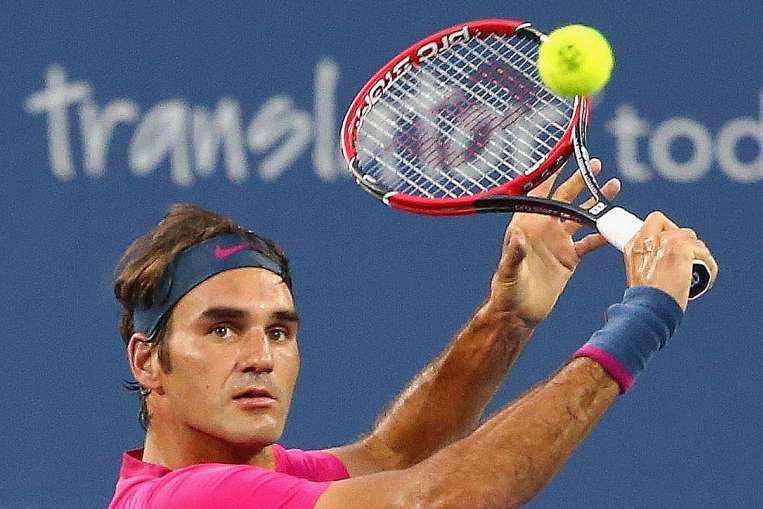
Roger Federer’s 7-6(1), 6-3 victory over top seed Novak Djokovic in the Cincinnati final was a masterclass in serving, risk-taking, attack, and efficiency. The Swiss did not put a foot wrong and the performance, and his run to the title might be the perfect setup for an 18th career slam at the upcoming US Open. The Tennis Review looks back at Federer’s performance and considers its possible positive impact on his chances in New York.
First win Over Djokovic in ATP 1000 Final Since Cincy ‘12
Since Federer committed to attacking tennis and got healthy again at the start of 2014, he has made 6 ATP 1000 finals and won two of them (Cincinnati ’14, Shanghai ’14) beating Simon and Ferrer respectively.
One of the four finals he lost was to Jo-Wilfred Tsonga (Canada ’14) while the other three (Indian Wells ’14, ’15, Rome ’15) defeats were at the hands of one man – Novak Djokovic.
Djokovic not only denied Federer those titles, but also beat him in the two slam finals the Swiss made –Wimbledon ’14, ’15.
That run came to an end last week in Cincinnati, and the impact that long-awaited big final win will have on Federer could be seen if the two meet in the New York final.
Against Djokovic, Federer is now 21-20. That slight lead, and the Cincinnati final win over his long-time rival that tipped the head to head in his favour, will be factors he can draw upon on in mentally difficult moments if the two should contest the final. Factors that could, in a game decided by a few key points, be decisive in determining the winner.
Back to World No.2
Federer’s win gets him back to No. 2 in the ATP rankings and assures him of the No.2 seed at the US Open.
Federer has said he does not care about the rankings and he has to deal with whatever draw he gets, but earning the second seed means he is guaranteed not to face Djokovic until at least the final. With Djokovic being out of sorts, the Serbian might not make it that far, making Federer’s quest for slam no. 18 a little bit easier.
Federer enjoyed the advantage of the second seed at last year’s US Open, and it looked to have worked in his favour when Kei Nishikori defeated Djokovic in the first semi-final. Unfortunately, Federer could not capitalize on that stroke of luck as he went down in straight sets to Marin Cilic.
This year it is hard to see Federer, considering his form, slipping up on the way to the final, and if he does get another huge stroke of luck and anyone other than Djokovic in the final, he won’t hesitate to take advantage (see Roland Garros ’09)
Serve on Song
Federer served better than he ever has against Djokovic in the Cincinnati final and, much like in his semi-final against Murray, he did not face a break point.
Federer’s first serve percentage of 57 might seem low to the 70s he was hitting in earlier rounds, but it is a compliment to the Djokovic return game. When Federer did get it in, his smart strategy meant it was effective – he won 83% of points behind that first delivery. His second service winning percentage was excellent too at 73%.
Not only was his service on form, though, but his return game was, too. Federer won 39% of points on his return, creating 8 break points for himself, and converting one of them. Not a spectacular conversion rate, but no one plays better with his back against the wall than Djokovic, and Federer’s positioning inside the baseline and risk taking on the return paid off handsomely –he out-returned that master of that shot, a most encouraging sign for the US Open.
Attack, attack, attack
Federer is not going to beat Djokovic, or any other baseliner, from the back of the fairly neutral US Open Deco-turf courts. Fortunately for him, his attacking game is well-oiled – Federer won 21 of 29 net points against Djokovic in the Cincy final. Compare that to Djokovic who won 2 of 9.
Back when Federer began to lose his grip at the top of the game, in 2010 when he first lost to Djokovic at the US Open after holding match point, Federer was intimidated from approaching the net by the Serb’s defence and passing shots.
Now Federer, thanks to his, currently sharper forehand, and much improved backhand, which he says Edberg helped him improve and shank less, he has greater consistency and depth. Invaluable assets to keep Djokovic behind the baseline, approach the net and get those points won fast.
Sharpening up those weaknesses won’t win him the Open, but they will make him much tougher to beat, and after how they held up in Cincinnati, the confidence Federer should have in them is immeasurable.
Efficiency is key
If Federer is going to win the US Open he is going to have to be quick about it. He certainly looked to be in a race to get home in time for the twins’ bedtime in Cincinnati.
Federer beat the world no 1 and 2 in straights sets, winning the final in 90 minutes, thrashed Anderson 1 and 1 and won comfortably versus Lopez.
At 34, and competing against men who could run all day, Federer’s nimble feet need to get up to the net as fast as they can.
He certainly proved, for a man who does not have time on his side age-wise, he has time on his side game wise, controlling the length of rallies and his time spent on court.
Playing like that will give Federer plenty of time to recover after best of five sets matches and ensure all his Cincinnati preparation gets put into practise as the 17 time slam winner attempts to win what has proven to be an elusive slam no.18, but which has, in the last three years, never looked more within his reach.
Commentary by Christian Deverille.
Liked this article? Share it and help us get read.
Have something you would like to say? Get yourself heard in the comments box below.
Subscribe to our email list for all the latest posts straight to your in-box.
 thetennisreview
Leave a comment