
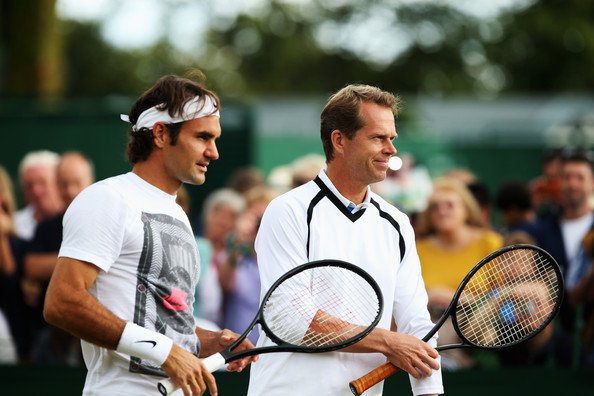
The Tennis Review gives you four great things about the Roger Federer- Stefan Edberg dream team which so very gentlemanly showed the tennis world volleying was still very much alive and you could still be in the mix for slams in your mid-thirties.
1. Edberg was Roger Federer’s childhood idol, and he still idolizes him to this day.
Thanks #StefanEdberg. You were an invaluable coach for 2yrs & will be my idol for life✌️🇸🇪🇨🇭https://t.co/h3i9jxWx8rpic.twitter.com/eUYjWJ6SxG
— Roger Federer (@rogerfederer) December 8, 2015
Federer’s words in the tweet above say it all.
Roger Federer’s idol. That is quite some status- being the idol of Federer, the most idolized tennis player on the planet, if not in the game’s history.
Federer’s idolizing of Edberg was there for all to admire in his early years on the tour in his willingness to volley and his one-handed backhand. A style of play that brought Federer to the attention of the world when he defeated Edberg’s old rival Pete Sampras in the 2001 Wimbledon fourth round.
That style helped Federer to become the world No.1, win his first Wimbledon title in 2003, and put together some of the greatest tennis seasons ever from 2004-2006.
However, Federer had to decrease his forays to the net in 2006 when a slew of young baseliners, namely Nadal, Djokovic, and Murray, began passing him at the net, pinning him back and beating him from the baseline with their heavy top spin and aggressive double handed backhands.
That double-handed backhand trio were helped along by the slowing down of the courts as they joined Federer at the top of the game and the Big Four were born.
Federer’s baseline game was good enough to enable him to compete with his challengers, but he could not dominate anymore, and he lost the No.1 ranking to Nadal in 2008.
Though the Swiss had to play more from the baseline, Federer still came forward when he could, and the net game and touch Edberg had inspired in him in his youth were still brilliant enough to win him four more slams from 2009 to 2012 and hold the No.1 ranking on two more occasions (2009, 2012) before injury took its toll in 2013.
2. Edberg rejuvenated Federer’s attacking game and brought him back to challenge for slams.
When Edberg joined Federer’s team, the Swiss was in decline after a disastrous 2013. He had struggled with a back injury, was adjusting to a new racket designed to compensate for his being a couple of steps slower aged 32, and had fallen to world No.8 by the end of the season.
Edberg came at just the right time with Federer recently recovered from his back injury and more comfortable with his larger framed racket.
Taking into consideration Federer’s vulnerable back, increasing age and larger racket, the Swede and Federer’s team devised an all out attacking strategy for Federer on-court and the results were seen immediately at the Australian Open ’14 when Federer breezed past Tsonga and Murray to make the Semi-finals.
Though Federer went down to Nadal in straights, in a match in which he struggled to impose his attacking game, he soon grew more comfortable with his new more aggressive approach and was challenging Djokovic in ATP 1000 finals, making slam finals (Wimbledon 2014), winning ATP 1000 titles (Cincinnati, Shanghai), and threatening Djokovic for the No.1 ranking.
Edberg’s influence on Federer’s attacking game allowed the Swiss to rob players like Djokovic and Murray of the rhythm they need to thrive (Federer has beaten them a combined 11 times since teaming up with Edberg), and to stop those rivals pinning him to the baseline and exploiting his single handed backhand with heavy top spin ground-strokes.
That strategy handsomely paid off most recently when Federer beat a fighting Nadal in the Basel final and dealt Djokovic a rare indoor defeat in the round robin stages of the ATP World Tour Finals, two matches that will linger in the memories of Federer fans for some time to come.
3. Edberg improved Federer’s backhand so that it was no longer such a weakness his top spin loving rivals could exploit.
Federer’s backhand is not a weakness- it is arguably one of the greatest shots of all time. But if Federer does have a shot prone to letting him down or being vulnerable to attack, it is his single-handed backhand.
Even Edberg himself has said it is the only shot which he feels he executed better than the Swiss.
Edberg, though, played in very different conditions. In Edberg’s day, the non- Clay courts were quicker, and balls coming to his backhand bounced lower and into his hitting zone so he could comfortably let rip on his backhand side or execute his formidable slice to open up the court.
Federer has been, and is still able to do that with his backhand- notice his rise back to No.2 in the rankings has been built mostly on deep runs at the tour’s quicker events.
As was also the case for Edberg’s backhand, Federer’s has been less of a strength on the tour’s slower courts, but unlike in Edberg’s day, slower surfaces dominate the ATP tour so Federer has had to deal with them more often than Edberg.
Federer has dealt with those slower courts remarkably well, too. The Swiss has developed into a far greater all surface player than Edberg was- he has had to-and Federer’s clay court achievements dwarf the Swede’s (Edberg made one French Open final his entire career.)
Federer, who has made five French Open finals (2006-2009, 2011), has, however, only managed to win one of them, and that was in the one final in which he did not have to face the player who punished his backhand the most- Rafael Nadal.
Nadal made a career of breaking down the Federer backhand, employing his heavy top spin to unsettle Federer on the baseline, get him off balance on the backhand side, force him into error or into hitting short balls, and, most crucially, by getting into his head.
Nadal is not the only player who has exploited that weakness in the Federer arsenal. Djokovic, Murray and other baseliners have employed heavy spin to the Federer backhand to produce errors, short balls, and shanks to great effect. Alberto Ramos Vinolas recently went for the Federer backhand with great success, and that was in Shanghai on a supposedly fast court.
Still, while Federer may have lost that match to Ramos-Vinolas, he has managed to win plenty of other tight encounters in which his opponent manged to exploit his weaknesses- Federer’s attacking game meant he only played 14 three setters in 2015 (from 50 best of 3 played), and he won 9 of them– thanks, in part, to Edberg’s contribution to making his backhand stronger.
Edberg has helped Federer position himself better in the court to hit the backhand, hit it back with greater depth, take risks when pressed so as to lose on a winner and not an error, and crucially, hit it back with the purpose of building a point to allow him to move up the court and employ the net game at which both he and Edberg so elegantly excel.
Watch the video below to see ten of Federer’s best backhands of 2015.
4. The sight of them together, and the obvious respect between them, always gave us a kick.
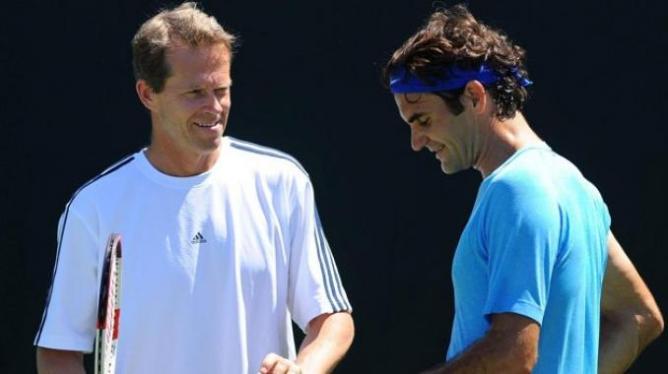
Could anyone else but Stefan Edberg make Roger Federer this bashful?
Pictures like this have been giving pleasure to both Federer and Edberg fans over the years (not surprisingly fans of one tend to be fans of the other).
Seeing Edberg supporting Federer court-side has been poetic, and who has not enjoyed the contrast of having Edberg’s former great rival Boris Becker cheering on his charge Novak Djokovic just a few meters away?
One has to think that the bond of friendship and respect between Federer and Edberg will continue even if the business arrangement has ended, and that Edberg will be present in Federer’s box offering the Swiss his steely support at upcoming events.
After all, it would not feel right if, after all the impact Edberg has had on the Federer game, the Swiss’ idol was not present if he finally managed to get that elusive 18th Slam.
One gets the feeling that both Federer and Edberg would not have it any other way.
Commentary by Christian Deverille
What was the greatest quality of the Federer-Edberg team for you? We would love to hear your comments in the box below 🙂
 thetennisreview
Leave a comment