-
Roger Federer The Old Tennis Player and the No.1 Ranking.
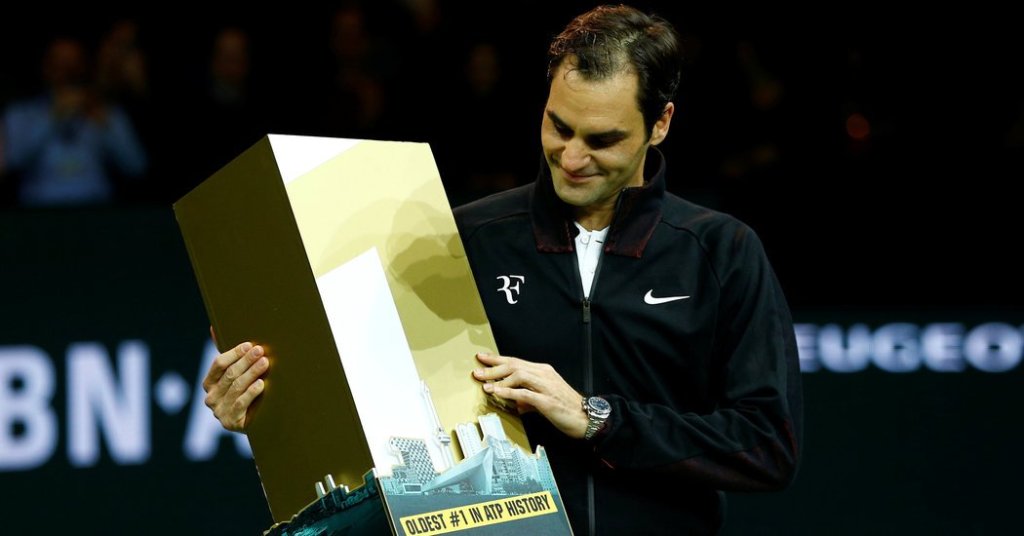
Photo courtesy of news2read.com By beating Robin Haase in the quarter-finals of the Rotterdam Open, Roger Federer, at the age of 36, became the oldest male player to be ranked No.1 in the world. The Tennis Review reviews how the Swiss got back to the pinnacle of the sport and wonders how long he could end up staying there.
Roger Federer has already been there and done that when it comes to getting back to the ATP world No.1 ranking- since first hitting the top spot on February 2nd 2004, the Swiss, before this most recent return to No.1, had already been knocked off the pinnacle and climbed his way back there twice.
But this comeback is not just “any old” comeback, the status all previous comebacks are now demoted to in light of this one. This comeback is arguably the greatest in any of Federer’s career, the Swiss, in the four years and 17 day gap between his third and fourth No.1 stints, falling to his lowest ranking, 17, (Jan 9th 2017) since no. 18 on the 28th March 2001 (he never fell out of the top four in his other periods away from No.1) and, remarkably in a near two decade career undergoing his first ever career surgery, two career setbacks which for any player would require serious work to bounce back from, but which for a player in their mid 30s could be setbacks too grave to dig themselves out of.
Federer’s stints at No.1:
Period Weeks Took Over From Replaced by Feb 2 2004- August 17 2008 237 Andy Roddick Rafa Nadal July 6 2009-June 06 2010 48 Rafa Nadal Rafa Nadal July 09 2012-November 4 2012 17 Novak Djokovic Novak Djokovic Feb 19th 2018- ? 1 and counting Rafa Nadal ? That effort to get back to the top was on Federer’s mind, when, after sealing the No.1 ranking again in the Rotterdam quarters, an emotional Federer said:
I think reaching No.1 is one of the, if not the, ultimate achievement in our sport so sometimes at the beginning you just all of a sudden get there just because you are playing so well. Later, you sometimes try and fight it back, you wrestle it back from somebody else who deserved to be there, and when you’re older, you know, you feel like you have to put maybe sometimes double the work in , so this one maybe means the most to me throughout my career, getting to No.1 and enjoying it right here, at 36, almost 37 years old, is an absolute dream come true, I can’t believe it.
When you realize you’ve achieved something spectacular 👏👏👏… #RFontopofthe🌍#abnamrowtt pic.twitter.com/ayQfgUU7n8
— ABN AMRO WTT (@abnamrowtt) February 16, 2018
If it was not Roger Federer who was achieving this feat, then it would be pretty unbelievable. After falling from the top ranking in November 2012, and just seven months later crashing out of the Wimbledon second round, getting back to the top was going to take some serious work for the then close to 32 year old Swiss suffering with back problems. A little later in the season, in the North American Summer Swing, struggling to adjust to a larger racket frame, a return to the good old days of just 13 months before looked even more far reaching when Federer was beaten in the Cincy quarters and US Open last 16, that latter loss marking the first year he had not reached a slam final since 2002.
Federer faced up to the challenge, as champions tend to do, and went about pursuing his dream in both a brave and a pragmatic fashion, making changes to his team in hiring Stefan Edberg and going ahead with and adapting to a larger racket head of 97 square inches.
The larger racket head helped make up for the loss in foot speed all mortal tennis players suffer as they age, even Federer, and the hiring of the Swede, Federer’s childhood hero, helped Federer commit to an aggressive game maximizing his strengths: the serve, forehand, playing mid court and at the net, footwork and shot-making.
Those strengths were what propelled Federer to the No.1 spot in the first place on February 4th 2004 and, ten years later, in 2014, hitting his mid 30s, Federer was executing them as well as he ever had and was back to where he was so often seen in the mid to late 2000s, in the Wimbledon final, though this time not winning the title as he did in six of seven finals in that period, but losing to Novak Djokovic in five sets, when his service percentage dropped late in the fifth set.
That return to slam finals really got the ball rolling for the Swiss who went on to challenge the Serbian for the No.1 ranking that season. Had Marin Cilic not peaked in his US Open semi-final versus Federer, the Swiss may have reached No.1 for a fourth stint even sooner.
In 2015, Federer was looking as close to his best on occasions as he reached both the Wimbledon and the US Open finals, losing to Djokovic, the epitome of the modern game, each time, in four sets. Djokovic, having one of the greatest peak periods of any player in the Open era, was playing pitch perfect baseline tennis, and with the Serbian’s key weapon his return, Federer’s serve had to be at its best- any dip and Djokovic took advantage, and unfortunately for Federer, Djokovic has the stamina and consistency to extend matches so that inevitably there would be a lull and the Serbian would be ready to pounce.
When Federer was serving well, he was able to beat Djokovic, beating him six times in 2014 and 2015, the only player able to impose his game on a fairly regular basis on the Serbian in that time period, and it seemed only a matter of time as Federer grew more confident with his commitment to an aggressive game and playing with a larger racket head that he would finally put all the pieces together in a slam final.
That was until, following his split from Edberg and hiring Ivan Ljubicic, one of the harshest realities of sport, injury, one Federer had mostly managed to avoid, bit Federer hard when in early 2016, after a four set loss to Djokovic in the Australian Open semis, Federer was bathing his children and slipped, injuring his knee. He did come back to the tour shortly after, but it was a very different Federer, one whose movement was hampered and who was unable to repeat his 2014-2015 feats, losing to Thiem and Zverev on grass in Germany and coming second best in the Wimbledon semis in a tough five setter to Milos Raonic.
Faced with another setback, Federer had his first ever career surgery and took six months out of the game, that rest and recovery from the injury paying dividends for Federer, as did a career changing adjustment to the Federer game encouraged by Ivan Ljubicic, the coach slotting in the missing piece of the puzzle, the backhand as a weapon not a flaw to be attacked, by having Federer attack more with it, taking advantage of the higher margin for error his larger racket head allowed him, and resulting in the Swiss avoiding the rallies baseline maestros like Djokovic were entangling him in their bid to draw errors.
The backhand now employed as a weapon to rival his forehand, the Swiss’ rivals now went less to that side and the Swiss himself became more likely to hit a stunning winner off that wing, often on big points, a shot to turn matches around, showing an opponent who might be feeling on top of him that the Swiss is not afraid to go down swinging, and reminding them his game is even more complete than it has been at anytime of his career, a scary little memo when you are facing the greatest player the game has ever known.
When Federer returned to Grand Slam tennis at the Australian Open 2017, Djokovic was not such a big factor anymore, the Serbian having lost his No.1 ranking to Andy Murray and losing in the second round of the Australian Open. Still, Federer had a tough draw to his first slam since Wimbledon 2012, most notably Tomas Berdych, Kei Nishikori, Stan Wawrinka and Rafa Nadal, all of whom had wins over him, some of them pretty big ones, and all capable of beating Federer if he was struggling physically or mentally. At times, Federer did both- he had a foot issue, and he fell 1-3 behind in the fifth set versus Rafa Nadal in the final- but a low bouncing fast surface and a great will to win meant Federer won his 18th slam title and with the dream of another slam realized, the prospect of Federer getting back the No.1 ranking also became a serious talking point.
Federer made that talk somewhat weightier when he went on to win Indian Wells, Miami, skipped Roland Garros in another smart scheduling move, won Halle, and then took slam No. 19 at Wimbledon, amassing 4,500 points, and the No.1 ranking really came into view on the horizon.
36 years 195 days…@RogerFederer continues to raise the bar in our sport. Congratulations on yet another remarkable achievement!!
— Andre Agassi (@AndreAgassi) February 16, 2018
However, there was one rival chasing him for that spot, Rafa Nadal, and with Nadal also picking up his career, and winning Monte Carlo, Madrid and Roland Garros, on top of reaching the Australian Open and the Miami final, the Spaniard was making his own challenge for No.1, and Federer was going to have to keep winning big if he wanted to get there first.
Unfortunately, the Swiss got injured in Montreal, and went on to contest the final, which he lost and in which he was visibly hampered and which with hindsight he might have been better off not playing. That decision to step on the court and compete, one reminding us how human Federer is, meant the Swiss pulled out of Cincy, where a confident and healthy Federer would have been expected to win the title, and the second seed at the US Open then lost in the quarters to del Potro, a tough draw as the Argentine is one of the few players on the tour who has the natural instincts to exploit the top players on an off day.
Federer bounced back though to keep himself in the race for No.1. winning Shanghai and Basel and reaching the ATP Finals semis, but those runs were not enough and the race to No.1 was sealed by Nadal in Paris when he reached the last eight and withdrew with injury. Nevertheless, with Nadal only winning 1280 points, and Federer 2100, from the US Open to the end of the season, Federer had caught up on some valuable points.
But while Federer may have been gaining valuable points, he also had some pretty big ones to defend, and with his 2017 ending on a flat note, and his not having defended a slam since the US Open 2008, the chances of Federer defending all 2000 AO points seemed, at the age of 36, a little, to those who had not learned just how normal rules of science and probability do not apply to the Swiss (his having two sets of twins and winning 19 slams not being enough to teach us), far-fetched.
Federer, though, getting used to being the game’s trend setter when it comes to what you can achieve at an age most former greats were long retired, strode to slam #RF20 in dominating fashion, and with Nadal going out in the quarters, and dropping 840 points after failing to defend his finalist ranking points (1200), and Federer defending his 2000 points, the gap was just 155 points.
Apparently I’m the oldest tennis player with a #1️⃣ ranking. Somebody might have mentioned that to me already but I had a hard time hearing 👴🏻
— Roger Federer (@rogerfederer) February 16, 2018
With Nadal recovering and not competing in any tournaments after the AO, Roger Federer, who had always said one day he hoped to return to world No.1 and now seeing that day not so far away, saw his opportunity and accepted an invitation from tournament director Richard Krajicek to compete in Rotterdam, the ATP 500 event luring Federer with its fast indoor low bouncing conditions, and a tournament at which Federer had a 23-6 record at, had won two trophies at, and had never lost before the quarter-finals, the stage he would have to reach once again and advance from if he was to earn the 165 plus points needed to return to No.1.
The player most likely to stand between top seed Federer and No.1 was fifth seed Stan Wawrinka, who had reached the semis in Sofia the week before, but the Swiss lost in his opener to 259th ranked wildcard Tallon Griekspoor, and Federer, after beating Rubens Bemelmans and Philipp Kohlschreiber in rounds 1 and 2, faced home player Robin Haase at the pivotal last eight stage and came back from a set down to defeat the Dutchman 4-6, 6-1, 6-1 to reclaim the No.1 ranking and break 2 records in the process- the oldest man to win, aged 36, beating Andre Agassi’s 33, and the longest gap between No.1 stints, 4 years and 17 days, also beating Agassi.
Federer then went on to defeat lucky loser Andreas Seppi in straight sets and then defeated Grigor Dimitrov in the final 6-2, 6-2 to win his 97th career title.
That Rotterdam title means Federer’s lead over Nadal at the top of the rankings is currently 345 points, a small margin, and the ranking is likely to change hands between the two quite a few times between now and the end of the year.
In the coming weeks, Nadal is expected to play Acapulco and Federer may play Dubai, both ATP 500 events, with Nadal defending finalist points (300), and Federer last 16 points (45). Federer then has 2000 points to defend in Indian Wells and Miami (Nadal has 690), and then comes the clay season, in which Nadal has 4680 points to defend and Federer has none. If Nadal is injured, that defence is unlikely, but if he gets back to full health, he could even exceed those points.
Federer, if he is No.1 going into the clay season, has nothing to lose and would be expected, considering his status as the game’s official leader, to enter at least Madrid and Roland Garros, two events at which he has achieved great success and which would greatly benefit from his presence. At those events, if Federer plays his game and sees what happens, he is likely to collect at least Madrid semis points and RG last sixteen, if not more, depending on the draw where he will be more vulnerable than in his preferred conditions.
Roger #Federer is going to be the world No.1, the oldest one ever, on Monday, 14 years and 17 days after his first time at the top of the rankings. There are no words, and who needs them when you have such numbers #Legend #No1 pic.twitter.com/1NYAj2r3pp
— The Tennis Review (@thetennisreview) February 16, 2018
After that, with Wimbledon, Cincy and the US Open coming up, Federer could, if healthy, be reasonably expected to hang on to the top ranking and even end the year as Year end No.1 for the sixth time, tieing and holding the record with Pete Sampras.
Who would be surprised if Federer went on to make that end of year No.1 record his own at some point, considering how he continues to defy expectations of what is possible for a player heading into his late 30s, and also taking into account the conditions that have enabled Federer to be the first man of this age to achieve success which used to be common among players in their prime of 24-28?
Greats who came up in the game from the late 90s through to the early and mid 2000s can have a second or third prime now, as Federer is doing, thanks to advances in nutrition, sports science, technology, and increases in prize money (Federer won A$4,000,000 at this year’s Australian Open compared to A$915, 960 when he first won it in 2004). Another factor keeping these second winds blowing is an increasingly demanding tour, media wise and travel wise with the tour expanding into Asia in the post US Open stretch, one played on slower surfaces, contributing to younger players failing to break through at an age the game’s next big things used to, 20-23, leaving older players, wealthier ones who can afford the very best in coaching teams and experts, and who have much greater experience in big pressure matches, to extend their careers into their mid 30s and meaning that the next big things stay that way until their mid to late 30s when they finally reach their first primes, and those that do will have to keep playing into their late 30s if they want to experiences the very different highs that come with a second.
Right now, the likes of Dimitrov, Zverev, Thiem and Goffin still seem a couple of years away from winning their first slams and with the Australian Open increasing the court speed, and grass favoring first class serves and attacking tennis played at its optimum, and enough big tournaments on favorable surfaces for the Swiss, there is no reason why, barring injury, Federer cannot hold on to the No.1 ranking, or trade it with Rafa Nadal until Tokyo 2020 when many people feel Federer may, if he wins Gold, hang up his racket.
Still, many people felt Federer should have retired in 2009 or 2013, and with the Swiss one of the reasons there is so much interest in tennis from the public and such great prize money on offer and seeming to love the game even more than he ever has, where better to celebrate that love for tennis than Paris in the Summer of 2024?
-
There Are Legends, There Are Other Legends, And Then There Is Roger Federer
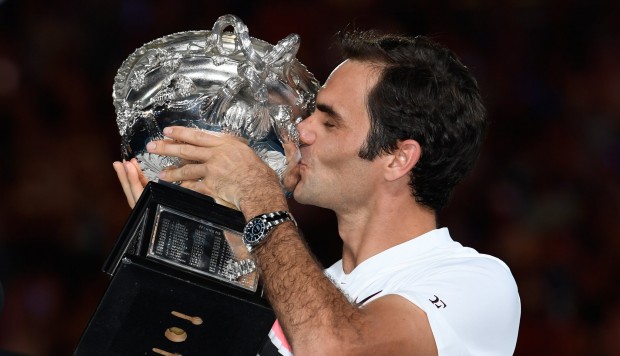
Photo courtesy of misionescuatro.com Roger Federer (2) defeated Marin Cilic (6) 6-2, 6-7 (5), 6-3, 3-6, 6-1.
Roger Federer’s five set win over Marin Cilic in the 2018 Australian Open men’s singles final on the Rod Laver Arena played under the admiring eyes of the legend himself was the Swiss’ record tying 6th AO title, his record 20th slam, becoming the first man to reach that number, and his first defense of a slam since the 2008 US Open.
These milestones were achieved in Federer’s favorite conditions, indoors, after the AO made the controversial decision to close the roof for the final. While it made sense to some degrees, namely the mid 30s the court thermometers read, it was disappointing, even baffling, for some Open tennis fans who wanted to see the players not just deal with each other, arguably the toughest medium fast court opponent they could meet in the final, but with the wind and the heat, too, as they had done all fortnight, to test in the final match their championship mettle versus the very best which tennis and nature had to throw at them.
🏆20. ❤ pic.twitter.com/WqUiSo3fd5
— Roger Federer (@rogerfederer) January 28, 2018
Cilic was a little thrown by the roof closure, himself. The first time AO finalist later revealed in his post match press conference that he was not asked about the roof closing:
Well, no, they didn’t ask me. They just came to me to tell me that they are thinking about decision, and they going to make the final decision just around 7 p.m., just slightly before the match. I didn’t mind to have roof closed, but it was a huge difference in temperature from having outside 38, then when you came in, it was like 23, 4, I don’t know. It was way cooler than I expected.
Cilic would have been more favored by indoor conditions if he had, as Federer did, practiced in them before the match, but the sixth seed, not expecting to play the final indoors, decided instead to practice outside on his usual court. That decision backfired, along with another one, not bringing on court rackets strung at the right tension for such cooler conditions, and an uncomfortable and vulnerable Cilic was trailing the greatest player indoors ever 1-4 in just short of 20 minutes.
Federer, who said he would not have minded playing outside, that the heat, which he had no problem with, might have slowed down Cilic, seemed as cool as ever in his 30th slam final, his seventh on Rod Laver, everything falling into place for him, taking the first set 6-2.
Fears of a fourth slam final blowout in a row, Cilic’s loss to Federer at Wimbledon one of them, were soon allayed as Cilic fought back to win a long service game in the third game of the second and then went on to take the set to a tiebreak, won 7 points to 5, one which Cilic edged with some typically aggressive and risky tennis, the only kind that was going to win him the match, the indoor conditions now playing into his hands, helping him to keep the ball low over the net and hitting the lines.
A match on his hands, Federer got a grip on his nerves, and his serve, serving at 81%, up from 57 in the 2nd , to take the third set 6-3.
WOW!!(🎥Eurosport) pic.twitter.com/UuwNh1n0tn
— doublefault28 (@doublefault28) January 28, 2018
Federer broke Cilic and led 3-2 in the fourth set, and a four set win which always looked on the cards was now just three service holds away. But it is not everyday you get to play for your 20th slam, and neither is it everyday you get to play your first Australian Open final, the chance to redeem yourself for the disappointment of losing your last slam final, and as fast as Cilic could swing at a forehand, Federer’s nerves and Cilic’s desire collided- Federer’s service percentage dropped to 36 and his already shaky ground game was now a tremor, while Cilic’s all round performance peaked and the sixth seed went on a tear to win four games in a row to win the fourth set 6-3 and force a decider.
In the opening game of the fifth, Cilic, who had never won a close match in a big final before, looked like he might be about to put himself in a position to break through when he held two break points in the opening Federer service game. The Croatian had his chances, too, but lacked the experience to quite know what to do with them, the huge forehand that had gotten him into this position now proving to be his undoing when he went for too much on the return on the first break point, but there was little he could do on the second, a service winner from Federer shutting him out, and the Swiss went on to hold serve with an angled backhand cross court winner that painted the line.
Federer then completed his escape from what could have been another collapse on Rod Laver with the man himself looking on, and did not drop another game, the serve the shot that got Federer through this one, Federer getting it back up to familiar territory, first serve percentage wise, of 61 %, one percent below his 12 month and career average, and while it was 10 % lower than Cilic’s, Federer had the higher winning percentages on both his first and second serve, with 71 and 73 respectively compared to Cilic’s 50 and 40, and a match that looked set to be about small margins now become about large ones as Federer put some distance between himself and his rival. There had been some shot making of the highest order here and there, one Federer forehand pickup while running backwards especially awe-inspiring, but on a medium fast court indoors, between two aggressive players struggling for consistency, the serve is going to be the decider and Federer’s held firm in the fifth while Cilic held just once and was broken twice.
Serving at 5-1, Federer closed out the match, hitting a service winner on championship point, but his #RF20 moment had to wait while Cilic challenged, and Federer who had already waited enough that day to win slam 20 had to wait just a little bit longer, a wait Hawkeye brought to an end when it revealed the Swiss had won championship point, and Federer could finally celebrate, raising his arms, and the eyes welling up, the dam that would eventually flood letting flow its first trickles.
In the trophy ceremony, the Swiss said he was glad “it” was all over, “it” no doubt the achievement of winning 20 slams, becoming the first man to do so. In his post match conference, the champion said:
All day I was thinking, How would I feel if I won it, how would I feel if I lost it? I’m so close, yet so far. I think I was going through the whole match like this.
It did not help that he faced an at times zoning rival like Cilic whose great play late in the fourth set and early in the fifth had Federer thinking history, which he had chased to within three service holds, may have to wait, which it might not, with time on its back, do. But though Cilic’s threatening play provided no end of stress for Federer and his fans, it did deliver the kind of drama which may have been tough on the nails but which made such a historic win the nail-biter we deserved.
With so much on the line and that line now crossed, all the tension finally relieved itself in Federer’ trophy speech. Federer thanked Cilic, the crowd, everyone from the volunteers to the fans to the legends who were present to his team, all before a Rod Laver filming the Champion on his smart phone:
Rocket, Rod Laver, nice to see you again, Ashley Cooper, thanks for presenting the trophy, it’s an absolute honor to be here again, and all the other legends, in the commentary booth, and around the stadium. It’s always a celebration of tennis when the tournament comes to an end, I just want to thank all the people who made this night so special for both players and all the fans out here tonight. You guys, you fill the stadiums, you make me nervous, you make me go out and practice, and I’d just like to thank you for everything. It wouldn’t be the same without you guys, thank you. Marin’s team, as well, you work hard, all the best. This is hard. And my team, I love you guys, thank you.
The tears poured and not just from Federer but from many a spectator, too. What sports lover would not be moved by a man who could have walked away years back a legend, could have been commentating, presenting the trophy himself to a new champion or snapping pics on the other side of the smartphone, but is, instead, with all the nerves eating away inside of him, still out there giving us everything, his gifts, his blood, his sweat, his tears, his love of the game, and taking us with him along for the ride, deeper into tennis history which he has now written into a fairy tale, winning his 20th slam, his 6th Australian Open title, a win which saw him defending his first slam since the US Open 2008, nearly a decade ago.
Federer has spent some of his time since that New York victory in the tennis legend wilderness, some of it in limbo, some back scaling the heights, some in the Hades of injury and surgery, and now, his 20th slam trophy won, his third in a year, he is back, seated in the most ornate throne on Olympus, with legends, indeed, tennis Gods even, and all the other legends, too, gazing up his way at the legend himself, him, Roger Federer, holding dear his 20th slam, and counting.
Roger (🎥Eurosport) pic.twitter.com/jf7l7wT6xx
— doublefault28 (@doublefault28) January 28, 2018
-
Australian Open Final 2018 Preview Marin Cilic Vs Roger Federer
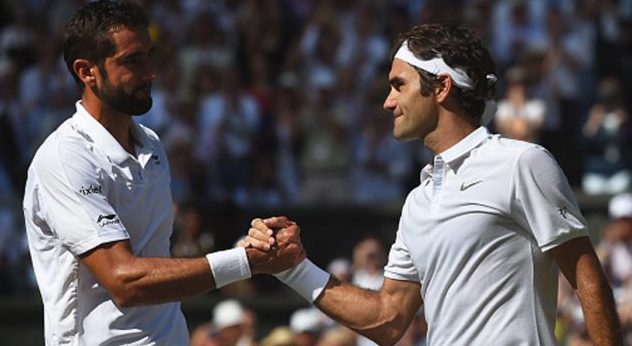

Photo courtesy of http://www.beritagol88.com Second seed and defending champion Roger Federer will take on sixth seed and first time Melbourne finalist Marin Cilic to win the 2018 Men’s Australian Open trophy. The Tennis Review previews the action and predicts the winner.
Paths to the final
Federer came into the Australian Open as the favorite and he has lived up to that status by reaching the final without dropping a set. He has had his awkward moments, such as late in the third set in the third round versus Richard Gasquet or at the start of his quarter-final versus Tomas Berdych, but he has lifted his game each time, producing his best tennis of the tournament in that last eight match versus Berdych.
That form rolled over into the semis when Federer dominated Chung in the early stages of their match, taking advantage of the Korean’s hampered movement, but the Next Gen Finals champ was finally beaten by a blister and retired a set and 2-5 down in the second set, a result which meant Federer did not get a competitive match going into the final. Federer said after the match that he will take a short semi, though:
Cilic also had a struggling opponent in his semi, Kyle Edmund, the unseeded player going down in straights. The British player did play very well in the second set, however, and Cilic handled his status of favorite well, raising his game to win the set, and taking control of the match in the third.
Another encouraging sign for Cilic is that the Croatian is the more match tough of the two finalists courtesy of a tougher path to the championship match. The sixth seed dropped a set to Vasek Pospisil in round 1, (a stage of the tournament in which Cilic is more vulnerable than most top seeds), a set to Pablo Carreno Busta in round 4, and two sets to Rafa Nadal in a match in which he played some of his best tennis of the tournament in the third set yet still lost it.
Coming through both that Nadal match, one Cilic did not ‘win’ the way he would have liked to, but one in which he was the fittest of the two and survived, and the Busta test playing some of his best tennis is the kind of preparation Cilic needs before facing five time Australian Open champion Federer in the final, the Swiss’ seventh down under.
The Serve
The Croat also looks to have the edge when it comes to the serve, the potential deal breaker in this match. Neither player has been unbreakable-Federer has been broken four times in three of his matches (twice by Berdych in the first set, once by Gasquet, and once by Struff) and Cilic has been broken nine times in four matches, (four times by Carreno Busta, twice by Nadal, twice by Pospisil, and once by Harrison)- but Cilic has the higher first serve percentage coming into the final with 67 in both his last two matches.
Meanwhile, Federer had a low first serve percentage of 43% in the nearly two sets he played versus Chung (granted, that figure could have risen) and had 63 % in his win over Berdych, 1% more than his 12 month average, but that first serve percentage is one Federer will want in the high 60s to mid 70s, at least, in the final because while Cilic’s return game is not his strength, he will welcome any second serves, especially in tiebreaks or at the business end of a fourth or fifth set, and if he welcomes them too warmly, if he gets hot, Federer could end up getting burned.
Head to head.
Federer can tell you all about Cilic burning you.
Federer has an 8-1 head to head lead over Cilic, but his one loss was a very significant one, a defeat in the US Open 2014 semi finals, in straight sets, and at a time Federer was competing in slam finals and involved in a tussle for the No.1 ranking. That day, Cilic redlined, producing a standard of tennis we have not seen from him since.
Federer got his revenge, and his second slam win over in last season’s Wimbledon final when he defeated an injured and visibly upset Cilic in straight sets for his 20th slam title. That victory was his third slam win over Cilic, the first coming at the 2011 US Open, which he won in four sets, and the second coming at the 2016 Wimbledon event when he saved 3 match points to beat the Croat.
The match-up.
That Federer and Cilic’s fourth slam contest is this year’s Australian Open final is no real surprise. Federer and Cilic are two of only six active slam champs in the draw, the reigning Wimbledon champion and finalist, and have games tailor made to succeed on a medium fast surface like the Australian Open’s plexi-cushion .
Both have great serves, both have weapons at the back of the court which can generate plenty of short balls, and both have an aggressive mind set and like to play inside the court and at the net. Also, while neither rely on their returns as strengths, both will take risks on the second serve, especially in a match versus a fellow big server in which they will get few chances and in which sets will likely go to tiebreaks.
But those strengths are as far as the similarities go: Federer serves more consistently, with unparalleled variety, and serves better under pressure; Federer also has a more effective and efficient aggressive game; from the baseline, if Federer is kept back there, he is the stronger off both wings, more versatile and less likely to break down under pressure; and, if there are risks to be taken on second serves, Federer’s will be the more calculated.
The biggest gulf between them, though, is the mental side of the game and how they handle pressure. Federer is a great front runner while Cilic has a history of letting winning leads slip, one of the most infamous being that match against Federer at Wimbledon ’16.
If Federer gets his grip on a match, he very rarely lets go, if Cilic gets his hands on a match, it can slip before he has even fully grasped it.
— Roger Federer (@rogerfederer) January 22, 2018
Cilic has not had any slippery moments, however, this last fortnight- whenever he has suffered any disappointment in a game or set, the sixth seed has rebounded and raised his game.
As well as being in good mental condition, Cilic is in good physical shape, too. The 2010 Australian Open semi-finalist, his best showing at the event until this year, said after his semi-final win that:
I’m feeling really, really good physically, even though I had few matches that went more than three hours. But overall, feeling really good. I think I played great tournament so far with my level of tennis…I think I improved it comparing to end of the last year. I’m playing much, much more aggressive. I’m feeling that I am, for most of the shots, hitting them really, really good. From the return, moving, forehand, backhand, serving, I think everything is in good, solid spot. Feeling really excited about the final, too.
An excited and healthy Cilic is going to be the most difficult opponent Federer has faced so far this tournament and one he is not going to underestimate, the Swiss always showing the utmost respect to the Croat when asked about him, having himself been on the receiving end of one of the few active Major champion’s slam winning game.
Prediction:
Slams are where Cilic thrives, the Croat winning 102 matches in 41 slams compared to 89 ATP 1000 matches won in 80 events- best of five sets give him the space to recover from the dips he has in form as much as the format allows for him to let winning leads slip- and if Cilic is able to produce his best form, Federer would, in turn, raise his, and we could get the best possible final on a medium-fast hard court.
There are, however, too many ifs attached to a Cilic win – if he played his best like he did at the US Open, .. If Federer has an off day,…If Cilic is stronger mentally in big matches than he has been in the past– and so a Cilic win would be a surprise, and in some ways, a good one. We would either see Cilic playing some of the best medium-fast court tennis we are likely to see in a slam final right now or we are going to see a new Cilic, one who toughs it out versus an in form Federer, who maybe manages to win despite not playing his best, but playing the big points better, which Cilic has never done at this level versus an opponent playing well. Such revelations from a player are one of the rewards of following them and any of the afore-mentioned scenarios would be quite the pay off for Cilic fans.
With Federer, it is a completely different story. We know only too well what we are getting- the Swiss, on form, playing in his 7th Australian Open final against a rival he matches up very well with, the player most qualified to get the slam won.
With slam No.20 on the line and the clock ticking on Federer’s slam winning days, what we will get is, most likely, a four set Federer win. Cilic is not going to go down without a fight, not after coming back from the hurt that must have been the Wimbledon final loss in such style, but Cilic will need a killer punch to win this one, and Federer is too good at seeing them coming in these conditions, too skilled at blocking such blows, swinging one of his own, and then never letting up.
Cheers to the final rogerfederer ! 🥥🎾 #ausopen https://t.co/Fc4z6zHqUA
— Marin Cilic (@cilic_marin) January 27, 2018
-
Australian Open 2018 Men’s Draw Discussion Who Will Win Their Quarters?

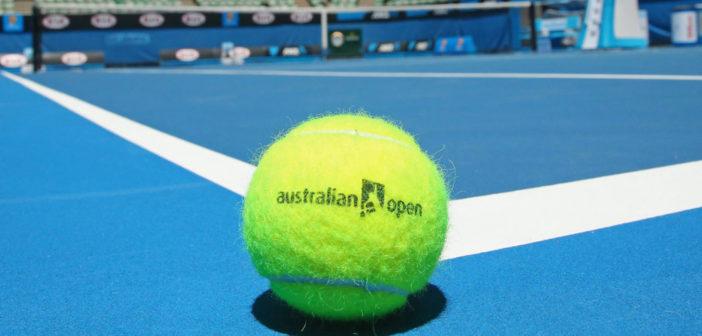
Photo courtesy of Paodom.net Tennis fans know only too well that our sport has no off season – the break between the last tour match of one season and the first official match of the next season is all of 42 days- but, while, it does seem harsh on players, one is hard pressed to fault ardent fans who – understandably – just cannot wait for the action to commence again.
And so here we are, the yearning is over, the New Year is upon us; as is the 2018 Australian Open.
World #2 Roger Federer is the defending men’s singles champion, and will be eager to “score” his Major trophy cabinet.
Andy Murray, a five-time runner-up Down Under, had to withdraw with a hip injury and has since had surgery. Murray is not the only big name absentee with Kei Nishikori also forced to miss the action with a wrist injury.
The 2018 Australian Open draw ceremony took place on Thursday, January 11 and the obvious question on everyone’s mind was, “Where, on the draw sheet, would the returning Novak Djokovic be?”
So, where did the 12-time Grand Slam champion land? And how is it for others? Christian Deverille, editor of The Tennis Review, and tennis aficionado Karthik Swaminathan dissect the draw and offer their thoughts.
Monday start @AustralianOpen getting ready. #vamos pic.twitter.com/02zv7g5Opv
— Rafa Nadal (@RafaelNadal) January 13, 2018
First Quarter:
World number 1 Rafael Nadal drew Marin Cilic (6) as the next highest seed in his section. The Spaniard commences his campaign against Victor Estrella Burgos and could next face Leonardo Mayer in, what would be, a rematch of their faceoff at the Big Apple last year. Borna Coric lurks as a potential third round opponent, as does John Isner (16) or Diego Schwartzman (24) in the fourth.
Cilic kicks off his quest against Lu Yen-Hsun before possibly clashing with Joao Sousa in the second, Pablo Cuevas (31) in the third and Pablo Carreño Busta (10) in the pre-quarters. Gilles Simon, who beat the Croat enroute his Pune title, is also a prospective fourth round opponent.
Survivor:
Christian’s pick – Marin Cilic– The Croat plays his best tennis in best of five at slams and with the surface reported to be as quick as last year, the 2010 semi-finalist has a good chance to make the semis here
Karthik’s pick – big servers could put the King of Clay in a spot of bother on a nippy court, but count against Rafael Nadal at your own risk
@AustralianOpen prep with @David__Goffin! First Grand Slam of the season!💪🎾🇦🇺 #TeamCilic 📸@SlavenHrvoj @FilaTennis @head_tennis pic.twitter.com/53lqHe8u0T
— Marin Cilic (@cilic_marin) January 14, 2018
Second Quarter:
Grigor Dimitrov and Jack Sock are the highest seeds in this section, seeded three and eight respectively, and the pair will be confident having ended 2017 on a positive note.
The Bulgarian has a couple of qualifiers first up, but standing in his path to the quarterfinal are two of his recent conquerors, Andrey Rublev (R32), who beat him at the US Open, and Nick Kyrgios (R16), who recently defeated him in the Brisbane semis.
Sock, who is the highest ranked American in the draw, opens against Yuichi Sugita before potentially running into the near seven-feet tall Ivo Karlovic. Philipp Kohlschreiber and Kevin Anderson could, respectively, lie in wait in the third and fourth rounds.
As one may have noticed, this quarter is loaded with shot makers and popcorn first round encounters such as Ferrer-Rublev, Tsitsipas-Shapovalov and Anderson-Edmund.
Survivor:
Christian’s pick – Grigor Dimitrov has the momentum after his great end to 2017 and his experience losing to Nadal in last year’s semis will motivate him to give himself another chance at the final
Karthik’s pick – Clearly, training at Rafa Nadal Academy has done him a world of good; Grigor Dimitrov looks set to change the order
Third Quarter:
Novak Djokovic, seeded 14, scored the best possible draw of those in the 13-16 bracket, drawing 4th seed Alexander Zverev in the last 16.
Sascha is by far the weaker of the top four seeds slam pedigree wise- he is 12-10 in slams and the furthest he has gotten is the 2017 Wimbledon fourth round- so, if Djokovic is playing well, he could exploit Zverev’s poor start to 2018 (the 20 year old going 1-3 in his Hopman Cup matches) and lack of experience in the second week of slams.
Zverev will be match ready, however, if he does make the last 16 of a slam for only the second time of his career. The 20 year old could have to face Dannii Medvedev (Sydney champion), Thanasi Kokkinakis (who beat him in Perth), Hyeon Chung (perhaps the most consistent of the #NextGenATP at the baseline and recent Next Gen Finals champ) or his own brother, Mischa Zverev, last year’s quarter-finalist, in the round of 32, all of whom are going to put him to the test physically, mentally, and, especially if it is his brother he faces, emotionally.
Scheduled to face Zverev in this third quarter last eight match is fifth seed Dominic Thiem who had a lacklustre end to 2017 and a virus ridden start to this season. The Austrian is drawn to meet 9th seeded Stan Wawrinka in the fourth round who is in the draw despite some rumors he might not be quite fit enough and whose form is as unpredictable as ever.
Auckland champ Roberto Bautista Agut (20), scheduled to meet Wawrinka in round 3, has the experience and the form to take out Wawrinka and then Thiem in the last 16 if either of them are struggling.
Bautista Agut will have to come through a tough first round against fellow country man and upset artist Fernando Verdasco in round one if he wants to give himself the opportunity of reaching a slam quarter-final for the first time in his career after nine last sixteen appearances.
Survivor:
Christian’s pick – Bautista Agut is match tough, very fit, and has the game and experience to take advantage of this wide open quarter
Karthik’s pick – quite hard to not back Novak Djokovic here, but head over heart: Alexander Zverev to finally announce himself at Grand Slam level
Hey @TheRock, am I doing the “Smoldering Intensity” right? 🤔 pic.twitter.com/5A5ILEXYNK
— Roger Federer (@rogerfederer) January 12, 2018
Fourth Quarter:
Defending champion Roger Federer has a comfortable route to the last eight with Richard Gasquet and Sam Querrey his scheduled seeds in the third and fourth rounds, though Milos Raonic could be an awkward fourth round match up if he can find some form and upset Querrey in round 3.
Things get trickier for the Swiss in the quarters, however. Federer has a scheduled quarter final match up with David Goffin (7) who is very comfortable on fast surfaces and has really picked up his game in the last year, even defeating Federer in the semi-final of last season’s ATP World Tour Finals.
If the Belgian is not across the net in the last eight, it could be Federer’s US Open conqueror, Juan Martin del Potro, drawn to face Goffin in the round of 16, who will be feeling confident having reached the Auckland final and returning to the world’s top ten.
The Argentine has a tough draw with Frances Tiafoe in round 1, potentially Karen Khachanov in round two, and Tomas Berdych, (10), who looked very good winning the recent Tie Break Tens event, in round 3.
Survivor:
Christian’s pick – Roger Federer looked good enough in Perth and has the edge over all his rivals in his quarter on a surface which complements his grand slam winning game so well
Karthik’s pick – That forehand never left. He has that look again. And he is back in the top 10. Fee fie foe fum, Juan Martín del Potro doth come!
1st semi-final:
Christian: Dimitrov d Cilic
Karthik: Dimitrov d. Nadal
2nd semi-final:
Christian: Federer d. Bautista Agut
Karthik: del Potro d. Zverev
Final:
Christian: Federer d. Dimitrov
Karthik: Dimitrov d. Del Potro
What do you think of the Australian Open 2018 draw? Join in the discussion in the comments below and share your thoughts.
-
Australian Open Preview Roger Federer on Course for Date with Slam No. 20

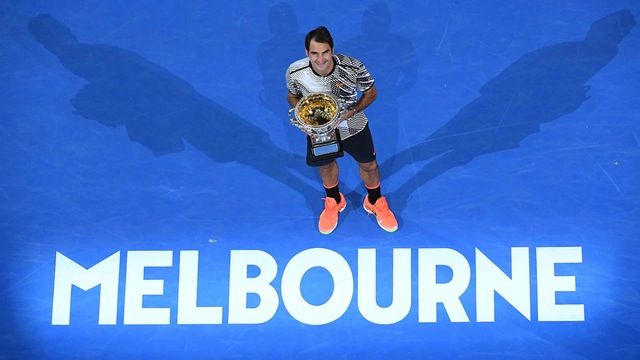
Photo courtesy of pinterest.com After having spent four and a half years looking for slam number 18 and finally finding it in Melbourne last season, Roger Federer is, after just a year, looking on course for a date with number 20.
We have seen more of Federer than we have seen of a lot of the potential big name Australian Open 2018 title favorites, and, if the defending champion’s four singles win at the Hopman Cup (defeated Sascha Zverev, Karen Khachanov, Jack Sock, and Yuichi Sugita, all of whom had their best seasons in 2017) are anything to go by, he looks to be the healthiest and most in-form of his fellow Big Fivers and other established title contenders in action.
This year’s Australian Open field is one beset by injuries and unproven quantities at slam level and with Federer seemingly healthy and with his grand slam pedigree the highest quality in history, he looks on course to win slam No. 20 in three Sunday’s time.
The Swiss’ serve and net game looked in especially good shape in Perth and he should iron out the kinks in his baseline game in the first few rounds in Melbourne as he faces Aljaz Bedene in round 1, and either Korean wild card Soonwoo Kwon or German world no. 53 Jan-Lennard Struff in round 2.
The Swiss’ draw pits him against Richard Gasquet (29) in the third round (Federer leads Gasquet 16-2 and has only lost to him on Clay), Sam Querrey (the Swiss leads 3-0 and has never dropped or set or lost more than four games in a set to the American) or Milos Raonic in the fourth (Federer leads Raonic 10-3 and the Canadian is on the comeback from injury and seeded 22).
In the quarters, the potential match ups get a little more interesting with David Goffin (7) or Juan Martin del Potro (12) potential opponents. Both those men inflicted big defeats on Federer in the final quarter of 2017- del Potro beating him in the US Open quarters, and Goffin beating him in the semis of the ATP finals, del Potro taking advantage of the Swiss’ compromised back and Goffin proving to be too canny for Federer at the very end of a multi slam winning world No.2 ending season.
Thank you Perth#Thank you @BelindaBencic
Great week, it was so much fun.
You played phenomenal 🇨🇭🎾👊🏼 pic.twitter.com/fSgLSsFkox— Roger Federer (@rogerfederer) January 6, 2018
https://platform.twitter.com/widgets.js
Federer will still be vulnerable in Melbourne of course being 36 years old and more prone to injury than ever, but the surface is in the Swiss’ favor and should make life easier on his body and mind- Craig Tiley has said it will be as fast as last year – and the balls will be to his advantage, too, ones that do not fluff up and play into the rackets of the game’s baseliners, and if Federer can impose his attacking game on his Belgian or Argentine rivals, a game which at its best overwhelms both players, Federer should find himself at the business end of the tournament with plenty of energy to spare.
Energy Federer will need, too. In the semis, Federer is seeded to come up against Sascha Zverev (4), but the German has yet to prove himself as a slam threat, and so most people’s eyes are drawn to a potential Novak Djokovic (14) match, one in which the Swiss could, if he is anything less than at his best, be made to run plenty of miles side to side and up and down on his side of the court.
Djokovic comes in looking healthy and motivated and is under relatively little pressure, a Djokovic we have not seen for quite a while. The Serbian, beset in recent times by physical injuries and motivational issues, has not been to a Grand slam final since the US Open 2016- his longest spell without making a slam championship match since winning his second Australian Open, and second slam in total, in Melbourne 2011- and will, for someone who holds the record for the most Norman Brookes challenge cups in history won in the Open era (six), go relatively under the radar.
That low key run through the draw might suit the Serb who went under so much media scrutiny in 2015 and 2016 in his quest to become the first man in the open era since Rod Laver to hold all four Majors, scrutiny that turned him from a sporting star achieving the kind of history beyond even Federer and Nadal to a shadow limping out of the first week of slams or crashing out in the second, his final set lost no less than a set to love.
Melbourne was the setting for the last competitive match between Federer and Djokovic, a four set win for the Serbian two years back, and the Serb leads Federer 3-1 on Rod Laver overall. But, Djokovic, while the more accomplished Australian Open champion, is, right now, still very much on the comeback trail, and if Federer faces him in the semis and is playing well, Djokovic could learn first hand that the resurgent Federer he managed to stop winning slam no. 18 in 2014-2015 has come back in the form of the resurrected Federer on his way to No. 20 in 2018.
Finally back in the land down under. I feel ready! Idemo!! #AusOpen pic.twitter.com/HFvpn3U5I1
— Novak Djokovic (@DjokerNole) January 7, 2018
https://platform.twitter.com/widgets.js
This year’s Australian Open final is scheduled, seedings wise, to give us a rematch of last year’s Fedal finale, and it looks like a fairly likely outcome, too, if the Spaniard is healthy enough, that is. Nadal, if his health is in question at all, could not have asked for a nicer draw, but then he could not have worked harder either in 2017 for that privilege.
If Nadal does not make it to his date with Federer, Dimitrov looks the next likely candidate to take his place, and then Marin Cilic, and if none of those three can reach the championship match, we could have another US Open 2017 scenario with a slam final lamb springing into that most brutal of arenas, as Kevin Anderson did in New York, this time the potential offering being Nick Kyrgios, Andrey Rublev, or Jack Sock.
Either way, whether the Swiss faces a more established slam pedigree or a fresh face on final’s day, Federer is the favorite to take his seat at the Champion’s table.
Nadal has eaten there before in Melbourne, and with great, even brutal, gusto, managing to win the Australian Open in 2009 with that heartbreaking win over Federer. But, in their recent rivalry, Federer has gained the upper hand over Nadal, winning five matches in a row, most recently in the Shanghai final, a record for the Swiss in their head to head, and with those limps on crutches we used to see from Federer in big matches versus Nadal now tossed into the doubles alley and replaced with a sure footed swagger inside the court and across his favorite surfaces, Federer would be tipped to execute his own strengths and expose Nadal’s few, but in these high stakes matches too few too many, limitations on the Rod Laver Arena.
As for Dimitrov, the Bulgarian may have broken out at the ATP Finals, but his first slam final versus Federer may be one step too soon just yet, and regarding Cilic, the Croat would have a chance in the final if he clicked into that US Open 2014 game once again, but is a little too volatile to back as a winner with any confidence.
If we do get a slam debutante of the likes of Kyrgios or Rublev, players who have shown plenty of potential having both reached slam quarters before turning 20, then Federer, who has said the difference between himself and those who have not won slams is that he knows what it takes, would be only too willing to show the Next Gen just exactly what “what it takes” is.
What it takes is a game which, when executed well, is too good on a medium fast surface for any other player out there. It’s a talent which has rendered, over a 14 year span of winning major titles, both inexperience and age irrelevant. It’s, the final and most vital part, an absolute passion for the game, one which Kyrgios and Rublev also have deep down within them, but which they let spill from their guts and then slip on, falling face down onto the court, as Federer himself once did.
A passion Federer tamed long ago and now pours, for all to see, in vessels shaped like trophies. A passion that spills over into never-ending wells and looks set, for Federer, aged 36, No.2 in the world, and the best looking title contender in the field, to run, at the very least, 20 slams deep.
Happy new year from Perth everyone, 2017 was unreal. 2018 here we come.
🎇🎆 pic.twitter.com/nFtTfNlpjQ— Roger Federer (@rogerfederer) December 31, 2017
https://platform.twitter.com/widgets.js
-
2017 Men’s Tennis- The Year the Comebacks Beat the Breakthroughs in the Battle of the Band Aids

Photo courtesy of youtube.com In 2017, men’s tennis saw the early signs of a shift at the top with Dominic Thiem, Sascha Zverev and Grigor Dimitrov all asserting themselves in the top 10, but the younger players were not able to outshine the return to the top of Fedal, a resurgence, which, along with the promise shown by the legions of #NextGenners, and #LostGenners, was just the healing tonic the sport needed.
When Novak Djokovic defeated Andy Murray in three sets in the Doha final at the beginning of the season, men’s tennis fans took what they could get. This three setter, one of Djokoray’s (not as catchy as Fedal is it?) better contests, was a decent enough way to start the year, better than many anticipated, with Djokovic looking like he might have recovered from his end of season slump, a development of some promise, suggesting that if 2017 was going to be a predictable season of Djokeray finals, fans might at least be spared too many matches like the 2016 ATP Finals championship match.
Just three weeks later, tennis fans were no longer having to search high and low for something to get excited about in 2017– on one of the biggest stages of them all, Melbourne Park, in the Australian Open semis, with Murray and Djokovic upset before the last eight, tennis served up four of the world’s most popular players, three single handed backhands no less, and a variety of styles- Roger Federer battling Stan Wawrinka and Rafa Nadal taking on Grigor Dimitrov, both matches going the distance.
Roger Federer’s win in the final, one in which he got some measure of revenge for his 2009 Australian Open final loss to Nadal, was the antidote to much of men’s tennis in 2016- tennis at its most sporting, entertaining and thrilling, a story every fan could follow, the kind of tennis to get the sporting world talking.
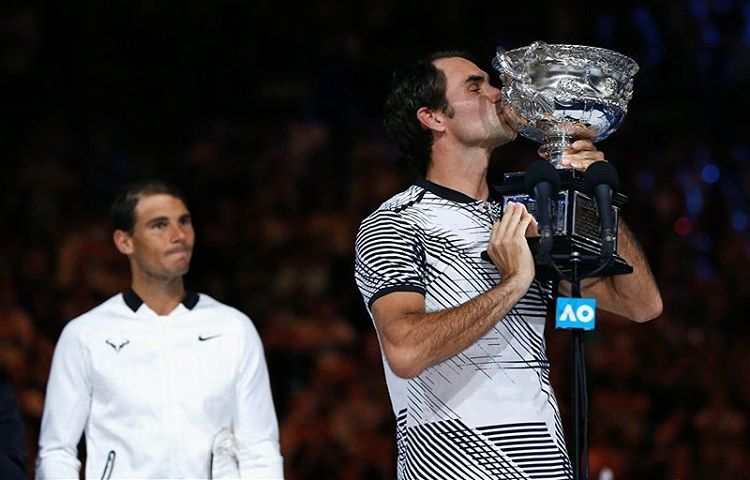
Photo courtesy of mulpix.com Federer carried that momentum over into the North American Spring swing, winning in Miami and Indian Wells, defeating Nadal twice more and putting together four wins in a row (Beijing ’15- Miami ’17) over the Spaniard for the first time in his career, a twist in their rivalry no one saw coming and which added even more spice, if any were needed, to the Greatest Ever debate. Federer’s first quarter of the season sprint saw him edge ahead in that one as he went 18-14 versus Nadal in slam’s won, and if you thought Djokovic had history on his side in 2016 when he held all four Majors at once, Federer’s early 2017 achievements- a record 18th slam at the age of 35, 18 slams after his 17th one at Wimbledon ’12, and the Sunshine Double (Indian Wells and Miami) 11 years after the last time he achieved that feat- might make you think again.
Not to be outdone, Nadal was on the verge of a historic comeback of his own, too. The Australian Open final was the Spaniard’s first slam final since Roland Garros 2014, and, in April, he completed tennis’ first La Decima, winning the tenth title in Monte Carlo before dominating the clay season until Dominic Thiem defeated him in Rome.
Thiem tested Nadal more than any other player in the 2017 clay season and was one of a group of younger players breaking through in 2017, along with Dimitrov and Zverev, but it was Sascha Zverev who made the loudest noise as he took the Rome title, defeating Novak Djokovic in the final. With Thiem, Zverev and Dimitrov stepping up their games in 2017, and the return of Fedal, tennis in 2017 was in a state few had predicted, and one which in terms of its surprise, and shock, value, was one of the best starts to a season in a while.
But if fans were hoping that the #NextGenATP or the other generations who had not managed to reach the very top of the game might finally do so in the absence of Djokovic and Murray, they were to be let down. The youngsters just could not break through on the big stage- Thiem losing in three to Nadal at Roland Garros after an inspiring win over Djokovic- and it was Nadal who won La Decima at Roland Garros, and then, a few weeks later, with Dimitrov, Zverev and Kyrgios all failing to make it past the round of 16, Federer won Wimbledon, a record 19th slam, Fedal dominating their best surfaces a decade on from the last time they both did so in the same season in 2007.
#19 tastes great pic.twitter.com/3Hv3lM5Rk9
— Roger Federer (@rogerfederer) July 16, 2017
https://platform.twitter.com/widgets.js
All hope for not lost, however, for a breakthrough from Zverev and company at the season’s final slam, the US Open. In the Summer, Zverev’s Montreal win, defeating an injured Federer in the final, and Dimitrov’s Cincy win appeared to set the stage for a breakthrough at the US Open, but it was Nadal, recently returning to No.1, who won his third US Open title.
Nadal took the title beating just one player ranked in the top 30, del Potro in the semis, and defeating first time slam finalist Kevin Anderson in the final, the South African emerging from the wreckage of a bottom half which did not even see its highest seed Andy Murray compete and which was missing Zverev, Dimitrov, and Kyrgios, the stand out players of the US Open lead in events, by the end of the second round.
del Potro’s performance in the event, beating Federer in four sets in the last eight, and taking the first set from Nadal in the semis, a performance which shook Nadal and made him play his best tennis of the tournament, was one of the year’s highlights and the Argentine’s comeback of sorts- his first trip to the semis of a slam since Wimbledon ’13- saving the tournament from being dismissed as another breeze to a slam title for one of the Big Four. If Federer was going to lose to anyone, then del Potro was the man to lose to, the Argentine rivaling the Swiss not just in forehand prowess but also with popularity among fans, and if Nadal was going to win the title without beating a top five player, then defeating the Argentine, a former US Open champ who beat the Spaniard himself on his championship run, added some much needed credibility to a grand slam run, Nadal’s 16th, which though overwhelming in its focus and intensity was underwhelming in its drama and competition.
In the post US Open final stretch of the season, Nadal and Federer were still going strong, competing for the end of year No.1 ranking, as Thiem and Zverev faded away. Federer scored his fifth win in a row over Nadal, a career first, in the Shanghai final, and Nadal sealed the world No.1 ranking, winning in Beijing, reaching the Shanghai final, and then winning a couple of rounds in Paris before withdrawing from his quarter-final against Filip Krajinovic, the Serbian going on to the final which he lost in three sets to Jack Sock, an unpredictable end to the year’s final Masters, an event which suffers the loss of the top players coming at the end of a long season, but which also prospers, delivering something different than the other ATP 1000s, champions like Jack Sock, David Ferrer, and Robin Soderling.
Federer and Nadal only had so much to give though, and by the ATP Finals, they were spent, Nadal withdrawing after his opening match loss to David Goffin, and Federer going out in three sets to the Belgian in the semis. Only Dimitrov had the stamina to play great tennis at the start and end of the season, winning the title and showing great depth to his game as he won some matches by hitting winners and others by being smart and keeping the ball in play. Dimitrov’s ability to win at the start and end of the season was partly down to his lesser match play from the end of February to the middle of August- of the Bulgarian’s 49 wins in the season, just 13 of them came (26.5%) in that nearly six month period- and partly down to his greater fitness levels than those of his rivals, a strength that made all the difference in a season which is as over stretched and tired by the end as its competitors.
Hometown!!!! pic.twitter.com/uoHSthkneU
— Grigor Dimitrov (@GrigorDimitrov) December 23, 2017
https://platform.twitter.com/widgets.js
Marat Safin said at the end of the year that if Federer and Nadal are still winning in 2017, tennis is in trouble, and the 37 year old former No.1 and multiple slam champ, who was retired by the age of 29, knows only too well the game’s once natural order of young stars breaking through and established players giving way to age, injury, and the survival of the fittest.
The Fedal resurgence can be largely explained by advances in sports science, technology, and prize money, but those advances are as ready and available to the current youngsters who are richer even quicker than their predecessors, who can afford the very best in the game money can buy, and who, by now, at their ages, (Dimitrov (26) , Thiem (24), and Zverev (20( (Safin won a slam at Zverev’s age)) should be capable of winning slams and reaching No.1. rather than merely threatening to so so and then vanishing once the pressure is really on. The younger player’s inability to step up and really break through means that if Federer and Nadal were to succumb to the injuries that plagued them at the end of 2017, and Murray and Djokovic were unable to come back, which is looking a likely scenario as we approach 2018, men’s tennis would find itself without a healthy, young, slam decorated star, one with the power to attract new fans, to inspire younger already existing ones, and to give the old faithful, the fans who tune in to every final whoever is playing, for sheer love of the game, someone to be proud of when family, friends and colleagues ask them about the game’s most recent slam champion.
That star would soon sparkle, of course, by default and design, with Dimitrov, Thiem and Zverev, ranked 3-5, in the end of year rankings, as likely as anyone to win slams in the absence of the Big Four, and tennis would, in this age of PR and marketing sophistication and manipulation, spin another narrative of “Big Fours” or a fresh one of “New Stars”. Right now, with the resurgence of two of the Big Four, Fedal, and the odd glimmers of those stars, flickers of a possible future we saw in Brisbane, Rome. Roland Garros, Montreal, Cincy and London, tennis has been, temporarily anyway, reprieved of its troubles, the wounds covered up with a band-aid where major surgery is required. With Fedal’s injuries at the end of the season and the lack of consistency of the likes of Dimitrov, Thiem and Zverev, that band-aid may be about to be ripped off sooner than expected, but what a colorful and distracting band-aid it has been for men’s tennis 2017, one which in a sport plagued by burn-out, injuries, and lacklustre rivalries could not have been better designed, more distracting, and plastered on at a better time.
-
How Did Grigor Dimitrov Become the First of the Lost Generation to Find His Way?
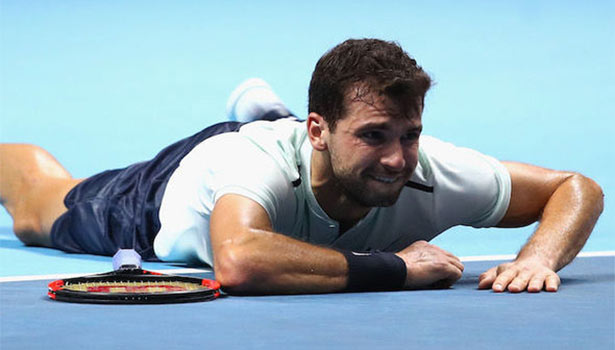
Photo courtesy of Eseenews Grigor Dimitrov’s ATP Finals win was the biggest victory yet for a member of men’s tennis’ lost generation, made up of the Bulgarian, Milos Raonic, Kei Nishikori, and David Goffin, all currently aged 26-27, all heralded from 2012-2014 as the ATP’s young guns, and all seeming to have lost their way in their bid to fulfill their potential. Dimitrov, however, with his ATP 1000 Cincy win and his ATP Finals trophy, has, in styles both pretty and gritty, finally found his way in the cruel world of men’s tennis, but just how has the new world No.3 managed to do achieve something the equally impressive talents of Raonic, Nishikori and Goffin have not?
In the period after 2014, when Dimitrov and co were lauded as the Young Guns, it seemed Dimitrov was the most lost of them all, seemingly succumbing to the curse of Baby Fed. While Nishikori reached a slam final at the US Open ’14 and competed for two ATP 1000 titles in 2016 (Miami, Toronto) and Milos Raonic reached world No.3 at the end of 2016, Dimitrov fell down the rankings from a career high of 8 in August ’14, falling as far as 40 (18th July 2016) within two years at an age he should have been gearing towards his peak.
That low was rock bottom enough for Dimitrov who, teaming up with Daniel Vallverdu, who had worked with Andy Murray and coached Tomas Berdych, then went on to reach the Cincy semis and the US Open last 16 to climb back into the top 20, and finish 2016 at No.17.
That rise really gathered momentum at the start of 2017. His peers may have had the higher rankings- Raonic ranked No.3, Nishikori No.5, and Goffin No.11- but it was Dimitrov who produced the highest quality of play as he won Brisbane, beating Nishikori in the final and Raonic in the semis, and then reached the Australian Open semis, defeating Goffin in straights in the quarters before playing, arguably, the match of the year versus Rafa Nadal, and climbing to world No.13.
Thank you @BrisbaneTennis pic.twitter.com/IOQkwQBXrq
— Grigor Dimitrov (@GrigorDimitrov) January 9, 2017
https://platform.twitter.com/widgets.js
In his next event, Dimitrov defeated Goffin in the Sofia final and then reached the last eight in Rotterdam, losing to Goffin in three sets.
But while Dimitrov’s great start to 2017 may have got fan’s hopes up that he had finally discovered just how good a player he was, knew where he belonged and was finally ready to become a top five player, his losses to Jack Sock in the Indian Wells second round, in which he held four match points, and to Guido Pella in his Miami opener, and his 4-5 record in the clay season (though he did play a very competitive fourth round match versus Thiem in Madrid) cast doubts over just how ready he really was. Slow hard courts and clay may not be the surfaces on which Dimitrov can really show off his talents, but failing to get past the round of 16 in seven consecutive events suggested Dimitrov had not really found himself at all and that he was still the most inconsistent of his generation.
Those concerns deepened when Dimitrov also disappointed in the Grass season, the 2014 Wimbledon semi-finalist and Queens champion getting off to a bad start in Stuttgart losing to Jerzy Janowicz in his opener and going 6-3 for the entire grass court season, There was a degree of silver lining, however, in the often cloudy British skies with the Bulgarian losing to an in form Feliciano Lopez in the Queens semis, motivated by his own tough loss to Dimitrov in the 2014 Queens final, and to an imperious Roger Federer in the Wimbledon last 16 and not being defeated by players he should have beaten.
After more early losses in Washington and Montreal, Dimitrov’s game finally clicked again, in Cincy, where he won the title, defeating Nick Kyrgios, a member of the #NextGenATP generation, one which looked to eclipse his own, in the final. Dimitrov did not have to beat anyone ranked higher than 19 (John Isner) to win the trophy, so he was a little luckier than Nishikori and Raonic who faced Djokovic and Nadal in their ATP 1000 finals, but he was also in new, and in some respects even scarier, territory for any of the lost generation able to get that deep in an ATP 1000 event- the favorite in every match en route to, and including the championship match itself, an ATP 1000 final.
Ranked 11, Dimitrov was the highest ranked player in each of his matches, and playing the likes of del Potro and Isner, two players with plenty of experience and armed with match winning shots on US hard courts, and with plenty of crowd support, Dimitrov could have folded under the pressure. Instead, Dimitrov held strong, and won the title without dropping a set, thriving in the Cincy conditions which, like Brisbane and Melbourne,, was a faster hard court played in the heat, and which played to Dimitrov’s strengths- his serve, his speed around the court, his aggression, and his reflexes and flair.
Another strength Dimitrov could draw on was the training he did with Rafa Nadal in the Summer in Mallorca, the Bulgarian noting Nadal’s positive body language when winning or losing, an area Dimitrov once struggled in, suffering a particularly bad tempered defeat in the 2016 Istanbul final where in a match he led by a set and 5-2, he lost 0-6 in the third after defaulting the last game after a third penalty for racket abuse.
Great practice today with @GrigorDimitrov at @RNadalAcademy pic.twitter.com/sVHEr4ofTi
— Rafa Nadal (@RafaelNadal) July 24, 2017
https://platform.twitter.com/widgets.js
But while Dimitrov was composing himself a lot better than he had, he still could not control his fluctuations in form. True to form for Dimitrov’s career, his peak was followed by a sudden dip as, in the favorable conditions of New York, the Bulgarian lost in straights to the 19 year old Andrey Rublev in the second round.
Surface, however, is where the similarities end between Cincy and New York, and it seemed the biggest of tennis stages was still too frightening for the 2008 US Open Boy’s champion. Dimitrov, however, was not the only players of his generation to fail to find their form in the biggest 2017 events. In fact, he was one of the only ones who even made it to New York with Raonic and Nishikori both absent with injury. Meanwhile Goffin also fell to Rublev, in the last sixteen.
In a season of stops and starts, Dimitrov, encouragingly, picked up his game again, and at a much quicker pace than he had after Wimbledon ’14 or Sofia ’17, putting together several strings of wins in the end of season swing, going 14-4, losing twice to Nadal, once to Isner, and once to Sock, and going undefeated on his winning run at the ATP Finals.
At the ATP finals, just as in Cincy, Dimitrov did not have to beat any of the Big Four or his two biggest generational rivals. The Bulgarian, instead, had to beat Thiem, Goffin (twice), Busta, and Sock. That lack of established top level competition, however, is not Dimitrov’s fault. The very fact Dimitrov was there, qualifying for and playing the event, was, however, down to him, and while Raonic and Nishikori have, for the time being, been sidelined with injury, Dimitrov was still out there on court, one of the healthiest and fittest professionals playing tennis right now, an achievement that is also down to his coach, Danny Vallverdu, who, after his charge’s ATP Finals win, spoke highly of Dimitrov’s hard work and dedication to reaching his potential.
I want to thank my entire team for the relentless support this past year. It has been an incredible journey and I wouldn’t have been able to do it without them. This was complete a team victory!
— Grigor Dimitrov (@GrigorDimitrov) November 22, 2017
https://platform.twitter.com/widgets.js
Dimitrov is not just physically one of the fittest men on the tour, either, but mentally, too. Despite some high quality performances versus Busta and Goffin in the round robin stage, Dimitrov did not have everything his way in London, having to defeat Thiem in three sets in his opener, and Sock, against whom he had a losing head to head against, and Goffin in three sets in the semis and the final. The Bulgarian came through in all those close contests, proving to be the more focused player in big matches, and in the final, when under pressure from Goffin, Dimitrov did not panic and showed us he had a B plan to fall back on if he cannot execute plan A, a B plan that held up to the pressure put on him by his rival, a hallmark of the mentally toughest players.
The Bulgarian had been criticized when working with Roger Rasheed for sometimes being too defensive, but with Goffin taking aggressive risks in the final, no doubt to avoid another demolition like the one he suffered at Dimitrov’s hands in the round robin stage, those Dimitrov defensive skills, perhaps implemented with clashes like this in mind, came to the fore as the Bulgarian focused on getting the ball back in play and making Goffin take the match to him, a strategy that paid off as Goffin’s attack let him down at crucial points and Dimitrov won the match not with the pretty tennis we had hoped to see, but with the kind of gritty tennis needed.
Dimitrov’s ability to execute a plan B successfully is one aspect which separates Dimitrov from Raonic and Nishikori. Raonic has worked hard to add depth to his game, but is still very much reliant on his serve and while Nishikori may have one of the sport’s most effective modern baseline A games, when he is in trouble, his B game seems to be hit the ball even harder and he over-hits himself into an even quicker defeat. Goffin, meanwhile, has a plan B, the more attacking tennis he showed in the ATP Finals championship match, but he is not practiced enough at executing it to really make it count, as his fluffed volley match point down demonstrated.
Superior fitness, a stronger mind, dedication to his sport, a lot of support, and a hell of a lot of talent, Dimitrov finally put all the pieces together this season and became the first of the lost generation to find himself. There is still far to go for Dimitrov to become the player he seems destined to be, to find the form and strength needed to win a slam title and earn the No.1 ranking, and, considering his fluctuations in form, no one should get their hopes up that he will get there anytime as soon as next season. Still, even if his career ended today- a world No.3, ATP Finals champ, ATP 1000 champ, and two time slam semi-finalist- it’s a career many players would take. A career, we hope, Dimitrov is not going to settle for, that he will, instead, keep searching for more.
-
ATP World Tour Finals Preview- Horror Show or Showstopper?

Photo courtesy of http://us.24h.com.vn The ATP World Tour Finals (WTF) will bring the curtain down on the 2017 ATP season, and the question is just what are we going to see on one of tennis’ biggest stages this year- a horror show or showstopping finale? The Tennis Review previews the tournament’s two round robin groups and gives you its predictions.
Sampras Group: Rafa Nadal, Dominic Thiem, Grigor Dimitrov, David Goffin.
Carlos Moya says Rafa Nadal is fit and ready to go and the year end No.1’s quest to win his first ever WTF title is the headlining story for the Sampras group. The fact Nadal’s name is not etched on the WTF trophy where it belongs alongside other greats such as Borg, Lendl, Sampras, Federer, Djokovic and McEnroe is, considering he has achieved everything else there is to achieve in tennis, one of the sport’s oddities.
At some point, one would imagine Nadal’s mental strength and cross-surface adaptability would be strong enough to triumph against the odds the tournament pits against him- the indoor hard surface and its low bounce, and the Head ATP balls, balls which do not react well to spin and ones with which Nadal has made no secret of his displeasure with.
Nadal may not be a former WTF champ, but he is anything but a slouch at the season finale- in his seven appearances there, he has made the semis three times, and the final twice, a record which suggests the top seed, considering the season he has had, is more than capable, if he has recovered from his knee issues, to reach the semis and give himself another shot at the title, and the trophy’s elusive nature could be just what Nadal needs to push himself through the physical pain that comes with a No.1 ranking season and past any insecurities the conditions might trigger in him to finally be the first to cross the WTF finish line.

Photo courtesy of m.v4.cc Group Winner: Dimitrov. If the Bulgarian is going to get another win over Nadal (Nadal leads the head to head 10-1) then these conditions might be the best ones in which for him to do so, and this stage of the season might be the right time. If Dimitrov is not quite ready to make that step, he should at least take Nadal the distance for the fourth time this season and pip Nadal to the top spot on sets won.
Runner-up: Nadal. Even if his knees are still bothering him- it is rumored he asked for his Sunday start to be postponed till Monday- the Spaniard is no stranger, like most tennis pros, to playing through stress and injury, and he should have too much game, even playing below his best, for Thiem or Goffin. Goffin likes indoor conditions but has had a less than remarkable indoor run recently. Thiem, meanwhile, will not be expected to progress to the semis, the fourth seed has been struggling of late, going 2-5 since the US Open.
Roger Federer’s 1HBH, but in a kilt.#AndyMurrayLive pic.twitter.com/apNt9jkxMN
— Ashish TV (@Ashish__TV) November 7, 2017
Becker Group: Roger Federer, Alexander Zverev, Marin Cilic, Jack Sock.
Federer cannot reach No.1 by winning the title, but, if he wins a seventh ATP WTF trophy and first since 2011,he could end up being seen as the real No.1 in many a fan and pundit’s eye. Federer, the only player in the draw to have won the title, should come into the event with enough motivation and form to get the better of a tired Zverev, the predictably inconsistent Cilic, and top ten newbie Sock.
The runner up spot in this group is as much a crapshoot as your scrappiest tiebreak. All three remaining players have big questions marks hanging over them- Zverev seems like he has had enough of tennis in a season which has seen him climb to world No.3, Cilic has had a fairly decent indoor hard season (5-2), but trails all three of his round robin rivals in their head to heads (2-12), and Sock is an unknown quantity at an event of this prestige facing such strong opposition.
Group winner– A healthy and fit Federer has won nearly every event he has been favored in this season (Australian Open, Indian Wells, Miami, Halle, Wimbledon, Shanghai) and there is nothing to suggest that trend is going to end at one of his best tournaments.
Second place– Sock is as good as a wildcard here. Of everyone in the draw, Sock has the least to lose, he has the killer combo of momentum and confidence, and, unlike his higher ranked young rivals in the draw, he is anything but jaded after breaking into the top ten, qualifying for his first WTF and winning his first ATP 1000 title in Paris-Bercy just less than a week ago. The head to heads are in his favor, too- the world No.9 is 1-1 versus Zverev, winning their only indoor hard court match at Stockholm ’16, and, versus Cilic, he is 2-0, beating the former US Open champ in straight sets in the Flushing Meadows 3rd round in 2016.
The semis–Federer vs Nadal. Federer is 4-0 this season vs Nadal, each time winning in favorable conditions, and it is hard to see him not going 5-0.
Having a great night out at the #ATP gala! pic.twitter.com/YWgcWBvkk9
— Rafa Nadal (@RafaelNadal) November 9, 2017
Dimitrov vs Sock. The event’s last qualifier, Sock, is one of the last players Dimitrov will want to see across the net in a big match like the ATP WTFs- Sock leads him 3-1 in their head to head, which means the match would be a good workout for Dimitrov before potentially facing Federer in the final. Dimitrov should still win the contest despite the head the head deficit- three of the four matches have gone three sets, the one Dimitrov lost in straight sets was on his weakest surface, clay, Dimitrov has won the only one played on indoor hard (Stockholm ’14), and the Bulgarian has been on a steep learning curve this season and has the necessary experience now to handle the pressure and win a big match in which he will be the favorite.
The Final- Federer would be the favorite- he leads Dimitrov 6-0 and has won four of those matches in straight sets. The match may not be that straightforward, though- Dimitrov has made significant progress this season and may be due his watershed moment. One thing is pretty certain, though, whatever the outcome, the story will be a popular one- a Federer victory aged 36 or Dimitrov breaking through to win his biggest title yet- and the tennis should be very pretty, too.
So, what will we get at this year’s ATP WTF- horror show or showstopper?
The ATP WTF comes at the end of a grueling season, and while the tournament may be big on prestige it can be low on quality with the outcomes often too predictable and with most of the matches one-sided, lackluster non-contests. This year, while there may be some horror show moments, with the resurgence of Federer and Nadal, the rise of Thiem, Zverev and Dimitrov, the swift comeback of Goffin, the unknown quality of Cilic, and the last dash splash of Sock, there should be enough show stopping moments to make this ATP world tour finals one tennis fans might be able to, now and then, climb out from behind their sofas, take a seat, and enjoy the show.
-
Roger Federer, Rafa Nadal, and the Race for the Real Number One

Photo courtesy of http://www.tdg.cn Rafa Nadal’s Beijing win and run to the Shanghai final looks, on paper, like it might have helped seal him the year end No.1 ranking- the Spaniard has 10,465 points to second ranked Roger Federer’s 8,505- but, those numbers might not add up, to some, to equal who was the best player in 2017, the real No.1. Not if Roger Federer has anything to do with it, anyway.
Should, in the next few weeks, the Swiss put together a couple more title runs like the one he made in Shanghai, a run which saw Federer avenge his US Open loss to del Potro and increase his 2017 head to head lead over Rafa Nadal to 4-0, (and cut the deficit to 15-23), then, as was the tradition before rankings began on August 23 1973 when journalists, pundits and player’s associations ranked the pros, and, as has been the case many seasons since, including last year when the WTF championship match decided the year end No.1, Murray winning the numbers contest, but Djokovic’s two slams versus the Scot’s one elevating him to, for many, player of the year, this season will also provide fans with another Who Was the Best Player of the Season debate to keep us busy in the off season.
🇨🇳🏆😘 pic.twitter.com/T31a6xthSf
— Roger Federer (@rogerfederer) October 15, 2017
//platform.twitter.com/widgets.js
The Computer No.1 versus the Real No.1 debate is always contentious, but what will likely make this one so hard to pick a side in is that Federer and Nadal have split the four slams, and if that contest is decided on a tiebreak, Federer has the slight edge with his Australian Open run arguably the toughest road to one of the slam trophies this season, the Swiss, after six months away from the pro tour, beating Tomas Berdych, Kei Nishikori, Stan Wawrinka, and Rafa Nadal, those last three matches all going the distance, and the final one a match in which he came down from 0-3 in the final set versus a player who had a 9-2 slam record over him.
Slams are not the only department in which both men share the same numbers. Both men have four other titles, but Federer has the edge here, too, his title haul the more impressive, comprising of three ATP 1000s ((Indian Wells, Miami, Shanghai) and one ATP 500 (Halle) while Nadal has two ATP 1000s (Monte Carlo, Madrid). and two ATP 500s (Barcelona, Beijing)
Great tour in China, with the title in Beijing and the final in Shanghai! This isn’t over, let’s keep going!
— Rafa Nadal (@RafaelNadal) October 15, 2017
//platform.twitter.com/widgets.js
If Nadal ends the year ranked No.1, there will be no debate, in some fan’s eyes, eyes which stick to the computer ranking to tell them who was the season’s best player. They will argue that season-long consistency trumps smartly scheduled flashes of brilliance, and Nadal has certainly been the more consistent, reaching ten finals to Federer’s seven, and has played more events (16 to Federer’s ten) ratcheting up a win loss record of 65-10 to Federer’s 44-4, the Spaniard’s only dip in form occurring between winning the French Open at the beginning of June to winning the US Open in early September (in that eleven week period, Nadal went 6-3; Federer went 11-1).
That Nadal dip and Federer rise, in the European and U.S Summer, was down to scheduling, and both men have had very different approaches to that integral factor of a best player of the year’s season. Nadal, after a surprisingly fruitful start to the season, really went prize picking in the Clay run, while Federer, who won the first big three titles of the season, skipped the entire clay season. That decision paid off for Federer in handsome style, the Swiss showcasing his panache for Grass in dominating style, getting his hands on the Wimbledon trophy for the first time since 2012, and also strengthening another grasp, his recent hold of Nadal in the Fedal head to head, one which has now seen him win five consecutive times against the Spaniard for the first time in the head to head, a hold which may have been a prime asset in the very decisive Shanghai final outcome.
While Scheduling and knowing when to rest has mostly paid off for Federer- witness his Australian Open run after six months of the tour to rest his knee and his Wimbledon run after missing the Clay season- Federer is not all scheduling genius. The Swiss’ decision to play Montreal rather than rest another week and play his much loved Cincinnati played a villainous part in an early US Open loss, and if he had gone for the Cincy option instead, a healthy Federer would likely have won the title and gone deeper in New York, and the 2017 Best player of the season debate would have been settled once and for all.
Congratulations once more to these two champs @rogerfederer and @RafaelNadal for the way they compete hard & keep smiling. pic.twitter.com/MiDW88ZF30
— Rod Laver (@rodlaver) October 16, 2017
//platform.twitter.com/widgets.js
As if- In the Federer Nadal Rivalry Tale there is no once and for all. This debate runs deeper than who was the better player in 2017, deeper than both men’s draws through the four slams this year, running all the way back to a balmy evening in Miami in Spring 2004, spanning 13 years and 38 matches, and potentially flowing all the way to the Tokyo Olympics and beyond. This one is about Fedal. The Federer- Nadal rivalry has been the story of the ATP tour for the last 13 years and when both men have produced the kind of tennis elevating them above the rest of the tour over the course of an entire season. as they did from 2005-2008 and have done in 2017, a tennis different in styles, but alike in passion, a tennis of diversity and parallels which makes Fedal not just the headline in men’s tennis, but one of the headlines in world Sport.
Those headlines will have to wait at least a couple of weeks though with scheduling and rest once again rearing its oh so sensible head now that the status of computer No.1 and the real No.1 is coming down to the wire and both men are trying to make sure they do not lose their footing on the tightrope walk to grabbing one accolade if not both.
Nadal’s withdrawal from Basel means we will not get to see that sporting highlight in the Swiss’ home city where Federer’s Nadal head to head deficit cutting began, the Swiss defeating Nadal in three sets in the 2015 final. But, if fans are fortunate, the Fedal rivalry could be played out twice more in 2017, in Paris-Bercy and the WTF. If that is the case, then Federer will have the chance of a tennis legend’s ever increasing lifetime to not only cut down the head to head deficit even further, and weaken an often used argument in the G.O.A.T debate, that a G.O.A.T could not have a lopsided head to head record against another G.O.A.T rival, but to also stake his claim to that status even further on the back of a multi slam, multi Masters, WTF winning season a decade on from the last time he achieved that feat.
(🎥@TennisTV ) pic.twitter.com/m92B2vA6al
— doublefault28 (@doublefault28) October 14, 2017
//platform.twitter.com/widgets.js
Fans should not count on Federer getting too far in Paris, though, and making it four ATP 1000s for the year. The tournament has not been especially successful for either player- Federer winning once (2011), his sole appearance in the final in ten visits, and Nadal reaching the final in 2007, the Spaniard having only competed there five times, the end of the season often the stage at which his season is done and dusted, the clay from the Spring caked too generously to his feet and legs. This year, though, Nadal’s health, as it did in 2010 and 2013, stood up to the grueling grind demanded of a Roland Garros-US Open season double, and if the Asian Swing has not finished him off, then a decade on, he could have another shot at the trophy.
Meanwhile, at the WTF, Federer has the clear upper-hand in the Fedal story, leading 4-1 at that event, the lower bounce and indoor conditions suiting him better. The importance that potential WTF match plays in the real No.1 debate is not lost on Federer, scheduling once again proving decisive in his decision making at the age of 36, the Swiss saying he is still undecided whether or not he will compete in Basel and Bercy or save himself for his priority, the WTF.
Federer’s scheduling decisions may end up being largely influenced by Nadal’s own scheduling choices- if the Spaniard pulls out of Basel and Paris, and Federer wins both, the rankings deficit would be just 460 points, and if Federer then beat Nadal in the WTF championship match to clinch No.1, or if Nadal won the WTF for the very first time, filling in the final hole in his career resume, and beat Federer in the process, then the debate would no longer be just about who the real No.1 is, but would also be about where this season ranks as either player’s, and Fedal’s, very best.
-
What Is Men’s Tennis Going to Serve up in the Last Stretch of the Season?

Photo courtesy of dnaindia.com With Nadal on the march for the Year-end No.1 ranking, Federer looking to end his year in style, del Potro showing signs of life again, Zverev and Dimitrov establishing themselves in the top ten, and new names like Gojowyczk and Dzumhur etched on trophies, the end of the year could serve up some quality tennis for fans. The Tennis Review has five questions on what the end of season is going to serve up for us.
Will Nadal finish No.1?
2017 is shaping up to be a No.1 ending year for Nadal. The Spaniard has 9,465 points, 1960 more than 2nd ranked Roger Federer, who has said he will not be chasing the No.1 ranking, 2,675 more than 3rd ranked Andy Murray who is injured, and 5155 points above fourth placed Alexander Zverev, so it looks like as long as Nadal puts in some strong performances here and there over the next few months a fourth year end No.1 finish is his for the taking.
In the years Nadal has finished year-end No.1 (2008, 2010, 2013), he has had a solid Indoor season in two of them, winning Tokyo and reaching the ATP WTF finals in 2010 and making the finals of Beijing, the semis of Shanghai and Paris, and the final of the WTF in 2013.
Nadal looks like he might not just repeat that kind of success this season, but exceed it. Federer will be his main obstacle – the Swiss might not be hunting No.1, but a high level of play could bring it his way regardless- and Nadal might still be vulnerable to a big hitter or feeling the effects of his very productive season, but it is highly possible the 16 time slam champ won’t have to be brilliant to finish as No.1- he has already put in the hard work this year, now he just has to be good enough, which is what No.1 is, for the most time, all about.

Photo courtesy of twitter.com Will Federer end his year as he started it?
Roger Federer will certainly go into the end of season stretch on a high after his Laver Cup experience, a lift he needed after his injury hit US Summer.
Federer has traditionally played some of his best tennis in the end of season stretch and, if he is healthy, will be expected to win titles in Basel and Shanghai, two of the faster surfaces on the tour, and reach the later stages of Paris (where his participation depends on how well he does at Basel and Shanghai) and the WTF.
A run like that still might not be enough for Federer to leap frog Nadal for year end No.1, but winning a couple of big events would put the wind back in his season’s sails and send him flowing in smoothly into the new season and the Australian Open.
Watch👀ut pic.twitter.com/XYeVNiBrbW
— Roger Federer (@rogerfederer) September 23, 2017
Will del Potro break back into the top 20?
Del Potro breathed some life into a a comeback that was starting to stagnate when he came back from two sets to love down versus Thiem and then showed just why he is considered one of the game’s greatest big match players when he upset Roger Federer on a run to the US Open semis.
Torneo inolvidable. Gracias por el amor y por los momentos increíbles. / I won’t forget this. Thanks for the love, #usopen. 🙌☺️❤️🗽 pic.twitter.com/6VeMbs7y9X
— Juan M. del Potro (@delpotrojuan) September 9, 2017
That breathe could get even more fiery now that events like Basel, Vienna Shanghai and Stockholm are coming up. del Potro has won Basel twice (’12, ’13), Vienna once (’12), and been a runner-up (’11), and been a finalist in Shanghai (’13). That end of season pedigree means a healthy del Potro could fly further up the rankings (currently ranked 24) and get a top 16 seed for next season’s Australian Open. In the next couple of months, del Potro’s main points to defend are Stockholm (250) and Basel (50), and with 625 points between him and world No.16 Sam Querrey, some strong runs in the next couple of months could be a welcome jump for del Potro and a sigh of relief for the world’s top 16 as they line up to compete in the first slam of 2017.
Where next for Zverev and Dimitrov?
Zverev and Dimitrov have been the breakthrough players of 2017 and both built on that success going into the US Open, winning ATP 1000 titles in Montreal and Cincinnati, but both also failed to consolidate at the season’s final slam, the two top tenners bowing out in the second round.
The final stretch of the season should inspire both of them with Zverev and Dimitrov having enjoyed success at this stage in years past, Dimitrov winning his first career title in Stockhom (’13) and Zverev in St. Petersburg (’16).
The two should have plenty of motivation, too, with the chance to qualify for the ATP WTF and improve on their already career high rankings. The question is how much do Zverev and Dimitrov have to give after a long season and where will their heads and bodies be- on the court fighting to win points and trophies or on the beach getting some well deserved rest before the upcoming trip Down Under?
Will we see more surprise title winners like Peter Gojowczyk or Damir Dzumhur?
With the end of season stretch hit by injuries and absences, the ATP 250 and 500 events are events where some new names could end up etched on trophies. Already during this end of season stretch, in Metz, Peter Gojowczyk won his first title and climbed to a career high No.66 in the rankings, and Damir Dzumhur won his first title and hit a career high of 40 after winning in St. Petersburg.
Both men had been around the tour a while (Gojowczyk turned pro in 2006, Dzumhur in 2011) and were primed to take their chance when it came their way, and there are plenty of other experienced and skilled players who will be entering the final events of the season hungry to upset the more established higher ranked pros or make the most of collapsed draws on their way to etching their names on to their first tour trophies and giving tennis fans some new names to talk about as this season draws to a close and the new one comes into view.

Tennis from a fan's point of view
[
[
[
]
]
]
 thetennisreview