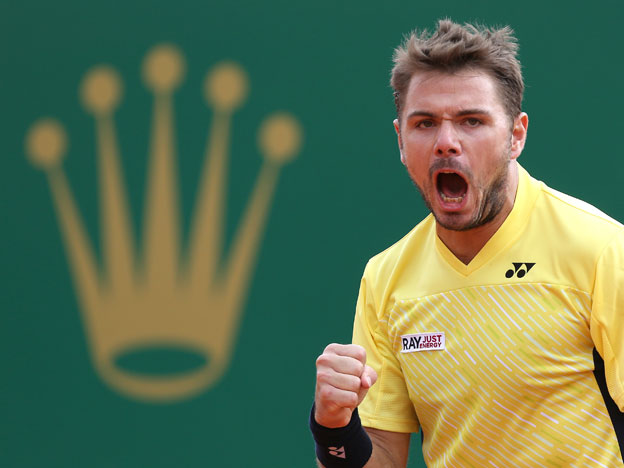
Stanislas Wawrinka beat Roger Federer in the Monte Carlo final to win his first ATP 1000 title. It was also his first win over Federer since he beat him at the same tournament in 2009. Right now Wawrinka is a Major Champion, can boast wins over Nadal, Djokovic and Federer, and is an ATP 1000 winner. And all in the last 12 months. Federer, on the other hand, has not managed any of those achievements in that time period. It is safe to say that by beating Federer in the Monte Carlo final, Wawrinka has strutted out of Federer’s shadow once and for all.
The tennis review looks at how he did it.
The First Set:
Federer edges Wawrinka
Wawrinka hit quite a few errors at the start of the first set and they undid him when serving at 2-2. Wawrinka led 40-30 in the fifth game but a forehand error leveled the game at deuce. A forehand winner got Wawrinka advantage. But he was not able to string together two good points in a row. A backhand long, a forehand long and another backhand long, and Wawrinka was a break down.
Federer held onto his serve for the remainder of the set and took it 6-4 as Wawrinka hit his 17th unforced error.
The Second Set:
Wawrinka finds his rhythm and breaks at the start of the second set.
Leading 1-0, 30-30, Wawrinka found his rhythm on his ground strokes and hit the forehand down the line and the backhand cross court with depth and pace to earn a break point. And this time it was a Federer error, a forehand long hit to Wawrinka’s feet, which settled matters.
Federer breaks back.
Leading 2-0, Wawrinka hit a forehand volley out to go down 0-15. A forehand error and he was 0-30 down. Another back hand error, this one into the net as he tried to get the angled cross-court shot to pull a slicing Federer out wide, and Wawinka faced three break points.
Federer needed only one. A backhand passing shot down the line that snuck onto the right side of the tram-line and Federer had leveled the set. And with Wawrinka hitting errors and Federer’s shot-making back on form, it was hard to see Federer not winning his first Monte Carlo Open.
Wawrinka turns the tables in the Tiebreak
It certainly looked that way as the match went into a tiebreak. But, leading 1-0 on serve in the breaker, Wawrinka got a look at a second serve, hit a well placed deep forehand return which Federer mishit on. Wawrinka held on to his break despite Federer’s consistency and fight all the way to 6-3. Federer saved the first, forcing an error with a cross-court backhand. He saved the second with an ace.
But it was third time unlucky. Wawrinka served out wide to the backhand and then charged the net, smashing the high return away to take the breaker 7-5. It was the 13th winner for Wawrinka in the set. The Swiss no 1 was ahead, too, in the winners-errors count, his errors standing at 10. Federer meanwhile was 11-18.
The Third Set
Wawrinka runs away with the Third set
Wawrinka kept his momentum into the third. A signature flat backhand cross-court winner saw the Swiss no. 1 lead 15-30 on the Federer serve. A cross court forehand hit at the net forced a Federer error for 30-40. His shoulders now wide open, Wawrinka pounded the ball in the next rally forcing another error from another huge forehand to seal the break and lead 1-0.
Wawrinka did not let up. In the third game a sublime backhand down the line, a tired drop shot from Federer and a cross court forehand winner that painted the line saw him lead 3-0.
Now emerging from the shadow, Wawrinka jumped into the limelight as he held serve all the way to 5-2. Though Federer tried his best to keep Wawrinka behind the baseline, the Swiss legend had lost some of his accuracy, a backhand cross court missing the line to give Wawrinka two championship points.
Wawrinka missed the first serve, and the second one landed in the middle of the service box, right into Federer’s hitting zone. Federer sliced the ball deep in the corner to Wawrinka’s backhand. Wawrinka struck a backhand down the line, pushing Federer behind the baseline. Federer hit cross-court to Wawrinka’s forehand. Wawrinka crushed the forehand down the line, getting Federer on the run. Federer got his backhand on the ball and Wawrinka got himself into position to take on the floating ball with his forehand. Wawrinka hit out at the ball, blasting the forehand cross-court for a winner.
Wawrinka did not celebrate the win over his practice partner and friend with anything more than a raised fist and a smile. He strolled over to the net to shake hands. He did not need to strut anyway. His game had done that for him, strutting out from beneath the shadow of his legendary compatriot as he continues his own journey into the tennis history books.
Federer raises his magic wand to the Monte-Carlo crowd. (thanks to http://www.abc.net.au)
Roger Federer is one match away from his first title in Monte Carlo. The Swiss no 4 seed must be pleased with his decision to take a wildcard into one of the few events to have eluded him.
And he is no doubt even more pleased that his rival Nadal, the man who stood in his way in the finals in ’06-’08, will not be on the other side of the net on finals day.
Who will be there is practice partner and countryman Stanislas Wawrinka. Wawrinka, the Swiss no 1 and Australian Open Champion, has stepped out of Federer’s shadow somewhat the past year and will be determined not to be pulled back into his legendary compatriot’s dark outline too soon.
Federer will not have it easy against Wawinka, despite his 13-1 career head to head. Wawrinka’s sole victory over Federer came at the Monte Carlo event in 2009, the year Federer went on to win Roland Garros. And while Federer might not be too displeased to see that pattern repeated, he would prefer to see himself take a Monte Carlo-French Open double.
If he plays anywhere near the level he displayed against Novak Djokovic in his semi-final today then he has a good chance of doing just that. For Federer, every shot was on while his opponent’s rich vein of form, taking in 16 consecutive wins, was hampered by injury. Federer took full advantage of it, placing the ball wherever the fancy took him in the court, with the emphasis being on making his Wopponent move and drawing gasps from the crowds as he beat the defending champion 7-5, 6-2.
Wawrinka meanwhile also put in a fine performance of his own, his flair and touch drawn out by the clay as he ended Ferrer’s famous Nadal beating run 6-1, 7-6.
Federer will have his work cut out to get his first Monte-Carlo title, but it is work he was born to do. The Swiss no 2 should prevail tomorrow and add another Clay court title to an underrated resume on the red stuff.
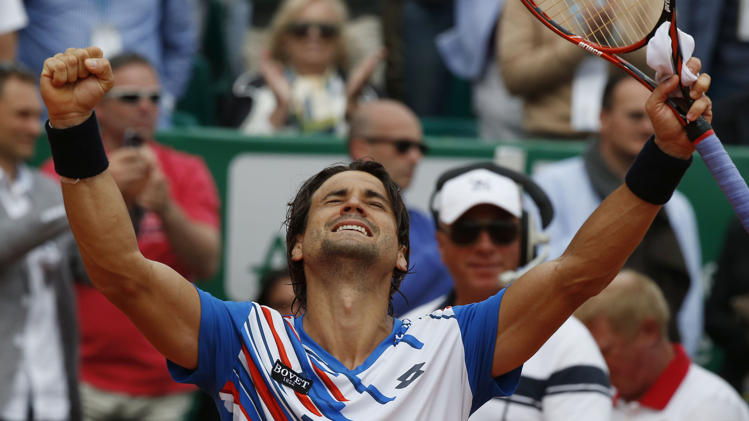
Ferrer celebrates after beating Nadal in Monte Carlo (Thanks to news.yahoo.com)
David Ferrer has upset Rafael Nadal in the quarter-finals of the ATP 1000 event in Monte Carlo. It was Ferrer’s first win over Nadal for a decade, and only his second clay career clay court win over his countryman.
The loss still comes as a shock despite Nadal’s lackluster start to the 2014 season. Defeats at the Australian Open, Indian Wells and Miami were all noteworthy for a variety of reasons, but this loss stands out. Nadal has had slow starts to seasons before only to revive himself when the tour hits the red clay. And much the same thing was expected this year.
But Ferrer had other things on his mind. Like improving his stats from 1-17 on clay. And revenge. Revenge must taste sweet, too. Ferrer suffered the bitter disappointment of letting leads slip against Nadal last year, but the clay in his mouth must be quite tasty right now.
Perhaps the last defeat on the surface, in straight sets in the Roland Garros final no less, was the last straw. Ferrer’s form has stagnated a but since then, but the clay and Nadal seemed to breathe new life into him. And he knew Nadal was there for the taking. From the very first game, Ferrer’s aggression and counter punching, an effective mix if ever there was one when added to the wheels on the 32 year old, got the better of Nadal.
Ferrer broke early in the first set. He was pegged back, but in the tie-breaker he ran ahead of his opponent, winning it 7-1. In the second set, he just kept on going as Nadal’s game declined into a sea of errors, 44 in total, while Ferrer kept attacking, coming to the net whenever the moment arose and denying Nadal the chance to embroil him in long rallies.
Ferrer served for the match at 5-2 in the second. He slipped up a little, but he did not buckle. At the second time of asking, Ferrer sealed the win, a famous one, and a worrying one for Nadal fans.
The world no.1 will see his ranking points drop, being the defending finalist, but his aura will suffer more. If Ferrer, seemingly off form and aged 32, can defeat Nadal on clay, then other players will believe they can, too. Belief-a quality Nadal is lacking right now. And one Ferrer will, and rightly so, be full of.
Djokovic looking good on the red clay (thanks to bleacherreport.com)
2014 will not be the first time Novak Djokovic enters the Red Clay season in great form. In 2011 he was the player to beat. He even defeated Nadal in two Masters finals, in Rome and Madrid. Had it not been for Roger Federer playing the match of his life in their Roland Garros semi-final, Djokovic might have the career slam.
In 2012, Djokovic also had his chances. Ranked no. 1, he made it to the final and for a set and a half he knocked Nadal off the heavy damp courts. But the match was suspended, the sun came out the next day, and with it Djokovic’s chances went out the window.
And in 2013, Djokovic, again ranked number 1, beat Nadal in his kingdom of Monte Carlo no less. Then at the French Open, Djokovic led Nadal in the fifth set by a break, but was unable to capitalize in yet another controversial meeting in which, while leading and attacking Nadal with an aggressive game plan, his racket touched the net losing him an important point and knocking his confidence.
Three big chances all come and gone. And 2014 represents a fourth.
This time, Djokovic comes in as the second best player in the world on the 12 month ranking system. But he is very much the best player in the world on current form.
He has won the Indian Wells-Miami double, has beaten Nadal in their last three finals since Beijing 2013 and although he suffered a loss to Wawrinka in Melbourne, he is very much the player to beat the last six months.
Meanwhile, Nadal has rarely looked more vulnerable going into the clay season.
The Spaniard has only won 2 tournaments in 2014, both ATP 500 ones, and the game that brought him the US Open, the French Open and five Masters 1000 titles seems to have deserted him.
And few players know how to get the better off Nadal than Djokovic. The Serbian beat the Spaniard in seven consecutive finals over 2011-12. Djokovic keeps the balls flat and low bouncing, opens the court to go down the line to the Nadal backhand, and has the confidence to step inside the court and take on short balls.
Djokovic has said that last year he was too focused on Roland Garros and that this year he was going to try and relax. A relaxed Djokovic with all the experience he has on clay- he has won every ATP1000 title on the stuff-and with how well his game matches up with Nadal is a dangerous prospect for the rest of the field.
While beating Nadal over five sets on Phillipe Chatrier is something only Robin Soderling has achieved, if anyone is going to do it, it is going to be Djokovic. Should he achieve that feat, he would have the career slam and his seventh Major.
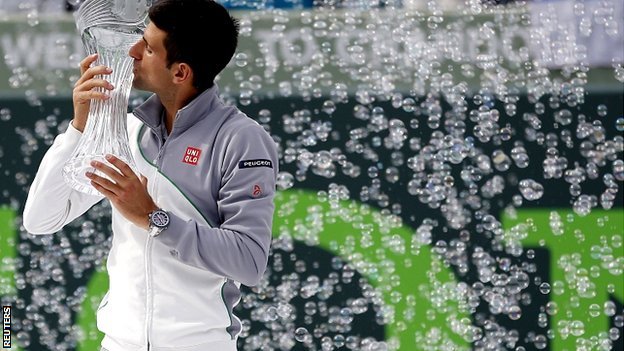
Djokovic kisses his fourth Sony Open trophy (thanks to bbc.com)
Two weeks ago in Miami, Novak Djokovic thumped Rafael Nadal 6-3, 6-3 in the Sony Open final. The tennis review looks at just how the world number 2 took apart the world number 1.
The Serve:
Novak started a little shaky on his serve, being taken to deuce in the first game. He got through it though, and never looked back. Meanwhile Nadal started off the match stronger on service percentages but his level dropped as his opponent’s rose.
While both men had a first serve percentage of 71 percent, Djokovic led the points won on first serve by 85 to 59 percent. Djokovic also led on second service points won by 57 to 46 percent.
Most tellingly though, Djokovic converted 3 of 4 break points while Nadal had one chance and failed to take it.
The return:
Djokovic won 40 percent of points on the return on Nadal’s first serve and 53 percent on his second. His return also came into effect in the first set when he hit two huge returns at 2-2 to earn the break of serve and establish his dominance in the match.
The forehand:
It was as much to do with what Novak did with his forehand as what he did not allow Nadal to do with his. In the first four games, Nadal was outhitting Djokovic on the forehand wing.
But at 2-2, 15-30 the Djokovic forehand made the difference as he struck it down the line and then cross court on the line to get the break point.
The Nadal forehand did strike a valuable winner to save a break point at 1-3 down in the second, but it was one of few moments of glory for the Spaniard’s signature shot.
Backhand:
The Djokovic weapon was as solid as ever, if not better. It was a backhand cross court winner that earned Djokovic the first break in the second set. It was the final shot in a long rally of deep, flat penetrating ground-strokes of both sides which eventually forced Nadal to go down the line on his forehand straight into Djokovic’s hitting zone. With the court open, Djokovic went cross court on the backhand and had a one set and a break lead.
Djokovic hit the backhand flat to Nadal’s forehand over and over, denying him the high bouncing balls he likes to generate spin with. That tactic worked for example with Djokovic leading 5-3 in the second set to get a 0-30 lead on Nadal’s serve.
Winners to errors:
Djokovic kept his winner count high, at 22, and his error count low, at 14. Nadal meanwhile was 15-20.
Net game:
At 2-2, Djokovic served out wide, came in on the short return and thumped a backhand down the line and then picked up the floating return with a backhand volley that dipped into the court.
And it was a half volley winner that won Djokovic Championship point, ending one of the longest rallies of the match. It was Djokovic’s 6th winner at the net, compared to 2 from Nadal.
Confidence:
Djokovic came into the match having beaten Federer in the Indian wells final. He had also beaten Nadal in their last two finals. Now having established himself as the best hardcourt player on the tour once more, Djokovic goes into the Clay season with his confidence peaking.
That also happened in 2011 when Djokovic also claimed the Indian Wells-Miami double. He went on that season to beat Nadal on clay in Madrid and Rome.
With his confidence as high as it is, Djokovic has a chance to repeat that achievement. And, maybe better it. Novak Djokovic 2014 Roland Garros Champion anyone?
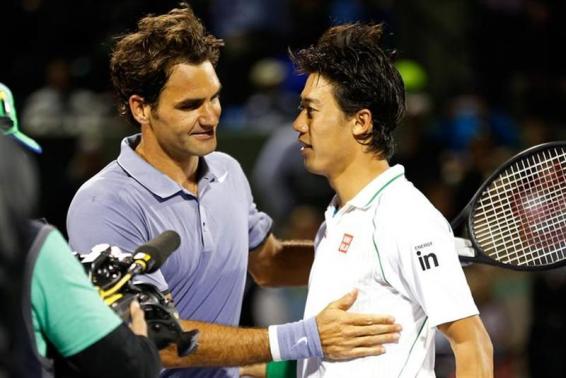
Kei Nishikori has nipped Roger Federer’s rise back up to the top of the game in the bud. The Japanese player beat the Swiss 3-6, 7-5, 6-4. It was his second win over Federer since the Italian Open last season.
The Swiss was up a set and then at 3-3 worked his way into the Nishikori service game. At advantage Nishikori won a 24 stroke rally, moving Nishikori around the court and then finally getting the better of the Japanese’s athleticism with a high forehand down the line winner, wrong footing his opponent. Another long rally ended on a Nishikori forehand error and Federer had break point. Nishikori saved it with a flat forehand cross-court winner. A forehand return winner down the line and Federer had another break point. Nishikori got a short ball on the rally and came in, but a Federer forehand cross-court passing shot was too good, hitting Nishikori racket rather than Nishikori hitting it, and the ball landing in the net.
A set and a break up, Federer then stumbled as Nishikori earned 3 break points, his deep and flat strokes at Federer not allowing the Swiss the room to set up for his shots and then earning him the chance to step into the court and hit a forehand winner for three break points. A Federer forehand cross-court winner saved the first. A Nishikori backhand error saved the second. On the third, Federer could not find his first serve and his second one was attacked on Nishikori’s forehand side, forcing Federer on the run and into error on his own forehand.
It was the Federer serve that would let him down. Serving to stay in the match at 5-6, he double-faulted to go down 15-30. A missed backhand volley and he was two set points down. He saved the first as he got Nishikori on the run and forced a backhand error. Federer then went for placement rather than power on his first serve, but he served into the wrong place-the Nishikori forehand. Nishikori had his timing going on that shot, fired a return and then pummeled the Federer backhand a couple more times to get the error and the set.
The third set was tight, going with serve, but at 4-5, Federer serving, Nishikori put the pressure on and got a look on a second serve on the first point. The Japanese took control of the point, hit the forehand deep, varying the speed and then injected point winning pace with a cross-court forehand to go up 0-15. Federer then netted a forehand into the net off a short ball and it was 0-30. Another second serve and Federer once more could not deal with Nishikori’s depth. His rhythm gone, when he was in position on the forehand, Federer hit a forehand cross-court long.
Nishikori had three match points for his second Masters 1000 semi-final. Federer finally got a first serve in, got the short ball and hit the forehand winner to save the first. Another first serve in, this one out wide, and the service winner saved the second. And Federer found the first service again. Nishikori got the return back, Federer hit to his backhand, but Nishikori’s reflexes and vision were on-song as he leaped into the backhand and struck a backhand passing shot that hit the line for a winner to win him the match.
Federer did not play badly, not on his groundstokes, striking more winners than Nishikori and less errors. But, his first serve percentage was only 51 percent, too low when up against a player of the depth, consistency and vision of Nishikori. His service woes and the talent of his opponent combined to stop Federer climbing further up the rankings to number four, and may even see him fall to number six once the Sony Open is concluded.
It has been an impressive run for Nishikori, beating Dimitrov and Ferrer in previous matches. Next up is Djokovic. The Serbian has not really been tested this week, while Nishikori has had as good a work out as you could hope for on your way to last four of a Masters 1000. Djokovic will have his work cut out against the world no. 21 who is looking like the top tenner the tennis world thinks he can become.
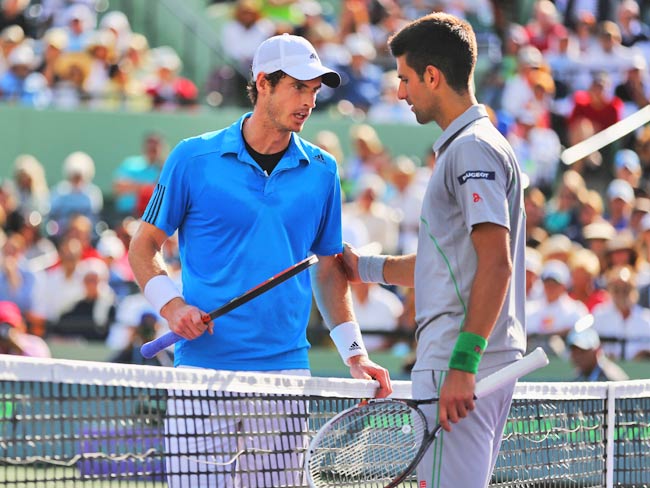
Djokovic and Murray meet at the net, the place where their Miami match was won and lost (Thanks to http://www.mid-day.com )Novak Djokovic was the winner of his quarter-final clash at the Sony Open in Miami, but the headlines will belong to Andy Murray. And for all the wrong reasons. The Scot had one of his infamous meltdowns on the stadium court at Crandon Park, allowing a mistake by the umpire to mar what had been, until the controversial incident, an encouraging performance.
For the first 11 games, Murray held his own with Djokovic. Usually, that would not be noteworthy. Murray has beaten Djokovic in 2 slam finals and many a Masters 1000 final. But, at this point in Murray’s career, staying with Djokovic is encouraging. The Serb is number 2 in the world, the recent winner in Indian Wells and playing well after some disappointing losses this season. Meanwhile Murray is ranked 6 and has not made a final in his five tournaments this year.
But the Scot matches up well with the Serb. Anything the Serb can do, the Scot can do just as well, and on his day, better. The two exchanged lengthy rallies, hitting the balls deep and back and forth until the moment came to go down the line or the short ball came for the winner. Then at 5-6, 0-0, Murray serving, Djokovic came to the net and volleyed a winner. And as the ball dipped into the court and died, Djokovic’s racket touched the other side of the net.
Murray saw it, Djokovic saw it, many of the crowd saw it. But the one person who needed to see it did not: the umpire. And even though the replay on the big screen reminded everyone and pointed out the error to the umpire, the umpire said the racket touched Djokovic’s side of the net. Djokovic said nothing, was given the point and Murray’s meltdown began. And when they start, he gets buried in the funk. The Scot would not let the Umpire forget he had forgotten to keep his eye on the ball, berating him in changeovers.
Murray did channel his anger somewhat positively, breaking Djokovic to go ahead 3-2 in the second. But, breaks of serve between these two, perhaps the game’s best two returners, are not uncommon. Djokovic broke back, Murray got even madder, and the Serb ran away with the match to take it 7-5, 6-3.
The incident marred what was until that point a fascinating match. Murray looks to be finally piecing his game back together as his body heals and a tough match here, win or lose, would have set him up nicely for the rest of the season. And for Murray, it would have been quite invaluable. The Scot will most likely sit out a lot of the clay season and prepare himself for the defense of his Wimbledon title, however, how good his chances will be after his slow start to the season is anyone’s guess.
Djokovic meanwhile continues his surge back to form. Having won Indian Wells and gained ranking points, he will also gain more points here as he bids to catch Nadal at the top of the rankings. Next up will be Kei Nishikori. The old guard against the new, two big ball strikers, let’s hope the tennis makes the headlines and not the failings of the officials or the players.
He knows how to win
Titles in Stockholm and Acapulco, wins over Djokovic and Berdych. A quarter-final at the Australian Open. After only a few years in the senior ranks, Dimitrov is racking up the wins on the ATP Tour. And he improves every month, too, so bigger and better wins are on the way. And everyone loves a winner, don’t they?
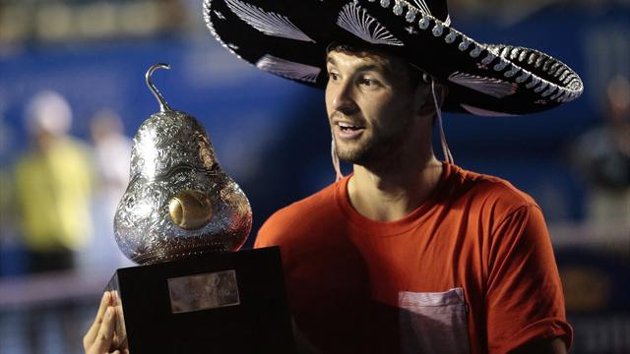
Dimitrov looks lovingly on his first ATP 500 trophy in Acapulco (Thanks to uk.eurosport.yahoo.com)
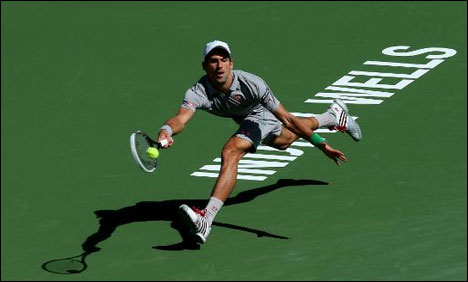
Novak Djokovic retrieves a shot at Indian Wells. (Thanks to http://www.thenews.com.pk)Novak Djokovic edged past Roger Federer 3-6, 6-3, 7-6(3) in an Indian Wells final thriller. The match could not have been tighter and had a few key twists and turns. The tennis review looks at the key points in one of the best ATP finals in some time.
Federer turns back the clock in set 1.
Federer came into the match on an 11 match win streak. And in Indian Wells, he had been in great form. He carried it over to the very start of the match. He broke Djokovic in the second game to lead 2-0 and then held his serve all the way to serving out to take the first set 6-3. His stats were as good as they can get. 74 percent of first serves in and 75 percent of those points won. 71 percent of second service points won. 12 winners to 9 errors. Ten approaches to the net and five points won. Against the game’s best returner and retriever, those numbers look even more impressive.
Djokovic knuckles down at the start of set 2 and changes things up.
In the second set, Djokovic did what he does best: he knuckled down and did not buckle. Not only that, he upped his own aggression. Leading 3-2 with Federer serving at 40-30, Djokovic took control of the point, hitting the ball flat, deep and angled from the centre of the court, getting the defensive floater and smashing the winner. Federer kept on with his own attacking style and won the game, but Djokovic had put pressure on his serve and gotten out of the rut of being blown away in Federer’s service games.
Djokovic breaks.
At 3-3, Djokovic’s service placement got him out of a deuce game. With Federer serving, all of Djokovic’s strengths came together. His depth of shot and tactical decision to hit to Federer’s feet on his backhand side, hitting to his body on the forehand and then being in the right place to hit the winner on the return, his retrieving skills. They all made matters awkward for Federer, who also made things difficult for himself as his first service percentage fell to 52 and Djokovic got the break. He then served out the set and was back in the match.
Djokovic turns the screw in set 3
Djokovic kept the pressure up in the first game of the third, taking Federer to deuce on his serve. The Serbian did the same at 1-1, getting break point when the variety on his backhand and his changing of the direction of the ball was peaking, a backhand down the line proving to be too much for the Swiss. Federer saved it with an ace, but the Serbian’s ability to get down and retrieve Federer’s flat low bouncing stokes and force him to go for too much earned him another break point. Federer did his best, getting his first serve in and sending it down the tee, but Djokovic’s feel on the return was perfect. The Serb sent the ball back deep to Roger’s feet, forcing an error and getting the break.
Federer fights back
Djokovic held all the way to 5-3 and then served for the Championships. But the Serbian, who had failed to serve out for the second set twice against Isner, faltered again. Federer had something to with it, too. The Swiss brought the Sebian to the net when he hit a short sliced backhand and Djokovic sent the volley long. Federer then got to 0-30 by coming in himself, his presence at the net seeming to force Djokovic into error on the passing shot. A Federer forehand that cleaned the line for a winner earned him 3 break points. The Swiss took it on his second when Djokovic went for too much on a short angled forehand.
Djokovic too steady in the tie-break.
The match went to a final set tiebreak. Federer served first, but could only deliver a second serve into Djokovic’s hitting zone on the forehand. The best returner in the game took control of the point, having Federer on the run or off-balance, and profited from a backhand error to go up a minibreak 1-0. A similar story happened at 1-3, Federer serving. Another second serve into Djokovic’s hitting zone and another rally ended on a Federer error, this one a netted forehand. Though Federer did have chances to control the rally when he changed direction of the ball and hit a forehand down the line, he was undone by Djokovic’s retrieving, the Serbian getting to the ball and then sending it back crosscourt and hitting the line. Djokovic did stumble at 5-1 serving when he hit a forehand down the line long but it with another mini-break in hand, he could afford to take the risk. A netted forehand from Federer as he approached the net and Djokovic had 4 championship points. Federer saved the first with an ace but the next one was on the Djokovic serve. The Serbian struck a second serve to the Federer backhand, a shot he then went for again on his next stroke. The tactic paid off as Federer errored on his vulnerable side. The championship was Djokovic’s.
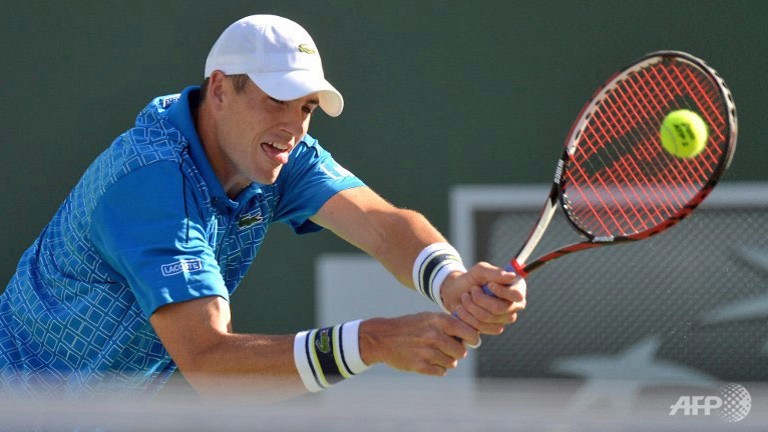
Isner lunges for a backhand in Indian Wells. (Thanks to http://www.channelnewsasia.com )John Isner has beaten Ernests Gulbis 7-6,(4), 7-6(3), to make the last four of Indian Wells. The 6ft 9″ American had to come back from behind in each set to put paid to the ever-improving Gulbis’ attempts to make his first Indian Wells semi-finals. It is not the first time Isner has reached the last four though. He made it there in 2012, beating Djokovic in the process, and making the final.
Isner’s beating of Gulbis to make the last four of Indian Wells was impressive in how his weapons held up in two very tight sets. The Isner service was at its best when he faced a break point-set point at 5-6 in the first set. Then, in the tiebreak, he got a mini-break for 5-3 and then hit two huge serves to take the set.
Isner went down a break in the second set, but his ever improving return game helped him break back when Gulbis served for the set at 5-4. Both men then held serve until another tiebreak. Isner has a reputation as something of a tiebreak king on the tour and once again he proved why. He secured another mini-break, hit his biggest serves, and took the match.
Isner will once more face Djokovic in the semis. And he is just as dangerous now as he was when he knocked the Serbian out back then in a final set breaker. This tournament, Isner has beaten Davydenko, Lu, Verdasco and, most notably, the in-form Ernest Gulbis. Isner, who won Auckland at the start of the season, had to retire from his Australian Open first round match, and did not return until over a month later at Delray Beach. There he reached the semis, losing to eventual champion Cilic. Isner’s Indian Wells run is another sign of his recovery from injury, and of his potential on American hard courts, where he enjoyed success in last season’s US Open series.




 thetennisreview