-
Dimitrov claims second top ten scalp
Grigor Dimitrov beat Janko Tipsarevic 7-6, 6-1 in the second round of Monte Carlo.

(Thanks to http://www.longines.com) It was the Bulgarian’s second top ten win after his victory over Berdych in Miami last season. Incidentally, it was Tipsarevic who beat him after that breakthrough win.
But this time, matters were in the Bulgarian’s favor. Dimitrov has been moving up the rankings while the Serbian has been moving down and so this was a prime chance for the more confident Dimitrov to beat a member of the top ten on the slide, the kind of match he needed to win if he was going to make the next step.
And this was the perfect surface to do it, too. The slow red clay of Monte Carlo gave the young Dimitrov all the time he needed to take the ball on the rise and strike it back deep and heavy, moving Tipsarevic from side to side and waiting for his chance. And this time, when it came, unlike in his other recent encounters with top tenners, namely Murray and Djokovic against whom he lost close first sets only to fade away, Dimitrov took it. Once he had set up his ground strokes to hit winners or it was safe to come to the net where he could display his fine touch and feel for the ball, he did so with aplomb. And, feeling inspired on this spring day in the South of France, Dimitrov surprised his opponent with drop shot winners, sending him scrambling toward the net to retrieve them only to be left standing, watching as they spun away. Indeed it was one of those days where everything worked for Dimitrov and nothing was beyond him, even diving into the clay and sending back a ball to get back into the point, which, being the kind of day it was, he went on to win.
Check out this clip to see just how much fun Grigor had as he earned his second top ten win and moved a step closer to achieving his potential as the leader of the current next generation.
-
Isner’s serve and forehand in fine form as he wins in Houston
Isner playing well on clay? It doesn’t look right, does it? But in Sunday’s Houston final against Amalgro, right is exactly how it looked.
Sunday’s final showed that the Isner game, the huge serve and the formidable forehand, can win on any surface when on. These two weapons are two of the biggest in the game and are what has gotten John into the top ten and earned him wins over the likes of Djokovic and Federer, the latter incidentally on Clay in five sets.
First, let’s look at the serve.
Coming down at you from 6ft9, this weapon can hit through any surface. And if Isner’s first serve percentage is high, then his service games are pretty much won.
Next, there is that forehand. That forehand is not to be fed to. Let’s take a look.
If Isner can set it up, then you can bet it is going to be a winner. Your only chance is to have the tall man on the run and prevent him from firing away on his favorite side but if the first serve is going in and Isner gets a weak return, then things are going to go something like this from Roland Garros in 2011,..
..which is pretty much how things went against Amalgro.
Try as Amalgro might to profit against Isner’s suspect return game and mobility, and it looked like he would as he went up 3-1 in the first set, the Spaniard, with more than 200 career wins on Clay, could not find an answer to the American’s A game.
When the Isner serve and forehand is on like it was in Sunday’s final, your only chance is that it suddenly switches off. A chance that, for Amalgro, did not come. Amalgro did not help himself either, growing increasingly annoyed by his opponent’s fiery form in the hot sun before a partisan Houston crowd. The Houston environment brings out the best in many an American non-clay specialist as the names of Roddick and Fish on the tournament trophy testify. Certainly the heat helps, speeding up the courts so those big serves and forehands hit through nicely, and the home support is worth a game or two, even a set. Isner took advantage of these factors and his fine play, breaking at 5-5 in the second to serve it out for a 6-3, 7-5 championship win.
It was a win that set tongues wagging that the man who took Nadal to five in the French Open ’11, and who incidentally participated in my favorite match of last season, a classic five set match at Roland Garros against Matthieu, might be able to provide some more thrills from his powerful attacking game in the coming Red Clay season.
-
Serena, the late bloomer, wins in Charleston.

(Thanks to zee.news.india.com) Just as she dropped the first set to Sharapova in Miami, Serena did the same to Jankovic in the Charleston final. Just as she had been in Miami, Serena had been caught off-guard by her opponent’s great form and hurt by her own early malaise. However, just as she had in Miami, Serena came back to take the next two sets and defend her title.
It was in Charleston a year ago that it all started again for Serena. Stops and starts are a fitting way to describe the younger William’s career. Since Charleston ’12, Serena has won 9 titles. Her haul is made up of slams, Wimbledon and the US Open, the Olympic, the YEC, Premier titles in Madrid, Miami, Charleston, and Brisbane and an International title in Stanford. A more eclectic array you could not find. Blue clay, green clay, grass, hard court, indoors. It has one noticeable absentee, the red clay, and one imagines she will do whatever she can do check it present. It is a haul worthy of a number one player. It is as good as any of the Greats have mustered and as good as her 2002-03 haul where she was also the dominant player.
Back in 2003, we really thought we had found our next tennis Queen, a Seles, a Graf, a Navratilova. But an injury mind 2003 saw Serena off the court for nine months and it was not until the 2005 Australian Open that she lifted another Major trophy. Perhaps now, we thought. But more injuries and two more seasons passed before Serena won, again, in Melbourne in 2007. Well, now? we asked. No. We waited until the US Open 2008. And then it rained, poured even. Serena won The Australian Open 09 and 10, Wimbledon 09 and 10 and reclaimed the number 1. In July 2010, it was hard to envision anyone but her winning the US Open. But a piece of glass got in the way, lodging itself into her foot at a party and it was another year before Serena was back on court and another year before she was winning Slams again.
Since then, we have been treated to the number one the tour needs. A number one with slams and history and star quality. Since 2010, Wozniacki, Azarenka, Maria and Kim, ( maybe you blinked and missed her one week stint), have all held the top spot but none of them convinced. Serena on the other hand takes leading with conviction to a new level. Only injuries and the odd inspired moment by her opponents can stop her in her current state of mind. It is a state of mind we should all relish while we can. It might not come along again for a long time. Ask Serena. And if your not a fan, forget about whatever it is from the past that prejudices you, and I grant you there have been more than enough moments, and watch videos of her latest victories in Miami and Charleston, and even her losses in Melbourne and Doha, and see the poise, the calm, the fight and the very fine play. See it and enjoy it. After all, better late than never. You can ask Serena about that, too.
-
Ferrer says sorry as he fluffs Match point against Murray in Miami final
‘I’m sorry’, said David Ferrer as he gave his runner-up speech after the 2013 Miami final.
Well, at least he apologized, we thought. We wondered if Murray would apologize, too. And what about the ATP? Were they going to step up, hold their hands up and admit wrong-doing? Weren’t they guiltier than anyone?
After all, none of us would ever get those two hours and twenty minutes back. We could have been doing all manner of things. Watching one of our favorite matches on replay, playing tennis on our consoles, hell, we could have even been playing tennis in real life. But instead we had watched the Miami final, a Miami bereft of the game’s two biggest stars, Federer and Nadal, a tournament slowly losing its status to the prosperous and Nadal-Federer graced Indian Wells.
Still we watched though. After all, Miami has history. In the days when the finals went to five sets and only Major champions won, it was seen as the greatest of the non-majors. And while it may be on the decline, it’s still a Masters and its still tennis. And there would have to be a pretty good reason for tennis fans not to tune in. Well, on Sunday, we might have got our reason: You see, we didn’t see much tennis.
We saw what is being sold to us as tennis but which when removed from its glitzy packaging is a different sport altogether. While there are still rackets, balls, a court and a net, what there is not so much of is tennis skills being shown on the court. What we get instead is two tree-trunked legged players running back and forth along the baseline and a ball which ends up in the net or beyond the lines more often than it does being dinked over the net or belted up the line for a winner. Close to 100 errors littered the final. And of 208 points played, 35 were at the net, the same number of winners for the entire match. Yes. You read correctly. 35 winners from 208 points and on a hard court. And while Miami has always been a medium slow paced hard court, those numbers are still too low.
David’s game does not not really produce winner after winner anyway so perhaps his apology could be seen as unnecessary. And it is not his fault that the court is too slow to hit winners through. He certainly tried his best at times, setting up his big forehand down the line only to watch as a tired Murray chased it down and sent it back free of pace. Neither could Murray really be blamed either. His tiredness which led to so many errors was not so much due to his lack of fitness but more down to the playing in the midday sun so that the TV network could show basketball later on. It did not help either that his match with Gasquet had gone to three sets. Three sets on these courts is three sets to many.
As we thought over the apology, David’s next words threw us off guard. ‘It was only one point’, he said. The runner-up was not apologizing for the non-tennis match we tennis fanatics had just sat through but was apologizing to the Spaniard-heavy Miami crowd for stopping the rally on his match point at 6-5 to challenge a Murray forehand that had hit the line. Had his challenge been correct then David would have delighted the large Spanish speaking contingent by becoming the first Spaniard to win the title. Instead, it was Murray who got more balls back and kept more in to run away with the final set tie-break, and that was all he had to do really on these courts against this opponent. Murray’s ability to grind it out reaped him the rewards of not only his second Miami title but also his re-elevation to the number two ranking.
And so, if Ferrer was not going to say sorry, perhaps it would be the Champion. But Murray did not apologize in his speech, either. And neither did the ATP come forward and face the disgruntled fans. You see, we were not there to face, being as were at home in front of our screens, frothing away. The fans that were at the match cheered away though. After all, a day at the tennis is a day at the tennis, and as much as this was an error-filled match between two tired, cramping players, it was a grueling spectacle with long rallies, the odd one gasp-inducing. And as long as the stadium is full and as long as the ratings are high, which they are as the ATP gets the word out about the superhuman specimens battling it to the death and pulls in a whole new breed of fans, then the apology will not be forthcoming. It will take empty stadiums, low ratings and the subsequent withdrawing advertisers to get them to say sorry. But asking tennis fans to stay away when tennis is all over the internet is a bit like asking a chocoholic to give up chocolate when the keys to the pantry are left hanging by the bed. Tennis fanatics will always watch the big matches and attend the tournaments for those moments of great tennis that we do get now and then. They will sit side by side the new fans, who gasp in awe of the speed and athleticism and the length of the rallies, and get on their feet and applaud when they see a drop shot or a well-constructed foray to the net ended with a backhand volley that clips the line.
And so while we are all there cheering and parting with money, there will be no apologies about the tennis or the minutes you won’t get back. Instead what there will be is executives diving into pools of golden coins, millionaires raising aloft trophies, players spending hours in ice baths and fans frothing away watching clips of 1990s Essen on youtube. And that, my fellow fanatic, is truly sorry because one would think that as a sport grows it gets better and we would not have to get our tennis kicks from players and surfaces long retired.
-
Maria the bridesmaid once more to Serena.
Maria Sharapova looked in the mirror and thought the bride’s gown fit nicely. God knows she had been trying hard enough to lose the pounds to fit into it. This was her fifth attempt and this was the furthest she had ever got. She checked out the pattern, the fit around the waist, the bust. She admired the neckline. And then her eyes met the mirror. She looked away. No, the dress really did not fit at all. She was not cut out to be the bride. She had better take it off and get into the dress that became her: the bridesmaid’s one.
Maria tossed the ball in the air. It was her second serve. She caught it. Serena had break point against her. It was a break point to level the set at 3-3. But it would do more than that. Maria knew exactly what it would do. She may have been only three games away from the match, and Serena might have been only ten games away but it made no difference. It was this point now that mattered. This point would tell Serena all she needed to know. Maria tossed the ball again. If she saved this point, she still had a chance. She watched as it came down. She still had a chance, her first chance since 2005 when she had held match point sin Melbourne. She came down over the ball. She watched as it missed the line. She listened as the official called fault and the Umpire called game Serena.
Game Serena. Since that 2004 YEC final when Maria fell to her knees after beating a hobbling Serena it had been game Serena more times than she cared to remember, to the tune of ten consecutive defeats, and some of them deafening. Those two famous victories in the 2004 Wimbledon and YEC finals seemed to loop in Serena’s head each time they met on court, winding Serena up so much that she unleashed more winners against Maria than anyone else on the tour. While against others she might let up and lose a set or even a match, against Maria she refused to do anything but play her best, a somewhat backhanded compliment if ever there was one.
But today things were as if 2005-2012 had never happened. It was like 2004 all over again. Maria was striking the ball hard and in the lines. She was moving Serena, finding the open court. And at 5-4 receiving in the first set, she had taken her opportunities as Serena, unable to find her first service and forehand, faltered. Maria pumped her fist and ran to the chair and ran as quickly out of it again, the momentum on her side, momentum which she continued to run with, striking away and playing the hard-hitting and fired-up tennis that had seen her win in Indian Wells and enter the Miami final on an 11 match winning streak.
But the time machine began to falter. 2004 turned ever so slowly into 2005, 2006, 2010 and 2011, years not just when she had lost to Serena but years when she had been runner up in Miami. And as the double fault handed Serena the break back the time machine was well and truly in need of repair. Serena, though, had repaired the faults that had seen her in a losing position, the wobble of her opponent being all the space in which she needed to step and strike back. Back in the match and with the prospect of overtaking Steffi Graf to become the most decorated Miami champion with 6 titles, the history loving Serena began to focus on that loop of Maria on her knees in 2004. Serena began to find her serve and those forehands found the line. As she held serve and then broke, held serve and then broke, we all watched on as the inevitable unfolded before us, as Maria went down on her knees but not in celebration, and Serena raised her arms aloft as those all too haunting and familiar words for Maria boomed from the Umpire’s microphone:
Game, set and match Miss. Williams.
The two shook hands and then went to shake hands with the Umpire, Serena going first as she is wont to do, despite etiquette being that the loser goes first. But Serena being Serena likes to have it her way, and against Maria that is something to which she has worked hard to become very much accustomed. The umpire took Serena’s hand and then watched as Maria wandered off, neglecting to shake his hand second.
Second. In Miami and against Serena, that is a position that Maria has been stuck in. A position she said after the match from which she would like to rise from. The tennis world watched as with her usual grace she stood back and caught the bouquet. Yet, we all know that behind the gracious smile would have been a mind working away at figuring how how she would get the figure to once again fit into that bride’s gown, look herself in the eye and tell herself how well it fit her, and, most importantly, have that loop that played over and over in Serena’s mind play itself out on the court in real life. And there would be nowhere more fitting than that very same court where she stood now, bouquet in hand, in Miami.
-
Maria Sharapova’s sweet tooth satisfied in Indian Wells
Week in, week out, Maria Sharapova makes it through to the final stages of tournaments. You have to go back to last year’s Wimbledon last 16 for the last time she was beaten before the semi-finals of a tournament. More often that not though, Maria, who is not ranked number two for nothing, has come second best. Kvitova beat her at Wimbledon ’11, Azarenka in Australia ’12, Beijing ’12, Miami ’11 Indian Wells ’12, to name a few, Serena at the Olympics ’12 and the WTA finals ’12. But these losses have not dented Maria’s spirit. If anything, they have strengthened it. Time and time again she has turned to her opponent on the podium and congratulated them for being the better player on the day with nothing less than a smile on her face. And, courtesy of her finding strength in her defeats, of coming back the week after and contesting the final stages, she has been, now and then, the recipient of the same acknowledgements; when Azarenka and Williams have been absent from the finals, it has been the ever-present Maria, bar the odd blip here and there (Miami 2012, cough), who has lifted the trophy.
In 2011, Maria beat Stosur in Rome and Jankovic in Cincinnati. In 2012, she beat Li Na in Rome, even got a win over Azarenka in Stuttgart and beat Errani in the French Open final. Four of those titles have come on clay, one on hard. And that run of clay court wins in 2012 saw her reclaim the number one spot for a few weeks. But only a few. The rest of the season saw her resuming her now familiar place of posing beside the winner, smiling sweetly with the runner’s up trophy in hand.
So,while, being the competitor that she is, Maria would not have wished for Serena to continue her boycott of Indian Wells or for Azarenka to withdraw from her last eight match, the draw would not have displeased her. The prospects of Errani, Kirilenko, and Wozniacki would have made sleeping somewhat easier than a Li Na, Azarenka or Williams encounter looming. Maria’s fans, and there are millions of them, would have slept easier, too. Spoiled by her earlier career victories from 2004-2008 at Wimbledon, the WTA finals, the US Open, Indian Wells, the Australian Open, the relatively lean times of the past few seasons have been at times frustrating, like having been allowed free reign in the chocolate factory and then being restricted to quarterly supervised visits. And while they, like Maria, would have liked to have gotten their fingers sticky with candy on the back of beating a Williams or an Azarenka, beating Wozniacki in the final was far more preferable than losing to her, which had this match occurred pre 2011, might have happened.
But the 2013 Maria is closer to the 2008 model than ever. Her final display against Wozniacki who had wins over her in Indian Wells ’11 and the US Open ’10, was laden with the hard hitting ground strokes that were missing in those wilderness years when she was susceptible to being beaten by anyone who could keep the ball in play, a practitioner of which Caroline is one of the world’s best. But Maria is out of the wilderness now and those groundstrokes can be unleashed at will and find the lines once more. And while with her high risk games comes errors, she keeps the winner to error margin big enough to keep herself out of the danger zone. Hitting 33 winners to 25 errors, while her opponent hit 2 to 19, Maria Sharapova did not hang around in her quest to add another elite trophy to the cabinet as she beat Wozniacki 6-2, 6-2.
No doubt Maria will be there in the final stages next week. The question is what role will she be playing should she meet Williams in the final? Will it be the smiling bouquet holding bridesmaid or will she and her fans have the keys to the chocolate factory once more?
-
Nadal resumes role as the master of the Masters 1000
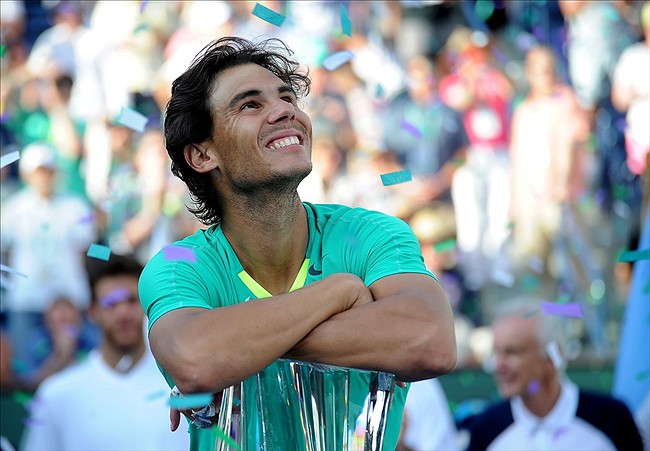
Photo courtesy of http://www.fansided.com Down a set and a break in the Indian Wells final to Del Potro, Rafael Nadal dashes to his far right of the court, gets his racket on the ball, and sends it back to Del Potro. The Argentine takes another strike, belting a forehand into the far left of the court. Nadal scurries across and once more sends the much-abused ball back to his opponent. Del Potro strikes again. This time the forehand just misses the line.
Del Potro had gone for too much. But he had had to. Unable to hit through the ‘hard’ court, unable to withstand his opponent’s defense, it was all or nothing. He had to go for the lines to strike winners and he had to strike winners to beat his opponent. While his defensive game has improved, he was never going to win a grinding battle against Nadal. The only game that was going to win him this match was the one built around getting into position and assaulting his opponent with that forehand, one of the most varied and potent in tennis. That game had worked for the first set and a half. He had been able to thwart his opponent’s defense, that mighty forehand tearing it down. But the longer Nadal is on the court, be it clay, hard or grass, the better his chances are. The more he runs, the more pumped-up he gets. And the tougher the battle gets, the harder he bites, and those teeth are sharp.
It was at a set and a break up in favor of Del Potro when the Argentine had to put Nadal away or else face the pain that is a fighting Nadal. Though Del Potro went for the lines, the ball just kept coming back and Del Potro started to miss. The kind of form that it takes for a big hitting giant like Del Potro to hit through these slow hard courts is, after all, temporary. On the other hand, the kind of class a player like Nadal has is permanent. Despite his seven month absence from the top flight of tennis, despite an opponent on the back of beating his big match nightmares Murray and Djokovic, despite not winning a hard court tournament since 2010, Nadal not only managed to get the balls back but also to attack when the moment arose, showcasing the hard court prowess that saw him win two hard court slams and multiple masters titles.
At 2-3 down in the second set, Del Potro serving, Nadal took matters in hand, defending and attacking in equal measure. And once he had broken back, once that forehand of his was on form and he had the Argentine on the run, unable to hit forehand winners, the chances of Del Potro winning the match shortened. Nadal, after all, is a matter of the tennis match, working his way into the game and then getting a grip on the momentum once he has swung it his way. Once Nadal broke Del Potro, the Argentine’s chances were all but gone. Counting him out would have been foolish considering his comeback win against Djokovic in the semi-finals but this was the Indian Wells’ final against one of the greatest competitors in the game. Finals and semi-finals are different beasts for players like Nadal, they bring out their very best when the trophy is courtside ready to be engraved with their names, and the third set saw a Nadal as consistent as ever, those ground strokes as unrelenting and that attitude as competitive as it had been before his disappearance from the tour last June.
Nadal put Del Potro under pressure as the third set got underway, making him fight for more than ten minutes to win his opening service game of the third set. It was now a case of how long Del Potro could stay in the match as he misfired his forehand and his legs began to wilt from covering all the corners of the court in the midday heat. With his game now collapsing, there would only be so many epic service games he could survive. With Del Potro looking vulnerable, Nadal did not let up. Nadal kept getting him on the run, took his chances and lapped up his opponent’s errors, pumping his fist and firing himself up. The Spaniard broke Del Potro at 1-1 with a forehand winner into the open court. Nadal’s muscle memory is not limited to his limbs alone. His brain had not forgotten to win as much as his hitting perfect topspin forehands had not escaped his arms. In front and having played himself into the match, Nadal kept his form and won the match with some fine attacking tennis in the final game, moving forward when the chance arose to hold two championship points. One was enough. Hitting deep, loopy forehands to Del Potro’s forehand side, the Argentine, not in the mood to trade forehands, went for a shot down the line but the ball went wide and Nadal fell onto his back.
It was his 22nd Master’s title, putting him back at the top of the all time Masters 1000 leader board. More will likely come this Spring when Nadal next plays on the red clay courts of Europe, a chance to extend his lead at the top of the Master’s leader board and engrave his name even deeper into the hall of all-time Greats.
-
Kvitova emerges Champ from the Dubai wreckage
Petra Kvitova emerged from the wreckage of the 2013 Dubai Premier tournament silverware in hand. She did so without having to face either of the world’s two best hard court players, world number one Serena Williams and recently crowned Australian champion Vika Azarenka. Though Kvitova’s draw was tough, beating Ivanovic, Radwanska, Wozniaki and Errani, it was not one made up of the two current hard court Major Champions. And it would have been one thing if both women had played and been beaten in the draw but neither of them struck a ball. Kvitova merely looked on as both women turned up in Dubai but limped off before their opening matches. With the draw already done, Suarez Navarro, a lucky loser, was placed in Azarenka’s spot in the draw while spectators missed out on the scheduled Williams-Bartoli encounter. The world’s top two were subsequently fined for their late and inconvenient withdrawals. But it had all the fairness of a parent spanking a child who hid before the swimming race after having spent all morning performing medal-winning pirouettes.
It was not just Kvitova and the tournament that looked on as both players hobbled away out of pocket. It was the fans, too. The very fans who would have bought tickets to the event after seeing Williams’ and Azarenka’s faces on the tournament promotions, faces they would have remembered only too well from last year’s ultra-competitive and entertaining US Open final. The excitement of perhaps seeing them in another hard court final would have been fueled even further by the Doha final the day before the start of the Dubai tournament, a final that went to three and in which Azarenka got her first win over the freshly re-crowned World number One Williams in ten successive attempts.
Yes, you read correctly. The final of the Doha Premier tournament was played the day before the start of Dubai. The two premier tournaments are played back to back, Doha being a Premier 5, Dubai a premier. Though it takes only 40 minutes to fly from one destination to another, and they would have flown first class, factor in the checking out of the hotel, the checking in at the airport, the disembarking of the plane, the checking into the new hotel, after a week of playing tennis at the highest professional level, contesting a three set final against your top rival and then the prospect of all of that all over again, and straight off the bat for Serena who would have faced no less than Bartoli in her opening match, and the withdrawals seem, though not excusable, somewhat understandable. Had fans seriously considered the stresses put on both Williams’s and Azarenka’s bodies, and those hard courts punish the players considerably, they would have done well to refrain from buying tickets expecting to see them in the Dubai final and bought their tickets instead to spectate two professional tennis players, regardless of who they are, competing for champion status and the ranking points and prize money that come along with it at the highest levels of the sport. Many would have done that but nevertheless there would have some disappointed fans seduced by the glitz of the promise of the world’s top two’s participation, expecting to witness the two divas decked in jewels sweating it out for the title only to find that both women were tucked up in bed instead, their mugs full of cocoa, jewels on their dressing tables, feet freshly spad and well and truly rested. Those two resting divas would not have been watching Errani and Kvitova duke it out though. After all there is nothing these two women love more than fighting it out in finals. They too would have been as disappointed as the fans that they could not compete. Wouldn’t you, if you loved your job, and you were the very best at doing it, and yet you could not handle the demands and had to flake out?
Having already played in 3 tournaments, one of them a Major, and going far in each of them, both women had certainly been playing their part in the WTA’s seven week old 2013 season. And another 15 or more tournaments, another eight months of checking in and checking out and pounding the body against fierce competition lies ahead before a two month ‘break’, if you call training and improving your game in order to be ready for the first Major of the next season which starts two weeks into it a break. The fitness necessary to come back at the crack of the new season and take the spoils is not gained from letting your hair down on the beach for more than a few nights. Thus the women have to find breaks in the tour itself, too, or face the consequences of early-curtailed careers a la Henin, Hingis and Clisters. If their bodies say stop, they have to listen, and if it happens to be on the eve of a big WTA tournament then someone has to suffer and somewhat humanly neither player is going to make that someone themselves.
Had there been perhaps a week’s rest between the final and the first round, then the fans, the WTA , the sponsors and the players would have all gotten what they wanted. The tour is too long, the competition potentially too deep to not have it any other way. But it is another way. The WTA’s way. You see, Indian Wells and Miami go back to back in less than a fortnight and then comes the clay. Doha and Dubai have to be back to back because that is where the money lies and the WTA is a business and Williams and Azarenka their top employees and with that comes both great rewards and great demands. And with those demands come consequences such as injuries and late withdrawals and fines rather than what those demands were designed for and which the WTA anticipated with their roadmap: the rivalries and ratings, anticipations which have gone unfulfilled and created a situation where the only real winners are the WTA chiefs.
Kvitova won though. And the fans saw a three set final. And as long as there are players there will be finals and the wheels will keep spinning and the sponsors money will continue to pay the bills and the bonuses. Unfortunately for Williams, Azarenka and the fans, who after all want to see the best players and rivalries more than anyone, the wheels of Serena and Vika stopped spinning and they not only paid with their bodies and their resumes but with their savings, too. The WTA though took the sponsors money and will no doubt be readying their next promotion for Miami and Indian Wells, demanding that players compete in both, promising the fans they will; yet those in the know, and even worse, they, the WTA themselves, know that a promise from the WTA means as much as the player’s health and safety do to those unfair parents of the game that were meant to help the players grow into and reward them for being the best professionals they could be rather than leave them hobbling out the gates and taking to their beds, sometimes for a few weeks or months, and sometimes, in the case of recent number one Safina, for good.
-
Reversal of Fortunes for Vika and Serena in Doha
For a while we had gotten used to the status quo: Vika at number one, Serena beating her in the latter rounds of tournaments. Last week though we had to adjust to a reversal of fortunes; it was Serena who was the top ranked player and Vika who had the W over Serena on her record.
It looked like we might be on the dawn of a new Serena era at the start of the year. Overwhelmingly favored to win in Melbourne, she bowed out in an injury-hit quarter-final. It was Azarenka who went on to take the title, proving as she did so that she was the hard court player to beat of this era. This match was Azarenka’s chance to affirm that statement. Serving at 5-4 in the first set tie-break with a mini-break in hand, it looked like she might. But a double-fault gave rise to whispers that Vika did not have the mental strength to beat a woman who had dealt her nine consecutive losses, four of them while she was number one in the world.
But it was all whispers and hearsay. Azarenka held her nerve and took the set. Things were very much there between her ears. The last time she had lost to Serena in the US Open final she did not have the experience of finishing a season number one, rising above a media storm concerning her Medical time out in her Melbourne semi, and defending a Major title. She was a better player than she had been back in September in New York; a stronger one.
Of course, Serena was not going to just let the first set slip out of her hands without a fight. She had fought tooth and nail to make the business end of the week, coming back from 1-4 in the third against Kvitova in the last eight, and with the number one having come to her as her fine results piled up, she would do her best to dress it with another title, potentially her eighth in the last 12 months. Nailing aces and winners, she took the second set 6-2, breaking away at 2-2 to turn the momentum her way.
No one on the tour is a better front runner than Serena and it looked unlikely that Azarenka would turn matters around. But perhaps the run of games from 2-2 against her had actually worked in Vika’s favor. Unable to have a say in proceedings, Vika took somewhat of a breather. Meanwhile Serena had been cranking up the intensity and continued to do so as she blasted a forehand return winner down the line at 0-0 for 0-30. Vika took on the third set with gay abandon, moving forward on the next point to hit a forehand winner and surprising Serena with her sudden attack as she hit another forehand winner. Vika hit her first serve big and kept up the depth and pace on her forehand to draw errors from Serena to take the first game of the third and get out of the rut.
Vika did not look back, breaking a somewhat bamboozled Serena for 2-0, her depth of shot and angles paying dividends, a forehand winner sealing the break. Try as Serena did to fight her way back, Vika was her good old solid self while Serena hit more errors than winners. Holding her nerve, Vika served out for the match, a big first serve drawing an error off the return from Serena. Beating her fist on her chest and pointing her forefinger skyward, Vika knew that this win meant more than who was at the top of the rankings, a status she knows Serena sees only as an inevitable conclusion to good results and not a worthy achievement in itself. This win was solid proof that Vika was Serena’s worthy adversary on hard courts and a promising sign of things to come should they meet in Miami in April, Serena’s home and one of her favorite tournaments and a venue where Vika is a two time Champion, beating Serena in the 2009 final.
-
Lessons from Melbourne
With the dust well and truly settled on Novak and Vika’s trophies, the tennis review looks back on the five lessons learned from the Australian Open 2013.
1. Everyone loves a one-handed backhand.
No doubt the best reaction of the fortnight was to Stanislas Wawrinka’s so-near-but-yet-so-far performance against Novak Djokovic in the last sixteen. Taking the ball on the rise, Stanislas hit his single-handed backhand with flair, liberty and creativity in what was a quite moving attempt to live up to his potential and take a big scalp at a Major. Time and time again he hit that backhand crosscourt and down the line for winners, a shot his opponent could do nothing about other than wait for it to start to miss. While he may have started missing in the end as the reality of actually delivering hit home, Stanislas’ talent did not pass by anyone as the tennis world reacted to his signature shot with nothing less than absolute admiration.
2. No one loves a tactical ‘medical time out’.
The crowd and tennis fan’s reaction to Azarenka’s well-timed medical time out as Sloane Stephens was about to serve to stay in the second set was nothing less than damning. Clumsy back tracking could not save Azarenka from a media and fan backlash. And deserved it was, too. Gamesmanship might be part of tennis but it is not, at the business end of a Major, acceptable. Alas the culture of tennis allows it to go on and it is up to tennis to ensure that it is a player’s game and not their gamesmanship that wins them the match.
3. Tennis gets the number ones it deserves.
The slow injury-inducing courts, the punishing heat, the lack of warm-ups, these were the conditions that the powers that be provide and the two players who thrived were the two most consistent, the two best defenders, two of the fittest if not the fittest players, and the two world number ones, Novak Djokovic and Vika Azarenka. They may not have the most flair or be the most likeable number ones, but tennis is not a popularity contest. It is a sport and the number one is the one who plays and wins the most and these two do exactly that in conditions that could not favor them any better.
4. The courts need to be speeded up.
Time and time again we watched as smashes and volleys were picked up from the back of the court, beyond the painted Melbourne signs, and sent past the player at the net for winning lobs and passing shots. Defensive players ruled in Melbourne and the attacking players lost out as they made unforced errors on their fifth or sixth attempt for a winner, frustrated at why the old game of coming forward and being aggressive was no longer the winning one on supposed fast courts that just refused to be hit through. While the gasps and oohs and aahs added to the atmosphere, there is no accounting for the zzzzzzs and shrieks of laughter that told all about some of the matches missed by the casual viewer. The courts need to be sped up a notch so that both aggressive and defensive players have a chance and to stop the game being more about athleticism than tennis skills. Defensive players have their surface, the red clay, and they get four solid months of it from February to June. The fast court players and the all court players deserve a real fast hard court to practise their skills, too, before grinding and not shotmaking become the norm and the zzzs drown out the gasps.
5. Pick yourself up and move on.
Twice Ni La fell and got back on her feet in the Women’s final. The first time she injured her ankle, the second time she knocked her head. Each time she came back out and competed with the world’s most consistent hard courter, Azarenka. The crowd loved her for it. If ever there was an example of getting back up on your feet, this was it. And though she lost, it hardly mattered to the crowd who applauded her as she lifted the runner-up plate more generously than they did the winner. Li Na promised she would be back next year to try to do one better, and after this display, we will take her word for it.

Tennis from a fan's point of view
[
[
[
]
]
]
 thetennisreview