
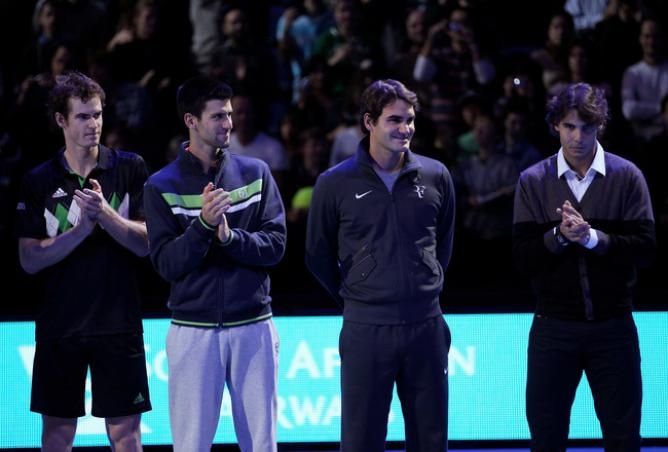
A recent article in a British Broadsheet claimed that the ATP’s Big Four had become the Big One and that the days of the Big Four were done. The Tennis Review, though, has other ideas- the Big Four was never about who achieved the most but about what they achieved together, and anyway, they split up a good few seasons ago.
The ‘Big Four’ was the label coined by the tennis media back in 2008 when a strange thing started occurring- the sight of the same four players, Roger Federer, Rafael Nadal, Novak Djokovic, and Andy Murray, competing in the last four of the game’s biggest tournaments over and over again.
That the top four should meet now and then in the semis of a Slam was not that odd, but that it should be every Slam was. The Greats had rarely found consistency across all Majors- Sampras had been missing from the French semis every year bar one, for example- so it seemed a remarkable feat that the game’s very best were the best right across the board.
The mystery of the Big Four’s dominance soon came to light, however- the same names in the last four of the Slam draws were competing with each other on very similar surfaces.
That surface similarity helped the Big Four along very nicely in becoming tennis’ most popular quartet. From the 2008 to 2012, they occupied the top four of the year end ATP rankings, and from Wimbledon 2010 to Australian Open 2012 they appeared in 6 of 7 Slam semi-finals. The one Slam semi they failed to all reach was the US Open 2010 when Andy Murray lost in the third round.
Murray’s name was the one missing from another important line up, too- the Slam winners circle. The Scot did make a final in that Wimbledon 2010-Australian Open 2012 stretch, (the Australian Open 2011), but he was the only Big Four member who during their 2008-2012 reign did not take home one of the Big Four trophies.
From the Australian Open 2008 to 2012, Nadal took home seven Slams, Djokovic five, and Federer four. The one remaining Slam trophy was won by Juan Martin del Potro at the US Open 2009.
That random run by the Argentine surpassed anything Murray- who did not win a slam until the US Open ’12- achieved in terms of silverware, but no one other than the big three could compete with the Scot consistency wise.
That consistency is what the Big Four were about anyway- it was never about winning the Slams. If it had been it would have the Big Three plus a cameo. But that would not have sold tennis’ biggest event’s semi-finals as the toughest possible competition, and, the Big Four at the Big Four had a catchy ring to it, too.
That ring, like every great hit does, faded out in the Summer of 2012 when an injured Nadal crashed out of the second round of Wimbledon. The other Big Four members kept winning slams, even Murray joined in, but the four were never back together again competing in the final four of Slams- Federer suffered a back injury in 2013, the year he, too, departed from the second round of SW19, and in 2014, it was Murray’s turn to suffer.
Finally, those injuries spells are over and at the end of 2015, all four of them are back in the top six, but only one member of what was the Big Four has been winning slams and been anywhere near the top of the rankings. That achievement has not ended the Big Four, though. That foursome ended a long time ago.
Commentary by Christian Deverille
 thetennisreview
Leave a comment