-
Nick Kyrgios Defeats Richard Gasquet in Open 13 Last Eight Hits 4 Aces to Win Final Game
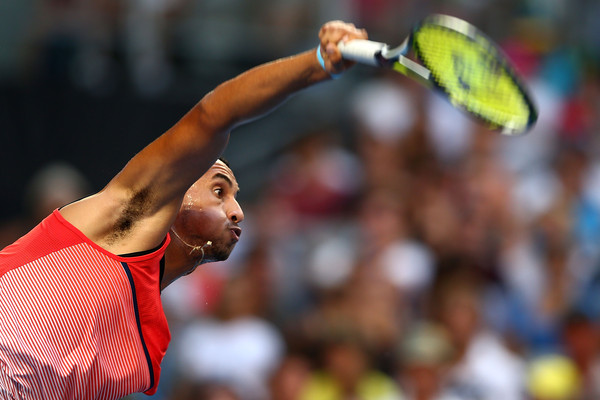
Photo courtesy of zimbio.com Nick Kyrgios hit the tennis headlines for all the right reasons today when he served four aces in one game as he served out for a comprehensive 6-0, 6-4 win over Richard Gasquet at the Open 13 tournament.
The Australian served his way into the semi-finals of the ATP 250 event- hitting 17 aces, getting 71% of his first serves in, and winning 96% of points behind that delivery (26/27 in total). The 20 year old also won 55% of his second serve deliveries, and did not face a single break point.
Gasquet has been a difficult opponent for Kyrgios over the years- the Frenchman led him 4-1 before the match including a controversial win at last year’s Wimbledon- but Kyrgios had no problems today as his service game, return game, and his overall ground game were all clicking on his way to winning an opening bagel set.
Gasquet was able to put up more of a fight in the second set, but Kyrgios grabbed a crucial break and then ended Gasquet’s hopes of breaking back to stay in the match in the most clinical way.
The world No 41 seemed to wrong foot the third seed on the first ace as the Frenchman moved to the backhand side for the return only for the serve to land on his forehand side in the third quarter of the service box.
The second ace was out wide, the third one was curved down the middle and the final one on match point went out wide, too.
That quartet of aces means Kyrgios is being talked about for his exceptional tennis skills rather than his on court dramas. The Australian, who became the first player since Roger Federer to make two slam quarter-finals before turning 20, has a big game which has defeated the likes of Nadal and Federer and is now many people’s favorite to take his first career title this weekend.
Kyrgios will now face second seed Tomas Berdych in the semis. The two met recently at the Australian Open when the Czech won pretty comfortably in four sets. Both men have shown good form this week and this match could be one that goes down to the wire. If Kyrgios can reproduce the kind of serving he did today, it could be time for some sweet revenge for the Australian.
Watch Kyrgios put together the perfect service game versus Gasquet in the Vine below.
-
Martin Klizan ATP 500 Rotterdam Title Run Five Things
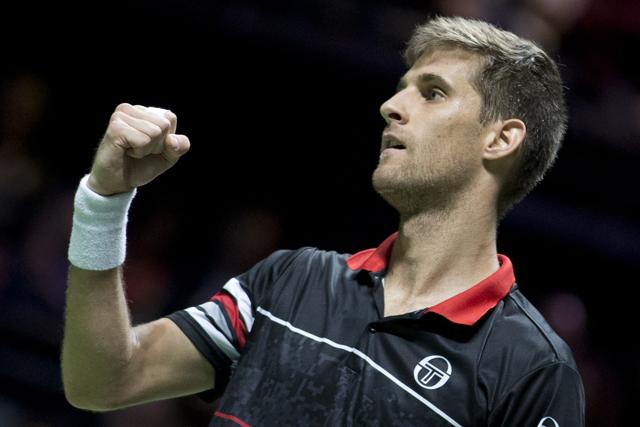
Photo courtesy of movietvtechgeeks.com Martin Klizan’s run to the ATP 500 Rotterdam title was one that showcased the Slovak’s fighting spirit, match winning forehand and his hunger for success. The Tennis Review looks at five points that made Klizan’s week in Rotterdam one to enjoy.
Martin Klizan saved 8 match points on his run to the final
Klizan did not lift his Rotterdam trophy without a few bruises along the way. The Slovakian came back from five match points down versus Roberto Bautista Agut in the quarters and then fought off three match points versus Nicolas Mahut in the semis.
Klizan, though, seemed to be having great fun in the heat of battle. In his semi-final win, Klizan made a name for himself not just as a Houdini, but also as a joker. During the second set tiebreak, the 26 year old hit a racket out of his opponent’s hand despite the point being over, did a forward roll after breaking Mahut when the Frenchman served for the match, and celebrated his eventual win by pretending to row a boat on the court.
Check out Klizan’s acrobatic skills in the tweet below.
Watch how happy Martin #Klizan is (very!) to break #Mahut as the Frenchman served for match https://t.co/kRsZ9udpkC https://t.co/rj8Y6AJR8x
— TennisTV (@TennisTV) February 13, 2016
//platform.twitter.com/widgets.js
Klizan came back from a set down in his last three matches
In both those matches, Klizan dropped the first set 6-7 before going onto win. The same scenario would play out in the final against Gael Monfils, though he would not have to save match points this time.
Klizan simply took control of the match at 3-3 in the second set, dropping just one more game on his way to a 6-7 (1), 6-3, 6-1 victory.
The title is the biggest one of his career
The Rotterdam 500 title is the biggest one of Klizan’s ten season pro career. The 2006 Junior French Open champion has won 250 titles in Casablanca (‘15), Munich (‘14), and St Petersburg (’12), but had never made it as far as an ATP 500 final before.
Klizan is 4-0 in ATP Finals
Klizan has never lost an ATP final. Compare his record to his opponent Monfils who is now 5-18.
In 2014, Klizan won the Munich Open as a qualifier. That streakiness, a quality seen throughout is career, is what had us at The Tennis Review picking him as the winner in a pool of Gael Monfils, Philipp Kohlschreiber and Nicholas Mahut in the semis. Once Klizan grabs some momentum, he has the skills, the mental toughness and the heart to run with it.
My gut tells me #Klizan is taking this. https://t.co/D7ABFlHQ3P
— The Tennis Review (@thetennisreview) February 12, 2016
//platform.twitter.com/widgets.js
That forehand, fighting spirit and hunger is going to take Klizan even higher
Tennis players peak older now, and Klizan, 26, is at the right age to hit his prime. He certainly has three of the biggest weapons you need to have a trophy laden couple of years- a big match winning shot, a love of competing and fighting, and the hunger to succeed.
Klizan’s forehand has been a major weapon in some big ATP wins- over Tsonga at the ’12 US Open, against Nadal in Beijing ’14, and versus Nishikori at Roland Garros ’14- and in some impressive contests which he lost but really pushed his rivals such as his 2014 five set loss to Tomas Berdych at the US Open.
That forehand is not just heavy and precise when he hits it in the right position for a winner, it is also full of shape and touch when he is on the run (See video below)
Knowing he can hit such a shot when in control of the point and when on the defensive is what is going to make Klizan a player to watch when he makes the business ends of slams and plays the big points.
Klizan’s hunger and fight can also be seen in his social media. His facebook below best says how much he wants success (well, second best after what he shows us on the court).
ATP ROTTERDAM,,V hlave sa mi pri tom neodohrávalo nič zvláštne, bolo to ako počas normálneho zápasu. Rozdiel je asi v…
Posted by Martin Kližan on Monday, February 15, 2016
In his Rotterdam trophy presentation ceremony, Klizan said he would not forget the moment. You have to think he will want to remind himself pretty soon, anyway.
Watch this space around the clay season and at Roland Garros. Klizan likes clay, he likes big matches, and he likes a crowd. There he will find all three and if he finds his game, he could find himself in the tennis big time.
-
Juan Martin Del Potro Delray Beach Comeback Fan Survival Guide
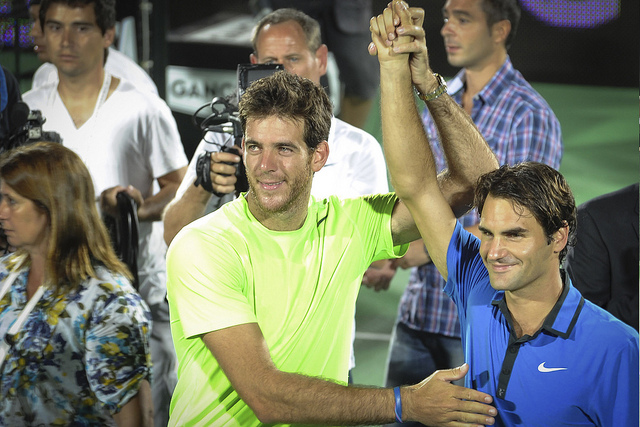
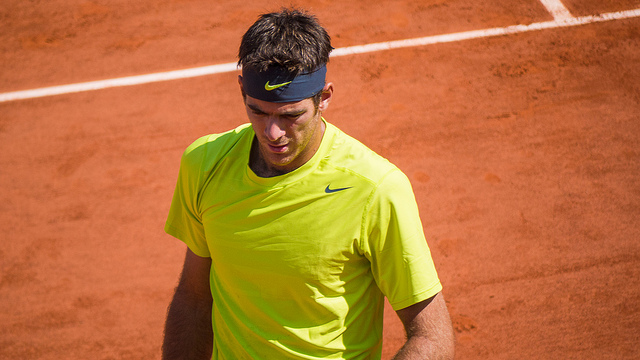
Photo courtesy of Yann Caradec @ Flickr.com (Creative commons) Juan Martin del Potro makes his long-awaited comeback from injury next week in Delray Beach. The Tennis Review gives you its del Potro comeback fan survival guide as his followers brace themselves for yet another return to the tour.
Have no expectations and enjoy the ride
del Potro fans know better than to have high expectations when it comes to comebacks so this is a word of warning for only recent fans.
The Argentine came back from wrist surgery twice last season- in Sydney and in Miami. In Sydney, he beat top seed Fabio Fognini before going down to Mikhail Kukushkin in the quarters, but despite the promising results, he looked very tentative on his backhand, and was forced to take another break from the tour until Miami where he was beaten by Vasek Pospisil in the first round.
del Potro has not played since.
Keeping that in mind, del Potro fans would be wise to just sit back and enjoy watching him on the court rather than getting their hopes up of a full time return to the tour, or even a part time one.
Even if del Potro’s comeback this time round is short, it will most likely be sweet. del Potro likes hard courts in hot conditions and likes Delray beach, too- he has played there once, and won the title in 2011.
Incidentally, that title was his first one after he won the US Open ’09 and a milestone on his road back to the top ten.
Take heart in how long it took him to decide to come back
Back last Summer, rumors did the rounds that del Potro would be back September time. That did not happen, but that could be a good sign.
This is not del Potro’s first serious injury. The Argentine injured his left wrist a few months after winning the US Open ’09, but came back too early to the tour at the Australian Open ’10, a comeback that harmed his career in the long term.
del Potro has been burned when it comes to come backs. His hesitancy this time round, and players who win slams aged 20 are pretty good learners, is an encouraging sign.
As is his regular communication with his fans. Tweets such as this:
Entrenamiento de hoy a 40ºC. Buen fin de semana!!
///
Today’s practice under 104ºF. Have a great weekend!! pic.twitter.com/FYbNpa5wjs— Juan M. del Potro (@delpotrojuan) January 22, 2016
//platform.twitter.com/widgets.js
and:
Parte del entrenamiento de esta mañana. // Practising this morning.💪 pic.twitter.com/GN75wB9yTH
— Juan M. del Potro (@delpotrojuan) January 7, 2016
//platform.twitter.com/widgets.js
show how hard he has been working to return to the tour, so he won’t be coming back unprepared, while tweets such as:
Aunque la cima se vea lejos, cada paso me acerca más.
Although the top looks far away, each step brings me closer. pic.twitter.com/arLN35o9u5— Juan M. del Potro (@delpotrojuan) November 18, 2015
//platform.twitter.com/widgets.js
are a testament to the passion he has for the game, getting back to the top, and his fans.
Remember he is one of only seven active slam champs
When he returns, del Potro will have the rare claim to be one of only seven active slam champs on the tour (Federer, Nadal, Djokovic, Murray, Wawrinka and Cilic are the others.) That is some pedigree, and at the fairly young age of 27 on the current ATP Tour on which Cilic, aged 26, is the youngest slam champ, his best years could still be ahead of him.
Enjoy that forehand
One of the best shots on the tour which whatever happens, fans will see at least for one match in 2016. Once del Potro gets into a rhythm, moves his opponent out of position, steps inside the court and then crunches a forehand winner, it will feel like he has never been away.
Words do not do it justice, so enjoy the video below.
Sit back and be charmed
Few players in tennis have the charm of del Potro. Expect plenty of smiles whatever the outcome from a player who gets plenty of love from his fans, and gives it back, and then some.
If this come back does not go well in the long run, and del Potro fans find themselves down in the dumps, a quick look at the smiling Argentine should be just what is needed to lift them back up.
Photo courtesy of Tigre Municipio @ Flickr.com (Creative commons) -
Dominic Thiem Defeats Rafael Nadal in Buenos Aires Semi-Finals Five Points
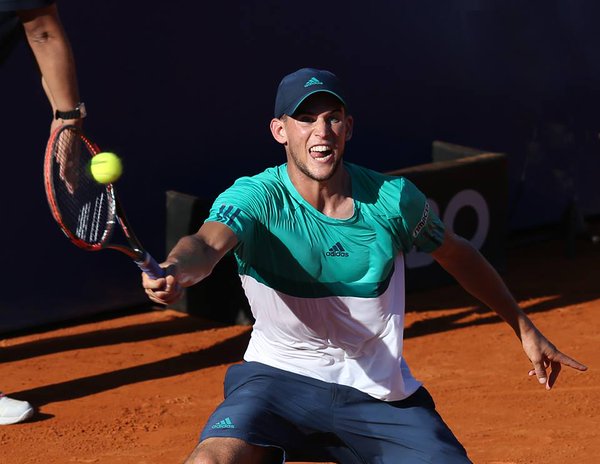
Photo courtesy of @TennisUpdateINA Dominic Thiem’s 6-4, 4-6, 7-6 (4) defeat of defending champion Rafael Nadal in the Buenos Aires ATP 250 semis was yet another breakthrough on the Clay for the 22 year old. The Tennis Review gives you five points about the win.
Thiem saved a match point
Fifth seed Thiem displayed his fighting qualities from the very start of the match against the top seed all the way to the final set tiebreaker.
The youngest member of the ATP’s top 20 came back from being broken in the first game of the match and then showcased his fine clay court skills to take the first set 6-4.
In the second set, Thiem was broken while serving to stay in the set at 4-5 and the match was level at a set all.
Thiem did not let Nadal grab the momentum, though. The 22 year old broke Nadal at the start of the third set, and then held serve to lead 2-0, but he could not hold on to the break as Nadal held serve and then broke back for 2-2.
In the third set, Nadal, with Thiem serving to stay in the match at 4-5, held match point. At that point, Thiem once more showed his fighting qualities. The 22 year old had played with great confidence and authority in the contest and displayed those qualities once more on the biggest point of the match as he struck a huge forehand winner to keep his chances of reaching the final alive.
This was Thiem’s first win over Nadal
Thiem then stayed with Nadal all the way to a third set tiebreak. Nadal handed Thiem a mini-break on the first point as he double-faulted, but the 22 year old did not need any more helping hands- Thiem served effectively and continued to strike the ball with great depth, pace and aggression to overwhelm the error prone and nervy Spaniard and race into a 6-1 lead.
Nadal, serving, saved the first two, and Thiem could not convert the third as he went for too much on a forehand down the line and sent it long.
On his fourth match point, Thiem served out wide with a lot of top spin, stepped inside the court, struck the forehand on the rise cross-court, moved up to the net, and watched as Nadal’s forehand passing shot attempt went long.
That gave Thiem his first win over Nadal and leveled the head to head at 1-1 (the Spaniard won their previous match in the Roland Garros second round in 2014).
This is not Thiem’s first win over a top 10 player- he beat then reigning Australian Open Champion and recent Monte Carlo winner Stan Wawrinka in the Swiss’ opening Madrid match in 2014.
Thiem has now won 13 of his last 14 clay matches
Thiem winning ATP clay court matches is nothing new- the Austrian won his first ever title on clay in Nice last year, and then in the Summer won Umag and Gstaad back to back before going down in the semis of Kitzbuhel to eventual champ Philipp Kohlschreiber.
That rich run of play, along with his general consistency on other surfaces, have helped Thiem rise to 19 in the rankings, and he hit a high of 18 on 2015.08.10.
Nadal is 6-3 for 2016
The loss means Nadal, who was beaten by Fernando Verdasco in the first round of the Australian Open, is now only 6-3 in 2016 despite being ranked 5 in the world and having played at a slam he has won and been to the final of, and playing at a clay tournament where he was defending champion. This poor start to the year comes as a surprise after what had been an encouraging run at the end of 2015.
Thiem is now 9-3 for the season
Thiem, on the other hand, has been having a great start to 2016. He made the semis of Brisbane, where he beat Marin Cilic before losing to Roger Federer, reached the Australian Open third round where he was defeated by David Goffin, and is now in his first final of the year.
-
Rotterdam ATP 500 What The Trophy Would Mean Gasquet Cilic Simon Monfils

Photo courtesy of Marianne Bevis @ flickr.com (Creative commons license) The ATP 500 Rotterdam tournament features a Federer less field, and one also lacking its defending champion Stan Wawrinka and its 2015 runner-up Tomas Berdych. That might not be so great for their loyal fans, but it is good news for the likes of Marin Cilic, Richard Gasquet, David Goffin and Gael Monfils who now find themselves with a great chance to grab a first ATP 500 title. The Tennis Review looks at each player’s chances and what it would mean for them if they won the trophy.
Marin Cilic: Runner-up 2014
Cilic’s trophy haul is an odd one- 13/14 of his titles have come at ATP 250 events, and his one other title is a Grand Slam (US Open ’14). He has made ATP 500 finals, though, including the 2014 Rotterdam one which he lost to Tomas Berdych, the Beijing ’09 and ’11 finals, and the ’09 Vienna final.
One reason for that odd title collection is his game can be quite hit or miss, and the five set format at slams gives him more time to work out the kinks. Another reason is that since Cilic’s 2014 US Open win he has been troubled by a shoulder injury, but his game looked to be getting back into shape last season after he reached the Roland Garros fourth round, the Wimbledon quarters, the US Open semis, and won Moscow.
The world No.13 has had a slow start to 2016. He was upset by Bautista-Agut in clinical fashion in the Australian Open third round, and became Alexander Zverev’s biggest scalp in the second round of Montpellier last week.
A slow start and a lack of form will not mean much to Cilic’s Rotterdam title chances- he can catch fire at any time and Rotterdam’s fast courts complement his big serve, mighty ground-strokes, and aggressive mindset.
A first ATP 500 title would start to balance out Cilic’s resume a little and help convince many he is more than a player who had a couple of spectacular weeks one September.
A first title of 2016 so early in the season would also set him up nicely for the rest of the year, and give him both the confidence and the winning feeling again which might propel him to a second slam title, perhaps at Wimbledon, a tournament he had made no secret of being keen to win.
Title chances: You cannot count out one of only seven active slam champs on the tour, and if Cilic’s game starts clicking then he is favorite for the title at a venue where he has had deep runs in the past.
It is a big if though. Cilic is is susceptible to upsets so he could go out in his first round or take the whole thing. Big servers like Denis Istomin, who he meets in round 1, and his potential second round opponent Gilles Muller, could outhit him in a serving contest in which matters would be decided on a point here and there.
In the quarters and semis, Cilic could be vulnerable to the consistency of Simon and the variety of Monfils, and in the final he might succumb to the all round talents of Gasquet.
You never know with Cilic, and that is part of the fun. But if he is on form, you can be pretty sure he will emerge from this field as the winner.
Richard Gasquet: Quarter-finals 2012
While Cilic’s slam success seemed to some a little out of the blue, Gasquet’s lack of it has been just as surprising. The world no. 10 was expected to join Rafa Nadal in the players most likely to take slams from Federer club before the likes of Djokovic and Murray were even in the conversation.
There is still hope that Gasquet, who had such a sensational start to his career beating Federer in Monte Carlo ’05, might be a late bloomer slam wise in an age when players reach their prime later than they ever have on the ATP tour. The Frenchman has emerged from what was a worrying period of passive play and, with Sergi Bruguera and Sebastian Grosjean on his team, has adopted a style more suited to his natural all court game.
Gasquet has been putting in strong performances on the tour’s faster courts since he defeated Wawrinka on his run to the Wimbledon semis last season and since then he has made the Cincinnati and US Open quarters, and the semis of Basel and Stockholm.
The French man pulled out of the Australian Open with injury but looked in great condition in Montpellier winning the title over strong indoor opposition, and it looks like the stars are aligning to bring him his first ATP 500 title in Rotterdam in an intriguing but mostly inconsistent field of which he might be the most solid member.
The former child prodigy, like Cilic, also lacks an ATP 1000 or 500 title. He has won ATP 250 titles, 12 of them, and made big finals in Canada (06, 12), and Tokyo (07), but has not been able to breakthrough.
An ATP 500 Rotterdam title would be his biggest title yet and as a result it could be the launching pad for Gasquet to make other breakthroughs on the tour, namely winning an ATP 1000 and making a slam final. The Frenchman has tons of experience, a game to trouble the very best, and you have to think, with an extra surge of self-belief the Rotterdam title might give him, he could finally make the kind of run his talent warrants.
Title chances: Very strong. Gasquet must be feeling good after his Montpellier title win this weekend. The fast courts will play to his strengths, and his strong defense means he can ask other aggressive players plenty of questions.
Gael Monfils: Semi-finals 2009
Monfils joins Gasquet as one of the ATP’s biggest underachievers, never having won a title above 250 level, but while you could not knock Gasquet for effort, there are plenty of questions about how committed Monfils, the tour’s ultimate entertainer, has been to winning and not playing around. The Frenchman seems to enjoy the applause he gets from one of his risky shots working out for him more than he does for holding trophies on final’s day- the world No.17 has been in 22 finals and managed just five titles, a baffling statistic considering his talent.
Monfils’ 2016 has been pretty representative of his career. He made the quarters of the Australian Open for the first time and then lost in his opening match in Montpelier, a tournament he has won twice, to 136th ranked Edouard Roger-Vasselin. On the positive side, that early loss will have given him some time to recover from his Melbourne run, and work on a few things.
If Monfils won the title, it would be a stellar start to the season, a breakthrough title wise, and, if he enjoys the cheers and platitudes a more prestigious title would bring him, he might think twice before choosing the showier shots on big points, go for the percentages, and play for even bigger titles more often.
Title chances: Mixed. Monfils loves indoor court with four of his titles won in those conditions, and he has been runner up twice at Paris-Bercy. But he will have to be at his best- he has a tricky opening round versus Gulbis and he has his nemesis Gilles Simon in his quarter. Simon has beaten him 6 times and lost once, and his last two wins came at last season’s Wimbledon and in the Marseilles ’15 indoor hard final.
Gilles Simon: Semis 2008, 2013, 2015
Simon must be feeling good after his strategy to hit down the middle and be more consistent than Mr consistency himself Novak Djokovic in the Australian Open helped him take the six time champion to five sets in the fourth round.
Simon’s game has taken him to 12 titles, five indoor, an ATP 500 trophy in Hamburg, and six finals including the 2014 ATP 1000 Shanghai final which he lost to Roger Federer in two tiebreaks. He is also a three time semi-finalist in Rotterdam so he will be feeling very comfortable.
Unfortunately for Simon, while he may be a nightmare match up for his projected quarter-final opponent Gael Monfils, he has his own nemesis Richard Gasquet, the top seed who is in tournament winning form, as a possible opponent in the semis.
Gasquet has defeated Simon 6 times and lost once, and those wins have all come on the tour’s quicker surfaces (Wimbledon, Dubai, Bangkok, Nottingham, US Open). However, the two have not met since 2012, match-ups can be turned round, and both are playing great tennis so if they met, it could be one of the season’s most thrilling contests.
The title would be Simon’s most prestigious, and after his Australian Open performance, would send out a clear message to the rest of the tour that he was one of the players to beat in 2016.
Title chances: Very good. Simon is a consistent player and will give himself chances to make the final. If he gets there, he has the indoor game, counter-punching skills and strategic smarts to get a 13th title.
David Goffin: Never gone past the opening round in two visits
Goffin is a huge talent- he made the last sixteen of Roland Garros as a lucky loser in 2012 where he took a set from Roger Federer- and has some ATP 500 success behind him, making the finals of Basel ’14, so he is not shy of the tour’s bigger stages.
The world No 16 and fourth seed is ticking along nicely, doing what he should be such as reaching the last 16 of slams- he beat Dominic Thiem on his way to the Australian Open fourth round where he lost to Federer- and making the Davis Cup final.
There is certainly potential for greater things, and last year in Cincinnati he hinted at them when he led Novak Djokovic 3-0 in the third set, but that match slipped from his grasp, as have others over the years, and that struggle to close out winnable matches will be tough to overcome if he does not get some big wins soon. Right now it is not overly concerning because he is still relatively new to the top tier of the sport, but if it becomes a habit, it will be a bad one.
While a run to the title in Rotterdam would not see him getting wins over the Big Four or Wawrinka or Berdych, he would likely have to beat some very successful and talented players which, along with a prestigious trophy, would make that next lead over an elite player that much easier to hold.
Title Chances: Goffin has a nice draw and should do well here. He has the all court game, aggression and athleticism to make the final, and it does feel like it is his time to make a leap forward in his career. An ATP 500 title would be the next logical step.
Other contenders:
Roberto Bautista Agut
Bautista Agut upset Cilic in Melbourne and nearly did the same to Berdych, and he is the recent Sofia winner, beating Troicki in the final, so this consistent and steely competitor will be one to beat.
Alexander Zverev
Coming off a big win over Cilic last week in Montpellier, Zverev has the depth and pace of shot to do well indoors, and it feels like he has momentum right now. He has a tough prospective second round against Simon though who will make him run, and on the indoor courts that won’t be that comfortable for the 198 cm tall wild card.
Viktor Troicki
Troicki started off the season beating an in form Grigor Dimitrov for the Sydney title, made the Australian open third round, and was the recent runner up in Sofia. Match tough, a great match player, and in solid indoor form, Troicki could take the title if he gets his game going.
Ernests Gulbis
Gulbis may be having to get through qualifying to get into ATP 500 main draws, but he is getting through them, and it will only take a big win to get him on one of his streaks. If he does it here, the title could very well be his.
Who do you think will lift the ATP 500 Rotterdam trophy? Share your views with us in the comments below.
Liked this article? Share and help us get read 🙂
-
Novak Djokovic Outplays Andy Murray to Win Sixth Australian Open Title
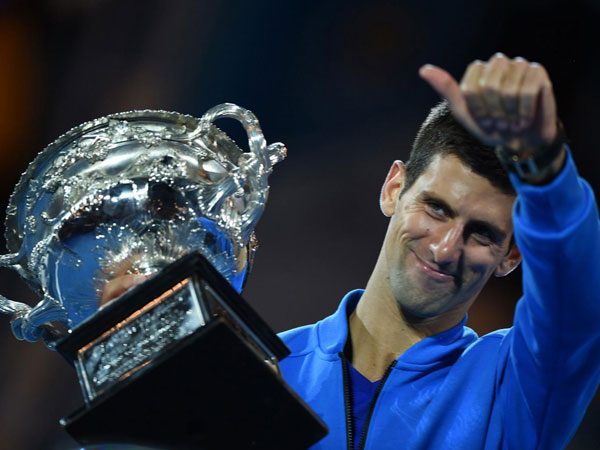
Photo courtesy of anninhthudo.vn Novak Djokovic’s (1) 6-1, 7-5, 7-6 defeat of Andy Murray (2) in the Australian Open final brought the world No.1 his sixth Australian Open title and his 11th overall. The Tennis Review takes a look at how Djokovic proved himself to be the most modern, the mentally toughest, and the most eloquent of champions.
There is something poetic about Novak Djokovic, the most modern of players, making the Australian Open, the most modern of slams, his own. The Australian Open- the first slam to have roofs and which sells tickets to the final online rather than through ballots-is about as modern as a slam gets, and Novak Djokovic is about as modern, game-wise, as they come.
The Serbian has now won six trophies at the ‘Happy Slam’ (2008, 2011, 2012, 2013, 2015, 2016), and is now the holder of 11 slams in all, tied with legends Rod Laver and Bjorn Borg, which means the Australian Open, like Wimbledon with Sampras and Federer, and Roland Garros with Bjorn Borg and Rafa Nadal, has an all- time Great who has won six or more titles at the event in the Open era.
The Serb has perfected the modern style of tennis that current slower hard court conditions such as Plexicushion on the Rod Laver Arena at night command – an athletic, relentless style which he showcases by running balls down, sending them back with his superb hands wherever he thinks they will serve him best, and then, when he finds himself in the right position, letting loose his brutal, deep and unforgiving ground strokes, particularly on that most modern of stroke, the double-handed backhand, to take control.
Those 21st century qualities were all on display in the first set of the 2016 Australian Open final between the top two seeds. Both Djokovic and Murray are experts of the modern games, but some experts are better than others, and in this contest Djokovic tends to have more answers than the Scot when the rallies go into double digits, his ground-strokes that bit more penetrating, that touch more consistent, and, most crucially, his head much more screwed on (he led Murray 21-9 overall and 4-0 in Melbourne before the match).
That general superiority was seen early on in the first set when Murray failed to covert a break point in the first game- and the modern game is now as much about the return as the serve used to be- only for Djokovic to take his break point chance in the second and convert it. The world No.1 did not look back and wrapped up the first set 6-1 in 33 minutes, continuing where he left off with his defeat of Roger Federer in the semi-finals.
One thing that has not changed about tennis, though, is that the mental side accounts for 80 percent of the game, and the technical side about 20. When Murray’s plan B to hit out began to pay off – the only plan that really stands a chance versus his old rival but which seems to take him a while to adopt- and he stopped feeding Djokovic balls to hit at will, and gave him nothing to work with instead, the Serbian’s level dropped, Murray got him deep into the second set, and it looked like the world No.2 was not just filling up the numbers but was actually challenging for the top spot and the big prizes.
However, though the technical side of things might not have been working for him, Djokovic’s mastery of the mental side of things never faltered, and it was that aspect of the match, that strength of the world No.1, which made the difference.
While the Scot growled and shouted expletives at his box when points did not go his way, despite the fact he was doing much better than many had predicted for him, Djokovic kept calm – you could not tell if he was leading by a set or struggling in the second- and at 5-5, Djokovic went from being at best consistent to being at times brilliant, one backhand down the line on the run winner will go down as one of the shots of the fortnight, notably on the big points. The world No.1 took control of the game from Murray, who led 40-0, breaking Murray and his spirit to take the set 7-5 in 80 minutes.
Djokovic had done what he does so well the past couple of years- he had ridden out his rival’s purple patch, kept himself in it, and then hit another gear when the chance came. He went with the momentum in the third, breaking Murray for 2-0, and looked to be in cruise control.
Djokovic, however, though it seems otherwise at times, is not perfect, and, as we saw in his previous matches versus Simon and Nishikori he is vulnerable to his opponent’s level, so when Murray began to spray more errors, especially on the forehand as he pulled the trigger way too early way too often, Djokovic made more errors, too (both men would end the match with more errors than winners- Djokovic with 31-43, and Murray with 40-65). The Scot broke back, the match got as messy as they get with these two, and Murray stayed with the defending champion until the tiebreak.
The first two points of the breaker symbolized the general play and purpose of both these men, one of them trying to extend his record of Open era titles in Melbourne to six, the other trying to put an end to a run of four losing finals – Murray opened with a double fault while Djokovic started his serving account with an ace for 2-0.
That was all Djokovic needed to take control and he flew through the breaker, helped along by another Murray double-fault. At 6-3 and serving on his third championship point, Djokovic ended the breaker as he started it, sending down another ace, joining Roy Emerson at six Australian Opens, and breaking his own Open era record.
As if being the best player in the world, and the most decorated player at a slam was not enough, Djokovic then showed us what a great ambassador he was for the sport, giving an eloquent trophy acceptance speech that paid tribute to all the qualities that made him and the Australian Open the best in the modern business of tennis- hard work, purpose, and, most of all, a passion for the sport to get up everyday and give your very best. Djokovic, like his favorite slam, not only gives it- they live it, too.
What did you think of the match? Let us know in the comments box below.
-
Australian Open 2016 Final Preview Novak Djokovic Vs Andy Murray
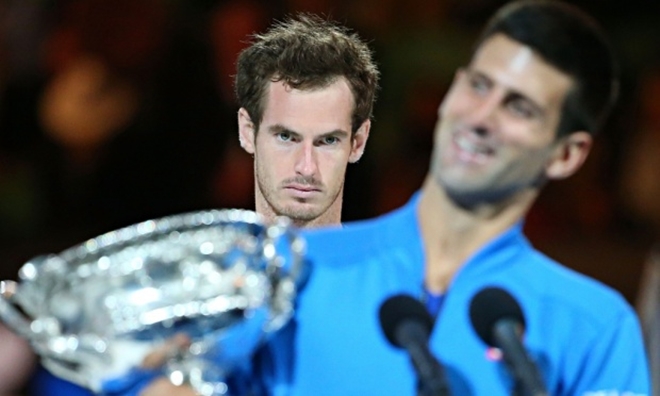
Photo courtesy of vietbao.vn Novak Djokovic (1) and Andy Murray (2) will meet in the Australian Open final this weekend for the fourth time in the last five years. The Tennis Review asks if five time champ Novak Djokovic is going to beat four time runner up Murray once again or if the Scot will finally win that elusive title down under.
Head to head: Djokovic leads Murray 21-9 overall, and 4-0 in Melbourne. The world No.1 has beaten Murray in three finals (2011, 2013, 2015) and in one semi (2012).
Djokovic has been dominating Murray of late, losing to him just once in their last ten matches.
What’s at stake: The world’s Nos 1 and 2 have contrasting records in Melbourne- Djokovic holds the one for most titles won in the Open era (5) while Murray has the record for the most runner-up plates (4).
If Djokovic reaches six titles at the Australian Open, he would tie Roy Emerson for all time trophy wins down under, and would have 11 slams, tying him with Bjorn Borg and Rod Laver. That status would also put him firmly in the Greatest Ever debates.
If Murray wins, he would end any discussion about his world No.2 status, and would have three slams at three different events. Most importantly, though, he would end his record run of losing finals in Melbourne.
Form going into the final: Murray was pushed to five sets by Milos Raonic in his semi, and was a little lucky the in-form Raonic, whom he was 3-3 in their head to head with, got injured.
Prior to that match, Murray had been doing what he does best- getting the job done, beating Bernard Tomic in straights in the last sixteen and defeating David Ferrer in four in the last eight.
Djokovic was a little patchy on his way to his semi-final meeting against Roger Federer. The Serbian hit 100 errors in his match with Simon in the fourth round, and hit 27 errors to 22 winners in his three set quarter-final win over Kei Nishikori. However, neither player gave Djokovic much to work with, Simon’s lack of pace and consistency and Nishikori’s error-strewn performance drawing more errors from Djokovic than is usual.
Djokovic did not disappoint against Roger Federer, though, beating the third seed in four sets. The world No.1 really saved his best tennis for his most dangerous opponent, playing his best from the get-go, and his depth of shot and heavy hitting kept Federer pinned to the baseline and in his hands. The defending champion did have a little bit of luck in the fourth set when a lucky net cord went his way and gave him break point for 5-3, but if anyone has earned a bit of luck, it is the man who has has won the most Australian Open titles (2008, 2011, 2012, 2013, 2015) in the Open era.
Who is the favorite?: There has probably never been a heavier favorite in grand slam history than Novak Djokovic in this weekend’s Australian Open final if you consider the tennis he showed versus Federer and his record versus Murray.
Andy Murray can win if: The Scot cannot beat Djokovic in a big match the way Federer or Wawrinka can with their naturally aggressive games. But he can change his game to be more aggressive and get the big wins such as he did at the US Open ’12 and Wimbledon ’13 when he defeated Djokovic for the titles, and to some extent the way he played versus the Serb in last year’s Montreal final.
The second seeded Scot has to have a high first serve percentage, be aggressive on his second, improve his return game which is one of the game’s best but has been inconsequential versus Djokovic in recent matches, play aggressively, attack with his forehand and hit behind the Serb. That is not Murray’s natural game, but if he tries to outhit Djokovic from the baseline and is too defensive, he basically plays into the Serb’s hands, gives him the rhythm he thrives on, and the world No.1 wrestles control and runs away with the match.
Murray has to do what he has done on only a few occasions in big matches- go out of his comfort zone, move inside the court when the chance arises, create those chances, and take time away from the player who is better at controlling it than anyone else. He also has to stay calm, channel his anger positively and not get wound up once Djokovic starts to work his way into his head like he did in last year’s final.
Being aggressive and staying positive- it does not always work for the Scot, even when he tries his best, but when it does, it pays dividends, and it is the only chance he has to put an end to his unfortunate record on the Rod Laver Arena and his rival’s much more impressive one.
Prediction: We know Murray can beat Djokovic, but there is no evidence to make us think it is going to happen this weekend. All the signs point to Djokovic to win, and to most likely do it in four sets.
Do you think Novak Djokovic will win a historic sixth Australian Open trophy or do you think Andy Murray is going to finally win the title? Let us know in the comments box below.
-
Australian Open Semi-Final Novak Djokovic Defeats Roger Federer Four Things
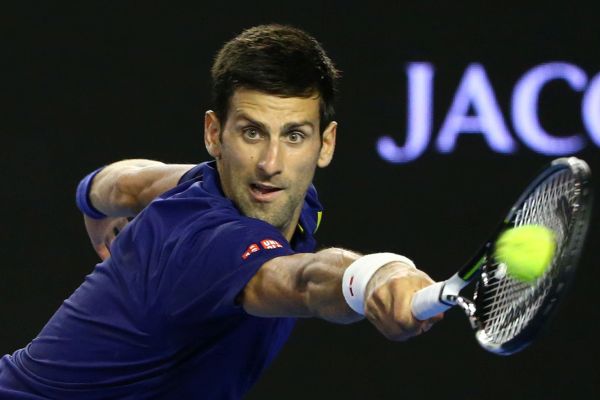
Photo courtesy of derbi.mk Novak Djokovic flattered Roger Federer in the most brutal way, saving his best for his Australian Open semi-final versus his old rival. The Tennis Review looks back at the world No.1’s dominant display.
This is the first time one of their Australian Open matches has gone beyond straight sets
Djokovic’s 6-1, 6-2, 3-6, 6-3 win was the first time one of his matches with Federer down under went beyond straight sets. Federer won the first in three in the 2007 fourth round and Djokovic took the 2008 and 2011 semis without dropping a set.
This match looked like it might go the way of their previous encounters when Djokovic ran away with the first set to the loss of just 11 points in 22 minutes and then dominated the second set 6-2,
Djokovic saved his best for Federer
Federer had to fight hard to make a match of it. The world No.1, who hit 33 winners to 20 errors over the course of the match, struck the ball with such depth and weight that for the first two sets Federer was never able to impose himself and found himself the victim of Djokovic’s rhythm as his defensive skills played into the hands of the Serb.
Djokovic return was brutal, too- he won 6/7 points off Federer’s second serve in the first set, and 8/12 in the second. The world no.1 was also serving at his best. Though his first serve percentage was low in the first set- 51- he won 91 percent of those deliveries, and 6/10 of his second serves. In the second, his serve got even better as he made 74 % of first serves in, won 86% of them, and was successful on 4 of the 5 second serves he struck.
The world No.1 could not keep his sublime level going, though, and as his errors increased and his depth and heaviness of shot dropped off, Federer fought back with better serving and improved returning, saving break point at 2-2 with a smash and then breaking for 4-2 with a cross-court forehand hit mid-court that forced a Djokovic error.
The Swiss then held his next two service games to take the third set 6-3 and started the fourth where he left off, getting to 0-30 on Djokovic’s serve in the opening game.
The Swiss could not keep his momentum going, however, and missed three second serve returns in a row, a surprise considering he had won 6 of 9 points on his second serve return in the third set, to trail 0-1 in the fourth. The Swiss did not let it get to him, though, and a pumped up Federer stayed with Djokovic right into the heart of the fourth set.
Leading 4-3, and returning, Djokovic had a little piece of luck, and if anyone has worked hard to get some it is him, when his passing shot hit the net cord and tore past Federer, earning him break point. The Serbian did not waste his chance, converting for a 5-3 lead with a ripping return that forced an error.
The defending champion then served out the match, a huge forehand on match point forcing an error off the Federer backhand to grab his third win over the Swiss in the last three slams.
Djokovic leads the head to head for the first time
Djokovic was tied 22-22 with Federer in their head to head prior to this match, and in all his long history with the Swiss he had never managed to lead their head to head. On the previous occasions when Djokovic had the chance to get ahead for the first time, such as in Cincinnati and in the WTF Round robin stage last season, the Serbian had failed, but this time he finally managed it.
The win means Djokovic is now ahead of his all top five rivals in their head to heads- he leads Rafael Nadal (24-23), Andy Murray (21-9), and Stan Wawrinka (20-4).
Djokovic will now play his sixth Australian Open final
Djokovic is already the record holder for most Australian Open titles in the Open era, and will be the heavy favorite to extend that record this Sunday. The Serbian will face either Andy Murray, whom he has beaten in all four of their encounters in Melbourne, including three finals, or Milos Raonic whom he has never lost to and who would be making his slam final debut.
For either Murray or Raonic, making the final might spark mixed feelings- if making an Australian Open final is the stuff players dream of, facing Novak Djokovic in the final, in the form he has shown against Federer, is what nightmares are made of.
Let us know your thoughts on the match in the comments box below
-
Australian Open Semi-Final Preview Novak Djokovic Vs Roger Federer
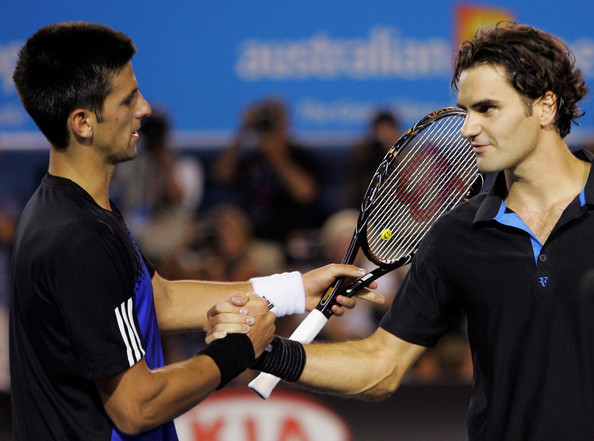
Photo courtesy of zimbio.com Novak Djokovic (1) and Roger Federer (3) will contest a highly-anticipated Australian Open Semi-final this Thursday. The Tennis Review previews the match and predicts the winner.
This is their third match in Melbourne and Djokovic leads the series 2-1
Back when Federer won their first match in Melbourne in the 2007 last sixteen in straight sets, the Swiss was the dominant world No.1 and reigning champion while Djokovic was ranked 15 and had never been beyond the first round in his previous two visits down under.
A year later when they met again, Djokovic was a very different player having made his first Slam final at the US Open (lost to Federer), had beaten Federer on his way to the ’07 Canadian Masters title and had climbed to world No.3. On a surface on which his aggressive baseline game thrived, the Serbian beat Federer in straights on his way to his first slam title.
The two would not meet again on the Rod Laver Arena until 2011 when once again Djokovic, at the beginning of what would be one of his best seasons ever, defeated Federer without dropping a set.
Djokovic has never lost an Australian Open Semi or Final
No one in the Open era has won more Australian Opens than Djokovic and once he gets to the semis or final he does not lose. The only times he has lost since winning his maiden title down under have been in the quarter-finals to Andy Roddick in ’09, Jo-Wilfried Tsonga in ’10 and to Stan Wawrinka in ’14.
But while Djokovic in the last four of the Australian Open is a daunting prospect for his rivals, Federer will still benefit more from meeting him there than in the final.
Slam championship matches, and finals in general, is where Djokovic has tended to play his best tennis since Wimbledon ’14, and if you are going to catch him out, then the matches before the final are your best bet.
Slam semis are also where Federer has played his best tennis at the Majors recently- check out his 2015 Wimbledon win over Murray and his 2015 US Open defeat of Stan Wawrinka. Without the extra pressure of a slam championship match in which he would be trying to win that elusive and historic 18th slam, Federer can relax and play the kind of free-flowing tennis he needs to produce on the big points.
This is the third consecutive slam they have met in
In the last two slams, Djokovic and Federer have met as the number one and two seeds.
Djokovic and Federer met in the Wimbledon and US Open finals with Djokovic winning each time in four sets, riding out Federer’s purple patches, and raising his own level when the Swiss’ dropped.
The US Open is where Federer had the best chance of a win- earning 23 break points- but he could only convert 4 of them, and made some critical errors on the attack on big points.
Both men had contrasting straight sets win to reach the last four
Federer was very impressive in his straight sets defeat of Berdych winning 83 % of the 69 % of first serve he delivered, claiming 24 of 29 points at the net, and striking 48 winners to 26 errors. The Swiss also took risks on the return and won 5 out of 10 break points.
Djokovic may not have been as impressive as Federer quality-wise, but he was impressive mentally in the way he handled a sub-par Kei Nishikori. The Japanese may have brought down Djokovic’s level (the Serbian made 27 errors to 22 winners), but the world No.1 still won in straights, raising his game as the match came to a close, against an opponent who was expected to trouble him.
Neither Federer’s or Djokovic’s quarter-final wins really reveals much about what will happen in their Semi, however. Federer matches up well with Berdych-he leads him 16-6 and has not lost to him since Dubai 2013- while Kei Nishikori never demanded Djokovic play his best.
In fact, Djokovic’s poor play up to now might benefit him in the long run- the Serbian has not been close to peaking, and can only get better. He will have to against Federer who will likely play the high quality tennis that will demand the Serbian raises his level.
Federer’s serve and attack will be going up against Djokovic’s return and aggressive baseline game
Playing his best on hard courts against Federer has been Djokovic’s biggest challenge the past year or two. While the world No.1 has some big wins on hard versus the Swiss since Federer committed to his current brand of attacking tennis in 2014 with victories in New York, Indian Wells (twice), and the ATP WTF, Federer has gotten 6 of his 7 wins over the last two seasons against Djokovic on hard- twice in Dubai, twice in Cincinnati, once at the ATP WTF, and once in Shanghai.
Against Djokovic on hard, Federer will mix things up, take charge of inside the court and the net, and win a lot of free points on his serve, not allowing Djokovic to get into any rhythm on his return or his ground game.
When Federer plays his best attacking tennis and wins the first set, he can beat Djokovic, and the Swiss has said he believes the Australian Open’s plexi-cushion surface allow him to produce that kind of tennis.
Going up against an opponent as in form as Federer on hard, and with his current self-belief, is going to be tough for Djokovic, but the Serbian will have one big advantage.
The night time conditions will favor Djokovic
Federer’s serving and his attacking game will be a little offset by the slower night time conditions that favor Djokovic so much, and those little things can make a big difference in these high stakes matches.
The Serbian loves the extra bit of time he gets to track down balls and hit a winning passing shot or force an error or to hit one of his penetrating ground-strokes in whichever direction he desires. Those qualities are his strengths and nothing brings those out more than a night time match on semis or finals night on Rod Laver.
Prediction
Federer will have to play great, will have to take charge early, and will have to be quick. The Swiss can do all that, but as Gilles Simon and Kei Nishikori brought down Djokovic’s level, Federer’s will make him raise it. Expect Djokovic to be focused, business like and to work his way into the Federer game, and into another Australian Open final.
Who do you think will win the Djokovic-Federer Australian Open semi-final clash? Let us know in the comments below.
-
Australian Open Fernando Verdasco Defeats Rafael Nadal Five Points
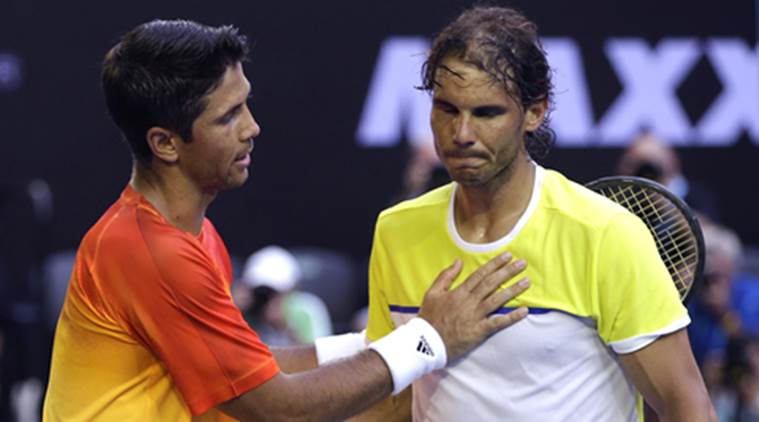
Photo courtesy of http://www.indianexpress.com Fernando Verdasco’s five set victory over Rafael Nadal in the Australian Open first round was a headlining result for many reasons. The Tennis Review gives you five of them.
Verdasco was one of the most dangerous unseeded players in the draw
A former top tenner and Australian Open semi-finalist, Verdasco, ranked 45, was one of the most dangerous unseeded players in the draw.
The fact Verdasco had not won back to back matches since Wimbledon did not matter. What really mattered was that he had won back to back matches at Wimbledon, and beat rising star Dominic Thiem and big-hitting Martin Kilizan (13-11 in the fifth) on his way to the last 32 there.
Verdasco is a big match player, has over 12 years of experience of playing five set matches at slams ( he has a 90-51 win-loss record), and has a long history of playing elite players on big slam stages. He is not the kind of player you want to see opposite you in the nervy circumstances of a Grand Slam first round.
Nadal had been getting better results the past six months and was expected to make the last eight at least
Rafael Nadal is nowhere close to where he was the last time he came up against Fernando Verdasco at the Australian Open in 2009. Back then he was world No.1 and the reigning French Open and Wimbledon champion.
The Nadal who Verdasco beat in Melbourne this Australian Open was ranked no. 5, had not won a slam since Roland Garros 2014, and had not made it past the quarters of one since then.
He is a lot better, however, than when he met Verdasco back at the Sony Open last season when he lost in three sets, losing only his second match to his countryman in 16 matches.
Since that Miami loss, Nadal recovered from a heavy defeat to Djokovic at the French Open, another early Wimbledon loss, and his first loss at a slam from two sets to love up when he went down to Fabio Fognini at the US Open. Nadal got his game in good enough shape to take a set off Federer in the Basel final back in October and by the end of the year had gotten back to the top five and ended the season with ATP WTF wins over Wawrinka, Murray and Ferrer.
More recently, he had been to the Doha finals. That last match though was not a confidence boosting one as Djokovic beat him 6-1, 6-2.
This is not the first time Nadal has gone down in a slam outside of the French Open to a big hitting aggressive underdog
If Nadal was a little shocked by the severity of his Doha Djokovic defeat then the last type of player he needed to meet on a hot day on a hard court was the big hitting, aggressive kind. The kind similar to Dustin Brown or Lukas Rosol. The kind who have a tendency to knock him out of Slams in the early rounds.
Fernando Verdaso was certainly aggressive- he struck 90 winners in a high risk approach, particularly on the forehand and mid-court which also saw him hit 91 errors. Verdasco also served 20 aces and won 25/27 net points. That’s about as aggressive as it gets, and more than Nadal, whose overly defensive game has gotten him into trouble many times on a hard court, can handle.
This was the first time Nadal has gone out in the Australian Open first round and a Hard Court slam’s opening round.
Nadal’s only other first round defeat at a slam was Wimbledon 2013 when he lost to big serving big hitting Steve Darcis whose efforts left the Belgian injured and unable to play his second round match.
Only his second first round loss in
44 slam appearances- that is all that needs to be said about Nadal’s form now compared to back when his losing in the first round was something that was simply unheard of.Rafael Nadal might need to change his coach.
The sight of Nadal chasing Verdasco winners as that 2-0 final set lead vanished before him told you how helpless he was. You only had to watch Nadal’s press conference to see how shocked he was he had gone out to a man who was supposed to test him not upset him.
The confidence, if it had come back at all, was now back to where it was around the time of his US Open defeat to Fabio Fognini. How Nadal is going to rebuild his A game-the steady at times dangerous serving, the aggressive forehand down the line, the pinpoint accuracy of his ground strokes- is going to be interesting to say the least. Is he going to keep trying to put back together a game that lately so easily falls apart or will he do what Djokovic and Federer have done- bring in a new coach to develop the aggressive sides of their games.
Most likely Nadal would keep Uncle Toni, his lifelong coach, as his boss. Another one is unthinkable it seems. But so was, to many, Nadal losing in the first round of this year’s Australian Open.
What do you think was interesting of the Verdasco defeat of Nadal in the Australian Open’s first round? Let us know in the comments below.

Tennis from a fan's point of view
[
[
[
]
]
]
 thetennisreview