-
US Open Men’s first round upset potential
I’d say there are a fair few potential upsets in r1.
Shevchenko over Norrie
Baez over Coric
Mmoh over Khachanov
Berrettini over Humbert
Fucsovics over Korda
Carbelles Baena over Rune
Raonic over Tsitsipas
McDonald over Auger-Aliassime
Nakashima over Djere.
-
US Open Women’s Preview – Another slam up for grabs.
Being out of the loop for a while, I’m not really the best person to write a women’s preview but I’m going to have a go. Mind you, me being out the loop means not watching tennis 24/7, posting every day and dreaming about the game. I’ve still been keeping an eye on things so read it anyway! I stopped covering the women’s game several years ago to focus on the men’s, but the women’s game is actually more interesting for me lately.
Some things I do know about the field right now:
- Iga Swiatek is struggling, suffering SFs losses in Canada and Cincy to opponents she was dominating.
- Rybakina hasn’t gotten back to her pre RG form. Elena was doing so well up until that virus. She was very off in her Wimbledon QF and had to withdraw in Cincy. She did win 3 matches in a row in Canada and might have won it had it not been for the scheduling only for injury to crop up once more in her next event.
- Coco Gauff is on the up. Gauf beat Swiatek in Montreal and went on to win the title. Also won Washington.
- Sabalenka is…still Sabalenka. Buyer beware. She should have won the Wimbledon semi. She had a decent lead in to NYC but lost to Samsonova and Muchova, players she’d be beating if she was feeling good.
- Vondrousova is still a wild card. She did fairly okay in Canada and Cincy, losing to Gauff and Swiatek and going 5-2, but she lost those matches fairly tamely. I feel like anything could happen with her this USO.
- Things are very open. One thing I noticed looking at the men’s draw is how much tougher the women’s field is. No one has a cakewalk and anyone could be upset. Sections are crammed with seasoned vets, proven seed slayers and players who’ve gone deep in slams.
Let’s look at the draws:
Swiatek:
1r Peterson
2r Ngounoue/Saville
3r Cocciaretto
4r Kurdermetova (Ostapenko and Cornet lurking)
QF Gauff
SF Rybakina
F Sabalenka
Upset potential: Above average. This is a fairly tough draw from the fourth round on. In fact, the second and third are not cakewalks. Gauff in the quarters is worse than Gauff in the semis. There’s less pressure on the American. If Rybakina is in the semis that means she’s healthy. Oh dear, Swiatek is out of favor with the draw Gods.
Gauff:
1r Qualifier
2r Qualifier/Andreeva
3r Mertens (Collins lurking)
4r Kvitova (Linette lurking, Brady and Wozniacki present)
QF Swiatek
SF Rybakina
F Sabalenka
Upset potential: Gauf will have her hands full from the second round on if Andreeva gets there. Gauff couldn’t escape the spotlight if she tried and if she faces Andreeva-Collins-Kvitova-Swiatek, she’s going to be playing on AA under the lights every night. Gauff has it tough.
Sabalenka
1r Zanevska
2r Blinkova/Burrage
3r Pliskova
4r Kasatkina (Vekic, Badosa, Kenin, Venus Williams lurking!)
QF Jabeur (Krejcikova, Podoroska, Zheng lurking)
SF Pegula (Vondrousova, Keys, Garcia lurking)
F Swiatek
Upset potential: An interesting draw. Kenin would be a tough match. Nothing too dangerous here, though. Arguably has the safest passage of the top seeds.
Jabeur did beat her at Wimbledon. But I don’t see Jabeur getting that far. She seemed pretty broken after her SW19 final loss and I think she might need more time.
So…expect a random upset.
Rybakina
1r Kostyuk
2r Tomljanovic/ Udvardy
3r Cirstea (Kalinskaya lurking)
4r Bencic (Azarenka lurking)
QF Sakkari (Muchova, Stephens lurking)
SF Swiatek
F Sabalenka
Upset potential: Red alert! High chance of a first round upset here. Kostyuk is a dangerous, seasoned opponent. Tomljanovic is incredibly wily. Cirstea, too. Good luck Elena! You’ll need it.
Vondrousouva
1r Qualifier
2r Putintseva/ Trevisan
3r Alexandrova (Tsurenko, Fernandez, Andreescu lurking!!)
4r Garcia
QF Pegula
SF Sabalenka
F Swiatek
Upset potential: Very high. Her section has plenty of banana skins. The typical narrative is the most recent debut slam winner goes home early and there’s plenty of competition to assist Marketa in following this script.
-
US Open Men’s Preview – Is the takeover on the cards?
I am hesitating to get too excited about a takeover at the top of men’s tennis. We’ve had some false starts such as Thiem winning the USO ’20 and Medvedev winning the USO ’21.
Alcaraz has proven to be a much surer thing. He backed up his USO ’22 title with the YE No.1 and Wimbledon ’23.
But with Djokovic also holding two slams and about to take over No.1 and winning their last match, it’s still his era. Alcaraz would need to defend his USO title to really say we’re entering Carlitos time now.
Djokovic’s win over him in Cincy adds some doubt as to whether Alcaraz is going to do just that.
If Alcaraz did win, though, the start of the Carlitos era would be undeniable – he’d have three of the last five slams, which starts to sound like dominance to me.
It’s hard to speculate much on what will happen before we see the draw, so I’ll update this when that’s out.
Okay-the draw is out. Here’s a breakdown of Djokovic and Alcaraz’s paths.
Alcaraz
r1 Koepfer
r2 Harris/Pella
r3 Evans (23)
r4 Norrie (16)
QF Sinner (6)
SF Medvedev (3)
Upset potential? Sinner could do it. He and Alcaraz had a great match last year. These two are tied at 3-3 in the h2h and this match will be one to watch.
Otherwise, it’s a pretty comfortable route to the final.
Djokovic
r1 Muller
r2 Zapatta Mirelles/ Quinn
r3 Djere (32)
r4 Auger-Aliassime (15)
QF Tsitsipas (7)
SF Rune (4) (Ruud, 5 lurking).
Upset potential? None. This is as good as a draw as it gets, particularly with Rune being injured.
Auger-Aliassime is there, but he has not been in good form at all. If he can somehow resurrect his career in the next two weeks, then that would be a match to enjoy.
Other contenders
The past few years it’s felt like a real waste of time speculating on this. And with Alcaraz and Djokovic being so far ahead of the rest, it still does. But, seeing as I’m doing this, here we go:
Sinner. He just won Montreal. He’s very much due a breakthrough at slams. He did make the Wimbledon semis, but it seemed like one step forward, two steps back.
He also quite enjoys beating Alcaraz. Goes into his shell a bit with Djokovic, though. And he’d likely have to get through both to win the tournament.
Draw: Faces Alcaraz in the quarters.
Has some interesting players in his section- RG quarterfinalist Etcheverry, Wawrinka, and Nishioaka. Potential second round match versus Sonego. Quite a hard draw for a top 8 seed.
Rune. He’s struggling with a back injury right now, but who knows what he can do. He’s a big match player and very talented.
Draw: Potential round 2 with Lehecka will be tough. Bublik in round 3 could be fascinating if Bublik is in the mood. In the fourth round, he could face Tommy Paul, the 14th seed.
Davidovich Fokina (21) is lurking, too. No tennis fan will complain if we get a repeat of their Wimbledon epic.
Ruud. He played great in the RG final and got precisely zero sets to show for it. His form going in isn’t great, but it wasn’t at RG, either. He’s made three of the last six slam finals and he shows up on clay and hard when there’s something on the line.
I doubt he’d win if he had to go through, say, Rune, Djokovic and Alcaraz. But I’d like to see it happen. Ruud is a great role model.
Draw: Seeded five, he has Rune in the quarters. That should be a lot of fun.
Wolf or Zhang in round 2 could be challenging. Wolf has the home crowd and likes playing at home and Zhang gave Ruud a tough time in Paris.
Korda in round 3 could be fascinating. And Tiafoe in round 4. These matches could all potentially be upsets. Ruud’s progress will be very intriguing and for the top seeds, his draw is arguably the toughest.
Medvedev. It’s funny that he’s the last player who came to my mind when making this list. Absolutely he could win. But Alcaraz seems to bug him.
Draw: Medvedev could face Coric in round 3 and his recent Canada conqueror de Minaur in round 4. Both are tough competitors and if he’s having one of his volatile days, it could be an early exit.
Tsitsipas. Hard to rule out the guy who’s made the other hard court slam final this year. Can be imperial on his day. He’s not playing with papa in his corner anymore, either. Less distraction and more focus should do him good. Though he doesn’t really ever bring it to New York.
Draw: Raonic in round 1 and potentially Eubanks, his Wimbledon upsetter, in round 4 is not the kindest draw for the ever vulnerable Greek.
Zverev. Oh dear. I hope not. But he is a great hard courter.
Draw: Could face Murray or Dimitrov in r3.
FAA. Has fallen off the cliff. But he’s capable of great things.
Draw: Could go out to Macdonald in round 1, could upset Djokovic in round 4. Who knows.
Fritz. We’ve seen crazier things. And it’s his home court.
Draw: Potentially Kecmanovic in round 2 and Musetti in round 4. The draw Gods were not kind to the home hope.
Well, as you can see from my last few picks, I’m beginning to stretch things now.
See you for my update once the draw is out.
-
My top ten Wimbledon moments
- Steffi Graf defeating Monica Seles in the 1992 final
- Nalbandian reaching the 2002 final
- Andre Agassi winning the 1992 trophy
- Federer and Nadal 2008 final
- Capriati defeating Navaratilova in the 1992 QFs
- Roger Federer defeating Pete Sampras in 2001
- Ivo Karlovic defeating Lleyton Hewitt rd 1 2023
- Pat Rafter vs Andre Agassi SF 2000
- Rafa Nadal defeating Juan Martin del Potro QF 2018
- Marion Bartoli’s 2013 title run
-
Alcaraz vs Djokovic match review RG 2023 SF
Djokovic (3) defeats Alcaraz (1) 6-3, 5-7, 6-1, 6-1.
This match had plenty at stake. If Djokovic won, tennis was still in the Big 3 era. If Alcaraz won, then it was possible that a new era was in place (though we’d need Alcaraz or Ruud to lift the trophy – Zverev doing so, an unlikely event, I know, would leave us in a bit of limbo).
Djokovic was the underdog. He’d had a woeful clay court lead in and was seeded No.3. He’d also lost his last match versus Alcaraz, on clay, back in the Madrid semis 2022.
Alcaraz was the tournament favorite. He’d won Madrid and his early Rome loss had given him some much needed rest time for a player who has been both the computer No.1 and the ‘real no.1’ since Miami (tennis fans on social media just will not trust those computers!).
The likelihood of a good match was high. Djokovic turns it up for the slams and Alcaraz is still fresh on the game’s big stages.
Early on, the match delivered, too, a beautiful Djokovic volley earning him the match’s first break for 3-1. Djokovic winning the first set would be good for everyone. It gave hints of a contest and he’d have a decent chance to even win the match. Going a set or two down versus a player reaching his peak 17 years his junior was always going to be a tough ask. Mind, that is the kind of question the man thrives on.
Djokovic went on to take the set with a service winner. He did it in reasonable time, too-just under the hour.
In the second set, Alcaraz settled in. The Spaniard inched ahead to a 4-3 lead and Djokovic took an MTO. Alcaraz was not bothered by this. In fact, he stepped up a gear, winning a beautiful smash filled point on his way to his first break of the match.
The Spaniard failed to capitalize as Djokovic succeeded in breaking him, a backhand down the line winner on his second break point putting him back in the set.
That fight back seemed to sap him, Djokovic going down three break points. It was a momentary dip, however. The third seed fought off those break points and took the game.
After saving break points in his next service game, Alcaraz broke Djokovic to love to level the match at a set all after two hours and eleven minutes.
Djokovic had missed his chances late in that second set. A two sets to love lead is an altogether different prospect to a set all versus an Alcaraz who’d worked his way into the match, pulling through some difficult moments.
Djokovic took a toilet break, bringing on some whistling and booing. Again, Alcaraz didn’t care much for any interruptions. On the first point of the second set, he brought his rival in with a drop shot and hit the return into the open court for a winner. On game point Alcaraz, a sublime lob sealed a 1-0 lead, and for the first time the top seed led the match.
A game later, the set at 1-1, Alcaraz began cramping. Djokovic approached him on his side of he net to support him as Alcaraz struggled. Unable to take a medical time out, Alcaraz forfeited a game while he received treatment and Djokovic found himself up a break in the third. The crowd whistled what they thought of this rule.
The level of the match dropped down as abruptly as the contest had taken off. Alcaraz could barely run and Djokovic seemed distracted. The third seed won the next several games to take the set 6-1.
The match lost all its tension. A bored looking Djokovic fought with the crowd a little, the spectators not happy with his drop shotting Alcaraz. He got himself down break points so he could fight back and give a roar. Anything to get some energy going.
Djokovic broke for 2-0 as Alcaraz netted a routine backhand. The games racked up on Djokovic’s side of the score board. At 5-1, he served out for the set, and brought an end to what had become a frustrating contest.
A match that had changed in less time than it takes to pound a forehand may end up changing tennis for the next season or two. Djokovic was always the favorite to win the upcoming Wimbledon and be the first to win #23. He’s also the pick to beat Ruud or Zverev in the final so it could be #24 he has engraved into his shoes or jacket if (well, when) he lifts the trophy in July. Then, he’d compete for the Calendar Year Grand Slam. Next up, a confident Djokovic would be heading down under. And so it could go on…and on.
We were close to the new era emerging. Had Alcaraz won, we’d have had two of the last three slams featuring non Big 2 players. One or two non Big 2 holding two of the last three slams. Finally, we’d have broken free, to some degree, of this long and seemingly never-ending hold the Big 3 have on the game.
Alas, it’s not to be. Of course, anything could happen. Ruud or Zverev could win the final. But tennis is a sport where anything doesn’t really happen. The same things, instead, do.
-
Life after the Big 2
Predictably, Novak Djokovic won the Australian Open 2023. I won’t bog you down with the numbers, stats, etc. Most likely, in a few months, we’ll see more history made when Rafa Nadal lifts up the RG trophy. Then Djokovic will win Wimbledon. And so it goes on. But this can’t continue forever, this Big 2 slam domination.
We’ll get some relief at the USO, at least. In the last few years, we’ve had Thiem (2020), Medvedev (2021) and Alcaraz (2022) winning in New York.
Of course, some fans can’t get enough of the Big 2 winning slams. But for those of us who are a little Big 2ed out, when can we expect some real change? And by change I mean not just someone different winning the USO, but 3 of 4 slams going to the next generations (and some of them are not so ‘next’ anymore).
1st, let’s look at the list of likely contenders. I’m going to group them.
Group 1: Medvedev, Zverev, Tsitsipas, Thiem.
Group 2: Alcaraz, Sinner, FAA, Ruud.
Group 1 have suffered a similar, but kinder, fate as the generation who came before them, led by Nishikori, Dimitrov and Raonic. Group 1 have fared better, with 2 slams between them and Medvedev reaching no.1.
However, it might already be too late to add more prizes and feats to their list. Alcaraz has already won a slam and has reached No.1 and shown he can beat both of the Big 2. And Sinner and co. don’t seem that bothered by group 1 and have racked up wins against them.
Let’s look at the different scenarios of life after big 2:
Alcaraz becomes the dominant player and takes over at the top. He has a Sampras 93-96 or Federer 04-07 type streak. This could happen now, with him dethroning the Big 2 or after they retire.
The chances of this taking place now seem low. Alcaraz seems to be suffering with injuries and has failed to build on his USO momentum or keep hold of his no.1 ranking. Most likely is that he’ll have the Sampras 91-92 and Djokovic 09-10 type sophomore slump before getting his potential ATG career going full strength.
Group 2 split the spoils. If Alcaraz’s injuries do impede him from becoming dominant, this could be the scenario taking place. Again, it seems a case of this happening later rather than sooner. Sinner is still showing issues with closing out big matches; FAA is inconsistent, and Ruud seems to lack the firepower to beat his mightier opponents.
As a group, they lack the bite that’s needed to take down the Big 2 at slams right now. However, with the big 2 out the way, it seems plausible that they could share the slams between them. They all have their own strengths and weaknesses, are a fairly balanced group, and crucially they all have that fatal flaw they can all take advantage of be it mental, physical or game wise.
Group 1 have a reboot and claim what’s theirs. They are, after all, only aged 25-27 (Thiem is 29, struggling to come back, and it’s over for him, probably). But the other players in this group are still in their prime, even if it’s at the tail end of it. Unfortunately for them, if we factor in the Big 2 still winning for another couple of seasons (or even longer), they would be nearer 30 by the time they got their chance. In that scenario, it’s more likely that the younger and by then more experienced Sinner and friends would be better placed to take over.
I know it’s a fashionable idea that players can extend their primes into their 30s, but we don’t know if that is true for non big 3 players as of yet. It shouldn’t be taken for granted that Medvedev and co. will experience such a second, or even, as in the case of the Big 2, third, wind.
When the Big 2 finally leave the stage, both groups 1 and 2 fight over the slams. Let’s accept that neither group 1 or group 2 are going to be healthy or in form enough to usurp the big 2 anytime soon. But, once the Big 2 step down, these two groups might end up fighting amongst themselves for the game’s big prizes.
This is the ideal narrative. Group 1 finally getting their chance, but now having to contend with group 2. And by this time, we might get a group 3 coming along.
So, what’s my final prediction? Djokovic will win AO and Wimbledon for a couple of more seasons. Nadal will win RG this year. Maybe not next year. The USO is anyone’s guess, but whoever wins it won’t necessarily build on it in the long term.
So, in 2025 we should start to see life after the Big 2. And it’ll be on the Big 2’s terms, naturally. And I think we’ll get the two groups fighting each other for the prizes. It’ll be unpredictable. It’ll be a mess.
I’m already counting down the days…
-
Day 1 Men’s upsets
I’d say possible upsets are:
Lehecka over Coric
Lajovic over Shapovalov
Garin over Korda
-
Australian Open 2023 men’s Preview
Alcaraz’s withdrawal means we don’t get the excitement of seeing if a men’s player can win the USO as his debut slam and then follow it up for the first time with an AO title.
So, what excitement could we get?
That depends on who you’re a fan of I guess. Djokovic fans must be in heaven right now. Their player is getting the full redemption narrative with Nick Kyrgios supporting him with their Friday night exhibition and Craig Tiley asking fans to refrain from jeering the fourth seed.
Djokovic got a nice draw, too. Really nice.
Djokovic’s draw from 3r: Dimitrov/Busta/Rune or Kyrgios/Ruud (with 8th seed Fritz lurking)/ Nadal.
As an idealist, I do think Dimitrov could be tricky and then there’s Busta who’s not afraid of Djokovic. Rune in the quarters could be tought too.
However, as a realist, Djokovic has to be the favorite. Yes, some of these players could bother him, but they’re unproven at doing it to him at this elite level. (Okay, Rune beat him in the Paris-Bercy final, but this is five sets and a slam). Unless we count with the help of divine interference like Busta got at the 2020 USO.
Some help from the tennis Gods might come to these players anyway. There has been talk of a Djokovic hamstring injury, but we’ve been here before with the Serbian and his ailments and let’s hope his opponents don’t get psyched out.
If you’re a Nadal fan, you could be in for some ride. Since his USO loss to Tiafoe, he’s 1-6. He got an okay draw, not as easy as some and not that great for a top seed.
Nadal’s draw from r3: Nishioka/ Tiafoe/ Medvedev/ Tsitsipas/ Ruud.
His winning would be a surprise, but then again, last year he managed to sneak one up on us, and he could do it again. We’ll be a lot more informed after his first round with Jack Draper. That’s one of the trickier first round matches you could get right now with Draper just breaking into the top forty.
Elsewhere, fans of the next gen will be hoping for Sinner, FAA and Ruud to make something happen. They all have the potential and I’ll be following their paths in later posts. Next Gen have started to deliver now with Alcaraz being no.1 and the USO champ so it’ll be interesting to see how they handle themselves in this first slam of 2023.
-
Juan Martin del Potro retires and boy will the gentle giant be missed.
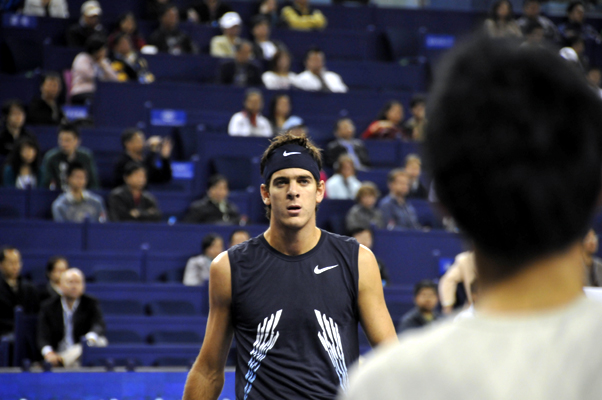
Photo courtesy of wikipedia commons. The night of Juan Martin del Potro’s 2009 USO Open final happened to be the morning I was starting my new job as a university tutor in Istanbul. Did I skip the match so I could go to work nice and fresh? Like hell I did! I stayed up until 6 am watching del Potro win the title versus Roger Federer at the tender age of 20. I didn’t have internet, either, so I sat up in an internet cafe cheering him on and drinking coffee. The next day at work training, in a room with 80 other tutors, I smiled away like a highly caffeinated love struck zombie.
del Potro’s win that New York Summer’s night promised so much to me. Back then, Federer and Nadal had been going at it for four years, and it was time for some new blood to win slams. del Potro, aged 20, reminded me of Safin who came along and beat Sampras at the Open in ’00. He had a lot of belief and so much talent, and that forehand.
That forehand. Swoon. No shot has given me so much pleasure. I’ve been fortunate to see it live. Going up the line, cross court, hit on the run, and the most beautiful of all, struck, in position, timed to perfection, the most brutal, beautiful shot in tennis.
del Potro’s career didn’t quite work out how we fans wished, or how he wished. His wrist issues started not long after that US Open win and who knows how things would have panned out if he had rested it and not played the 2010 Australian Open. The Argentinian had eight surgeries in total, four on his wrists. But it’s not my place to dwell on the what ifs- it’s my place to celebrate what he did achieve.
When he came back, he always delivered. He had many wins over the big 3, won plenty of titles, was a top five regular and gave us that 2018 Wimbledon last eight match versus Nadal and that 2018 run to the USO final. That 2018 Indian Wells final win over Federer is probably my greatest ATP 1000 match of all time.
More than anything, he graced us with his smile, his gentleness and his humility. Tennis players don’t have to give their best qualities to us, but he shared his tennis and his self with us in equally generous measures.
I’ll never forget when, in the trophy ceremony after that 2009 US Open win, the MC tried to take the mic off him after deciding del Potro had had his say for the night. del Potro took it back and spoke in Spanish, his eyes wet with tears and his face flushed with the brilliance of his tennis that night. That gentle tenacity and fight never left him.
del Potro; we love you. Keep in touch!

Tennis from a fan's point of view
[
[
[
]
]
]
 thetennisreview