-
Nadal wins first Cincinnati title

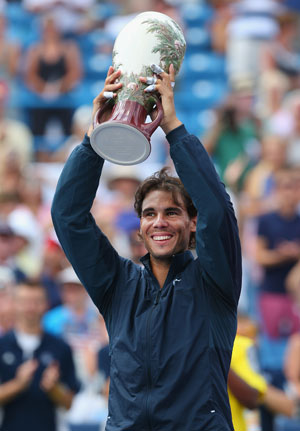
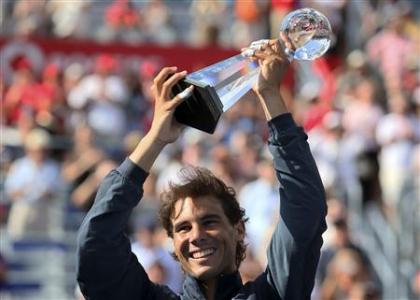
Nadal holds aloft his first Cincinnati Masters title (Thanks to sports.ndtv.com) Rafael Nadal beat John Isner 7-6 (8), 7-6 (3) to claim his first Cincinnati Masters title.
That Nadal should beat the ATP tiebreak leader in two sums the man up. Isner had beaten Gasquet, Raonic, Djokovic, and Del Potro on his way to the final. Were he to get Nadal to a tiebreak, one would imagine, considering his form and the confidence he must have in tiebreakers, he would be able to win one.
Isner did get Nadal to a tiebreak in the first set, holding serve without facing a break point the entire match. The American also got his first serve in 77% of the time, winning 74% of the time. Nadal though pulled up a pretty impressive service performance of his own. The Spaniard had a first serve percentage of 73% and won 84% of his first serves. That was not the only service statistic in which he outdid the game’s most successful big server. On second serves, Nadal won 79% of points while Isner won 72%. Small margins but when a match is being decided on breakers, small margins are what make the difference.
At 3-4, Isner hit a kick serve on the second serve. Nadal hit it back deep on his forehand to Isner’s, the American’s weapon on the ground, which gleaned him 21 winners; however it also missed the mark 21 times and this happened to be one of them, an unfortunate time, in the heart of the tiebreak. On the next point, another second serve, the kick serve bit harder, drawing the short return and the forehand found the open court. Then, Nadal made an error on the forehand, one of only seven on that side, to hand back the mini-break.
With both men’s weapons buckling under the pressure, the tiebreak was there for the man who held together a splitting bag the better. Nadal got in his second serve out wide and spinning out of the reach of the Isner forehand to keep his end of the bargain and get his first set point. Isner saved it with a service winner. Then he reached his own set point, his third of the set, surviving a long baseline rally with Nadal to come out on top with a forehand down the line winner, but the American failed to convert, hitting a backhand error.
7-7, the Nadal forehand held up, the Spaniard striking it down the line and sending it up high, forcing an error from Isner. Nadal had his second set point, but on the Isner serve. An ace and it was 8-8. Isner served, move forward to volley but Nadal’s passing shot was as good as ever and Isner, who had left the court open, was caught out of position, netting the volley to give Nadal another set point, and on his serve, as good as it gets against the giant American.
Nadal did not get in the first serve but the second one was good enough, short and into the body, a service winner. He had gone into his opponent’s territory and claimed it, roaring with appropriate passion.
The second set, high in quality, the match’s winner count exceeding the errors, went into a tiebreak, too. With Isner’s tiebreak record being over 70% in his favor, if the match went to two more breakers, in all probability the title would be his. But Nadal makes opponent’s suffer where they are most comfortable. See his Wimbledon ’08 and Melbourne ’09 defeats of Federer for reference. He was quick to do it in the breaker, sliced a short forehand return that drew Isner in and drew an error from him, the surprise element of the shot his undoing.
The mini-break his, his opponent’s strength disarmed, Nadal’s confidence abounded, his own strength the forehand now doing as he bid it, cutting and opening up the court, a drop shot the final blow to lead 4-1. The peak of Nadal’s forehand skills fell in with the fall of Isner’s, a forehand into the net gifting Nadal another mini-break and a commanding 5-1 lead. It did not completely collapse though, holding up in the next point and drawing an error from Nadal’s. And the American had not lost his fight, too, getting one of the mini-breaks back when a Nadal backhand volley went wide. Another opportunity came his way on the next point, a short Nadal second serve but Isner could not capitalize, his forehand return down the line landing in the net.
Nadal had two match points, both on Isner’s serve. Nadal got a look at a second serve to his forehand. The American moved forward hitting the approach shot back to the forehand, back into the Spaniard’s strength. Nadal could not have asked for more. He struck a winning forehand passing shot down the line to win his first Cincinnati Masters.
It was his 26th Masters 1000, his 15th consecutive hard court victory, and his third Hard court Masters of the year, with two more won on the Clay. The numbers speak loud and clear. His game speaks even louder. It’s a sound his opponent’s hope will be silenced come the US Open. Nadal likes it silent though; the more uncomfortable the better.
-
Azarenka comes back against Serena in Cincinnati
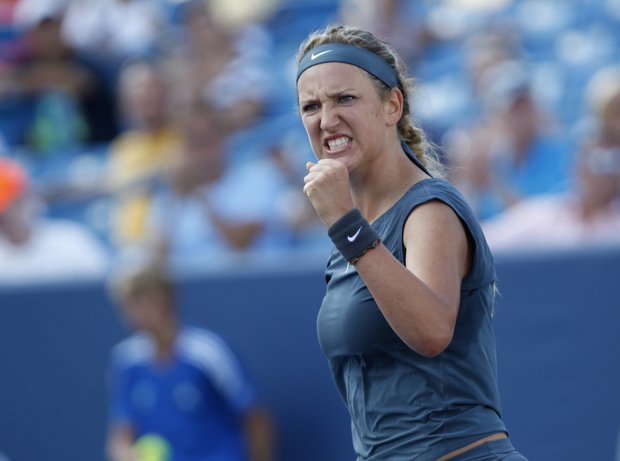
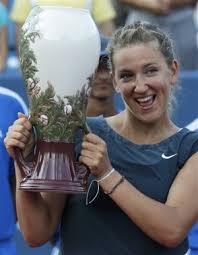
Vika Azarenka with the Cincinnati trophy (thanks to newsinfo.inquirer.net) Victoria Azarenka overcame her fair share of obstacles to come back against Serena Williams and win the Cincinnati trophy 2-6, 6-2, 7-6 (6).
There was Serena Williams standing in her way, first of all; the athletic world number One who has won eight titles this year. Her aura alone wins her a couple of games, if not sets, per match.
History stood in her way, too. The world number two had won only 2 of 14 matches against Williams. That record only strengthens Serena’s swagger. History has a way of repeating itself and few players have channeled into this and worked it as well as Williams.
Then there was the score on the day. History can be thrown aside in sport; therein lies its spectacle. But when Williams took the first set 6-2, an exhibition looked more likely. To overcome Williams on home soil from a set down is a tall order, one Azarenka got close to at last year’s US Open, but she was left watching Williams smoking the cigar.
But on this day Azarenka did not believe she should be the one standing by watching. Down a set, she fought back and leveled it at a set all, her tenacity and grit eating into the Williams game, as it had done when she was down a set in last season’s US Open final and had gotten herself into a winning position, serving for the Championship.
In the third set of this encounter, it was Williams who broke in the third and served for the match. The roles were reversed once more as Williams failed to do so, and the match went to a tie-break. Once again Williams led but Azarenka did not back off, her margin for error high, her athleticism at its best, her will even better.
At 5-5, the greatest server in the game served a double fault to gift Azarenka a match point on her serve. That same woman has another title she lived up to though: the greatest fighter. She returned big, moved forward, and forced an error to save the match point, fearless as ever.
But Azarenka has, as she proved in Doha this year and in her two Major final wins, a fair amount of courage pumping in her heart, too. At 6-6, Azarenka moved Serena side to side, opened up the court, moved forward and hit a forehand volley that died the second it hit the court. Another championship point, on her serve, Azarenka struck a forehand deep and loaded with pace at Williams who could only react and the reaction was not in her favor, a forehand into the net. Just as she had done in Doha, Azarenka had beaten Serena Williams, overcoming an obstacle so many are unable to overcome but which she, on a few days in her career, has strikingly cleared.
-
Isner saves match point and defeats Del Potro
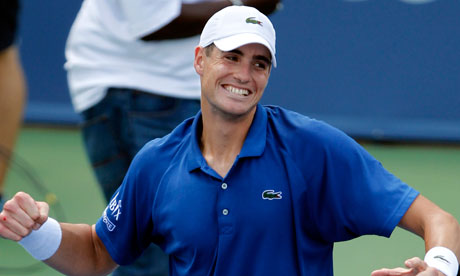
John Isner celebrates his come back against Del Potro (thanks to http://www.theguardian.com) Isner defeats Del Potro 6-7, 7-6, 6-3, Cincinnati Semi-finals
John Isner came back from match point in the second set to beat Juan Martin Del Potro in the semi-finals of the Cincinnati Masters 1000.
Before the match, John Isner was 0-4 down against the Argentine in their head to head; at 6-7, 3-5 that record did not look like it was going to improve. At 30-30 the Del Potro forehand was on full steam, attacking the Isner backhand and getting him on the run until the Argentine finally forced the error and held match point.
With the Del Potro forehand working so well and the match point coming on the Argentine’s serve, saving the match point looked like it might be a laborious and unlikely task. Luckily for Isner, he did not have to work hard to save it; the prospect of his second Masters Series final of 2013 jangling his nerves or of his opponent’s improved return game getting the better of him, the Argentine threw in a double fault.
A big return from Isner on the deuce point and the American had break point. It was a point he could not have played any better. Isner fed the Del Potro forehand slice, denying him the pace he craved, and after a few forehand rally shots had come his way, Isner injected pace into the rally, striking a forehand down the line winner to get himself back on serve and into the match.
Isner on serve is not a prospect you want to face. The American holds serve better than anyone on the tour and once he gets the set into a tiebreak the odds are of him winning are 70 percent in his favour. Against an opponent struggling on serve, those statistics rise even higher. At 6-6 in the second set breaker, Del Potro serving, Isner once more put his improved return and defense to effective use, retrieving the Del Potro forehand over and over until he found himself in a position to strike a formidable one of his own to force an error and hold set point.
The American did all he could to take the set. He got his first serve in. He moved forward and hit a drop volley. But Del Potro covers the court well for a tall man and he picked it up. In response, Isner hit a volley down the line, only for the Argentine to volley it back into the open court for a winner that had the mostly pro-Isner crowd cooing. to save the set
An ace down the tee earned Isner another set point. A Del Potro service winner saved it. But at 8-8, Del Potro served another double-fault to hand Isner another set point, and on the American’s serve, too. But the Argentine’s great play saved him once again, A big return from and a winning cross court forehand leveling the breaker. Another ace, another set point for Isner. The Argentine could not find his first serve nor his forehand as he made an unforced error to aid Isner in his comebacak.
Back in the contest and spurred on by his home crowd, Isner’s spirit trajectory was as high as his kick serve while Del Potro’s collapsed much like his serve had done at critical moments in the second set. The American broke Del Potro at the start of the third set and then held his nerve to clinch another tight match over a top ten player, his third one in a row.
Isner will next face Rafael Nadal whom he last encountered in the first round of Roland Garros in 2011. That day, he led the Spaniard two sets to one, his two sets won on, unsurprisingly, tie-breaks, before Nadal came back to take the match. It will be the fourth encounter between the two and if Nadal’s form is anything to go by, his win over Tomas Berdych in the semis, a win as intense and clinical as they come, the match has the potential to be an appetising prelude to the upcoming US Open. There the in-form Isner will have a top sixteen seeding and his positioning in any of the top eight’s draw will be anything but welcome especially if he manages to end Nadal’s 14 match hard court winning streak in today’s final.
-
Isner inches past Djokovic
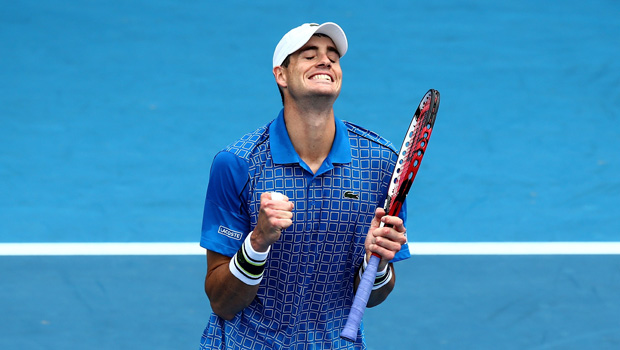
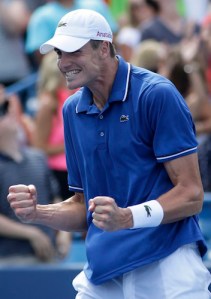
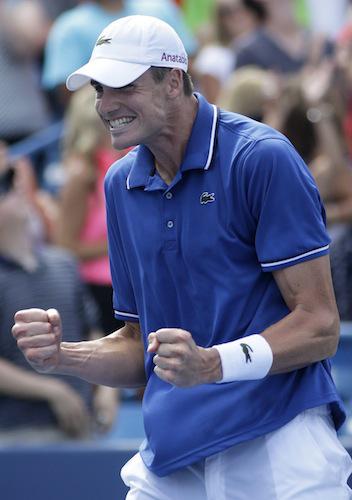
John Isner celebrates his win over world number One Novak Djokovic. (Thanks to sports. nationalpost.com) John Isner inched past world number one Novak Djokovic in the Cincinnati Quarter-finals 7-6 (5), 3-6, 7-5.
While the American iches past Novak quite easily height wise, career wise and game wise the two are very far apart. But the fast hard courts of Cincinnati are prime for Isner to get a win over the Serbian, his huge serve and forehand more advantageous than anywhere else. And there is the home court advantage, too. Just as Isner makes the most of his height to bolt down those huge serves, he makes the most of the home court crowd, too, with some of his biggest successes coming on home soil.
The match started out unsurprisingly. That Isner should take the first set is no shock, being as he is a king of tiebreaks. Djokovic’ s comeback to take the second set did not raise any eyebrows either. After all, who comes back better than the most aggressive defender in the game?
No, it was the manner of the third set that shocked and pleased the crowd, and upset Novak. At 5-6, Djokovic serving to stay in the match, Isner played perhaps the best return game he ever has in a big match. The American is infamous for losing tight final setters, his return game too flabby in contrast to his supremely toned service one. But he has clearly been working out his return, and his defense, too.
At 40-15 Djokovic, Isner hit a winning running forehand down the line passing shot. At 40-30, the American kept the margins for error high, hitting the return into the middle of the court. He then charged in on a short ball to take time away from Djokovic and force a backhand error. At deuce, the pressure on Djokovic, who subconsciously may have been thinking back to the final set tiebreaker he lost to Isner in Indian Wells ’12, was too much, which is quite something for a man who has made a career out of absorbing pressure and then releasing it with the free hitting fearlessness of a player with nothing to lose. The Serbian attacked, moving into the court and striking a backhand down the line, his instincts as fearless as ever, but Isner got the ball back in play and Djokovic faltered, hitting a routine cross-court backhand into the net. Down match point, Djokovic did what he does best, hitting a clutch ace down the tee. But back at deuce, he faltered again, serving a double fault to help Isner out in what is considered his weakest department, breaking serve in critical moments. On his second match point, Isner got a look on a second serve. This time though Isner hit another return down the middle of the court, playing it safe, and Djokovic hit another backhand into the net. The match was Isner’s.
Isner gave a wry smile to his box from under his cap. This was what he had been working on, putting on the pressure on his opponent’s serve at the business end of a big match. The quarters of a Masters on home turf less than a fortnight before the start of the US Open, your home slam, against the world number one on a bid to win the one Masters title to elude him, is as big as Isner is tall. And a return game like that will give him the experience and confidence to make it through the next match at a Major when matters get tight in the fifth, another advantage for a man who seems to be learning how to make effective use of the ones belonging to him.
-
Nadal defeats Federer in classic
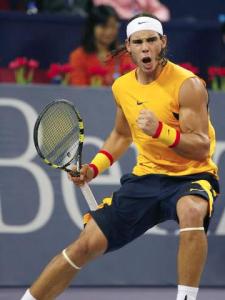
Nadal celebrates a winner against Federer in Cincinnati (Thanks to tennisearth.com) (4)Rafael Nadal defeats (5)Roger Federer 5-7, 6-4, 6-3, Cincinnati Quarter-finals
With Federer’s career on the rocks and Nadal’s recent hard court rejuvenation, predictions were rife that Nadal versus Federer part 31 was going to be as painful as the Italian final had been for Roger Federer fans, and neutrals.
Federer was having none of it. Cincinnati has brought the best out of him no less than five times in his career and the fast courts, perhaps the fastest of the tour’s outdoor hard tournaments, are where his game shines. And shine it did. The serve, net game, and most strikingly, the forehand, and there have not been many shots better struck than that one, was at its best. In the battle of the forehands, it was Federer who performed the better in the first set. And the backhand was on form, too. A signature single-handed backhand down the line winner hit from a flying Federer mid-court punctuated the end of the set, an exclamatory reminder of what the Swiss could conjure up on fast hard courts.
Federer did not let up in the second. Playing the aggressive tennis necessary to beat a man who has proven time and time again he has the better of him from the back of the court, the Swiss did his bit, winning his service games and moving towards a second tiebreak where his more frequent and successful attempts at the net might prove to be the decider.
At 4-5 and serving though an all too familiar narrative was woven onto the court. Federer was volleying and moving forward, doing all he could to keep the Spaniard at bay, to lead 40-30 but a missed forehand from mid-court allowed Nadal back into the game. Nadal put the pressure he applies so well and liberally onto Federer, tearing into his ground strokes with pace and applying angle to force errors. Federer responded by continuing to go for his shots, the only chance he had to finish the match off in straights. But it was a case of hit and miss as Nadal’s liberally applied pressure earned him a set point. Federer saved the first one with a smash but a shanked forehand from the Swiss gave Nadal another chance. This time the Spaniard did what he does better than anyone against Federer. He attacked the backhand and once the short ball came his way he crushed it with a forehand to take the set 6-4.
The writing was on the wall, in bold and capitalized. By the time Nadal led 3-0 in the third his forehand winners had overtaken Federer’s 13-12 and the highest number on the winners-errors statistics sheet was 16 backhand errors for Federer. Nadal’s serving percentage had risen too, to 73%, while Federer’s had fallen to 63. Serving for the match at 5-3, Nadal did face some final resistance from the Federer forehand, some blistering ones struck down the line to save match points 2, 3, and 4 but a forehand error donated match point 5. The Spaniard hit the ball deep and early, robbing Federer off any timing on his forehand, and then, when the opportunity came his way, Nadal struck into a forehand winner down the line, and claimed his 21st victory over the Swiss.
Nadal will face Tomas Berdych in the final. The Czech beat Andy Murray 6-3, 6-4, his fifth career win over the reigning US Open and Wimbledon Champion in nine meetings. It was one of those clean hitting, aggressive performances that the Czech man delivers now and then. The kind in which he makes the basic principles of hard court tennis look so deliciously simple and enticing that were you watching for the first time you would ask for seconds and thirds and tennis fandom had gobbled you up. It was the kind of match you would very much like the Czech to follow up with another win and then another all the way to fulfilling his potential by raising the US Open trophy. Against Nadal, a man who he has beaten only 3 times in 17 meetings, he will have his work cut out but if he can get a high first percentage, move forward, strike the ball cleanly and keep away from Nadal’s forehand, he could get the win. Against a man in the current form of Nadal, nothing less than perfection will do.
-
Stephens shocks Sharapova in Cincy
Sloane Stephens celebrates her upset of Sharapova (thanks to bangkokpost.,com) Sloane Stephens notched up the second top ten win of her career in Cincinnati, beating Maria Sharapova 2-6 7-6 6-3 in the second round.
The Russian world number three, who has been out of action since losing at Wimbledon the last week of June, still managed to lead by a convincing set and a break against the 20 year old American. But the Russian could not maintain her form and her slipped as Stephen’s play began to rise. The American broke back and worked her way into the set, staying with Sharapova to force a tiebreak. The tow women exchanged mini-breaks before Stephens got another one. On her second set point Stephens embroiled Maria in a long rally and the tentative Russian hit stepped up the pace despite her rhythm being off and yet another baseline error saw her gift Stephens the set.
Stephens deserved the gift though, her smarts, defense and depth synthesizing with the rusty Sharapova game and taking full advantage. Stephens broke early in the third as the Russian’s serve failed her and she was only able to produce tepid offerings on which the American hit back with depth to force errors and lead 2-0. The American proved herself to be a good front runner, leading 4-1 and having more chances to break but Sharapova dug deep and hung in the match playing aggressively despite the rust and reaping some reward for her courage. Stephens was not to be undone by Maria or nerves though. The big match temperament that helped her beat Serena Williams in Melbourne proved to be anything but a one off as Stephens served for the match at 5-3. Down 15-30, the American hit a big serve down the tee to leavel at 30-30. A backhand error into the net and Stephens had match point. The nerves got to her and she double-faulted. A backhand error and Sharapova had break point but Stephens challenged the point and Hawkeye called it in. Back at Deuce, Maria forced an error for another break point but another error and it was Deuce once more. Stephens found her serve and moved Sharapova around, forcing another error from a Maria on the run. On her second match point, Stephens hit another double-fault. A service winner and a third chance to take the match. A second serve but this time it went in. Sharapova struck the ball with all her might, the American defended and another Sharapova error, her 62nd of the match, meant the match was Stephens’.
The win was similar to Stephens’ victory over Williams at the start of the season in that the American did not play her best all the way through the match but found some good form when her opponent faltered and managed to just hold it together enough when the win was in sight to scramble to victory. She would make life a lot easier for herself if she could calm her nerves and play more aggressively when approaching the finish line.
As for Maria, it has been a long time since we have seen her play such an error-prone match. Perhaps the loss in the French Open final and the early loss at Wimbledon has hurt her confidence in her game. In addition, she may be adjusting to life with new coach Jimmy Connors. Going into the US Open with this defeat on her clock is far from ideal but the Russian will find some relish in the challenge no doubt and give us something to talk about in two weeks time in New York.
-
Nadal the poly-trick pony

Nadal raises the Montreal trophy (thanks to uk.reuters.com) Rafael Nadal proved he was a poly-trick pony when he won the Montreal Masters Sunday. Mind you, he was not really proving anything. More reminding. After all two Wimbledon titles, an Australian Open title, a US Open title and several hard court Masters are already pretty convincing evidence. But he had not won a title off the Clay since his 2010 season until this season’s Indian Wells so his success this year, beating players of the hard court quality of Del Potro, Federer and Djokovic along the way, has been more a case of him proving himself once again to those who doubt his surface versatility.
The win in Montreal came against newly top ten installed Canadian Milos Raonic. The affair was straightforward for the Spaniard, a 6-2, 6-2 victory that saw Nadal convert all four of his breakpoints against a man with a first serve percentage of 50%. It was a match in which Nadal was as consistent as ever, hitting 17 winners and making only 7 errors and winning 33 of the 46 baseline points played.
The win bodes well for Nadal, especially after the defeat at Wimbledon to Darcis. That loss might even work out well for Nadal in the long-term. Nadal would not have worked himself entirely out of the mindset of the Clay court game, which with the clay and outdoor hard court surfaces sharing similarities speed and bounce wise may prove to be advantageous. How fast the US Open hard courts are remains to be seen but the former Champion and finalist has the form to go far there, especially if he can keep his first serve percentage at the rate he had it in the Montreal final-70%. He will also go in with a slight psychological edge over his chief rival, Djokovic. His semi-final win against Djokovic, which the Spaniard won by dominating a third set tiebreaker, was his first win over the Serbian away from the Clay since 2010 and will no doubt prove to be a match he draws upon for confidence when the going gets tough in NYC.
Meanwhile, Serena Williams beat Sorana Cirstea 0 and 2 in the women’s final. Serena, like Nadal, swept all before her on the Clay circuit only to be pulled up short in SW 19. Though she went further than Nadal into the last sixteen she was not able to adapt to the Wimbledon grass courts so soon after three months on the Clay. But adapting to the Montreal courts so soon after her Gstaad victory was no problem for the world number one.
Motivated by her early Wimbledon loss and with the confidence this win and any further matches should give her, a fifth US Open title looks well within the reigning US Open champion’s reach.
-
Gulbis gets going against Murray in Montreal

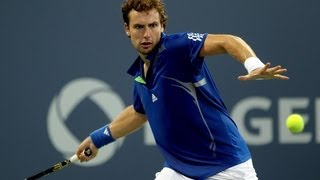
Gulbis about to strike that beautiful yet ferocious forehand of his (thanks to sportballa.com) It is quite a sight at which to marvel, a rare event, but when it occurs, the tennis Gods be proud: the sight of Ernst Gulbis hitting the high notes and handling the low ones, too.
For Andy Murray, it was a sight his season could very much have lived without. The Scotsman is about as close on the journey to number One as he might get, holding as he does two Majors, a runner-up placing in Melbourne and the prestigious Miami title. The sight of Gulbis in his draw as early as the third round of a Masters would have made his heart sink a little. And the sight of the Latvian winding up for the forehand, his non-playing arm sweeping round, the hand outstretched, fingers wide apart, would have made his heart plummet into the Ocean bed.
But while the spectacle of the Gulbis forehand being struck, the weapon fired and finding its mark, gleaning winners or setting them up, would have been one to make Murray’s eyes sore, it is one that causes the spectator’s eyes to widen and smile; the imagination ignited at a shot that must be exhilarating to hit, and truly frightening to be beholden to.
And beholden Murray was, his own weapons curiously absent. While Gulbis busied himself pushing Murray around with his forehand, Murray took to pushing the ball into play. Gulbis did not miss a beat in the first set, bossing the ball with the authority of a world number one and now and then stroking it with the fine touch one would use to brush one’s fingers over the head of a crystal corgi. Nowhere was this better done than at 5-4 returning. The Latvian reached break point with, after crushing the ball for several shots, winning the rally with a sublime drop shot at which Murray must have been sick with envy. The set was sealed with a crushing return that a weak Murray second serve deserved only in its ferocity and not in its beauty.
It is not uncommon for Gulbis to show up for the first set of a match like this and then go AWOL in the second. So, it was encouraging for those who wish to see his talent fulfilled when he broke at 1-2 in the second. Perhaps this would be the win that would define his season at worst or kick start the surge up the rankings and into the business end of Majors that we have all craved for him. But Murray, down a set and a break, dug his heels in and, unperturbed by his lack of firepower on the day, went back to what he does best: defending. The Scot retrieved balls that, were it not for the ‘speed’ of the court, would have been dead on arrival once upon a time, and broke back. This is what the Scot excels at: getting back into matches he has no business being in and then exploding into them, stealing them from beneath the executioner’s nose, his head well away from the block, the ax now in his hands.
All Murray needed now was the attack of nerves, the collapse of serve upon which he has feasted on his journeys to many a trophy. But Gulbis was not interested in pandering to Murray’s favorite play. He had some making up to do. Chances have slipped out of his hands this year, no less notably than against Nadal in Monte Carlo, and he was not going to see another one slip from his talented hands and shatter on the court. He held his nerve and his serve and, at 4-3 returning, played the big points so cleanly you could have eaten off the court. A winning volley got him the break for 5-3 and the chance to serve for the match. At 30-30, Gulbis hit a service winner out wide for match point. The Latvian could not have been more clutch. An ace down the tee and a significant win was his.
Gulbis has had big wins before, his 2012 defeat of Berdych in the first round of Wimbledon was as big a performance on Grass as you could wish to see, only to have small returns in the next round. A loss in the next round would be no surprise but a win would be most welcome. The sight of Gulbis tempering his risky all out aggression with such fine feel are a sight one could never bore off in a game prevalent with grinders. Should Gulbis decide to screw his head on more often, tennis might see a game that defies surfaces and legs that never tire, a game that sets the imagination very much on fire.
-
Del Potro and Stosur shine again in U.S Summer

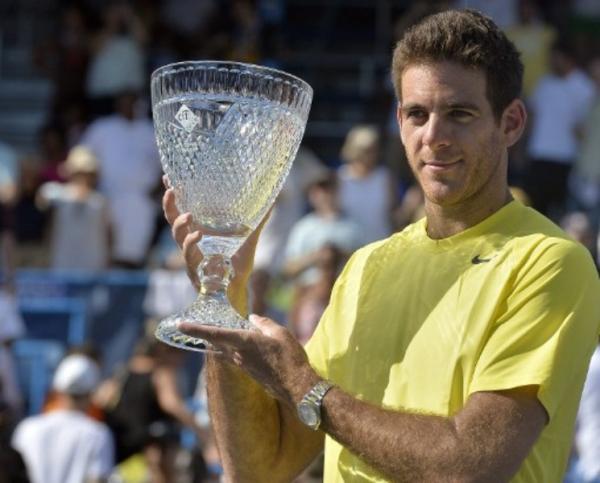
Del Potro holds his third career Washington trophy, his first since 2010 (Thanks to Khelnamea.com) Two former US Open Champions, Del Potro and Stosur, who have not reached the dizzy heights of their first and only Major successes since, were victorious in the second week of the US Open series, igniting hope in their fan bases that repeat success in New York may not be that far-fetched.
Del-Potro took his third Washington trophy, coming back from a set down against John Isner, the winner of last week’s Atlanta tournament. The American rode his fine form to a set lead but Del Potro is the better all-rounder and his superior back court game and big match play made the difference. The Argentine broke Isner in the second set and then knuckled down to claim the match.
The win is Del Potro’s first in the US Open series since his run to the US Open title in 2009. That year in NYC Del Potro put together back to back victories over Nadal and Federer, the first man to achieve that feat. The courage and play that had seen him win the title put great expectations on the unassuming Giant, but a wrist injury and a premature return to the tour in Melbourne 2010 meant that his 2010 season was a disappointment. It took until 20011 for the Argentine to start to play well again. Slowly, Juan-Martin re-established himself and by the end of 2012, wins over Federer in Basel and London suggested Del Potro would be a threat again in 2013. His run to this season’s Indian Wells final and the great performance he gave against Djokovic in the Wimbledon semis was evidence that such speculation was justified.
The win in Washington will do wonders for Del Potro’s US Open hopes. The US Open, like the French Open, has a build up to it with five weeks of tournaments. While Del Potro will be careful not to peak too soon, five weeks is just enough time to get some form going and get match fit. It will also add to his reputation. Players will definitely be a bit more nervy against a confident Del Potro in New York, his impressive 2009 run still memorable, and any aura he can start to form now will definitely be worth a couple of easy sets in the early rounds.
Sam Stosur tasted success in the US Open more recently than Del Potro, in 2011. Since then, saying she has been slumping is somewhat euphemistic. Like many first time slam winners this last decade, Stosur has suffered from the shock of achieving an unexpected feat that propels an otherwise unheralded singles player into the elite and into the spotlight. She has been the victim of many an upset, has seen her ranking plummet out the top ten, and her Major winning status has not put an end to her choking away big matches in Majors but has increased the media vitriol that comes with such losses. So, after not reaching a semi-final this season, her last eight win over number four Radwanska and her final win over Azarenka will have raised her spirits just in time for her return to the Major where she beat none other than Serena Williams.

Sam Stosur celebrates her Carlsbad victory. (Thanks to news.com.au) Stosur’s win over Azarenka, a clinical and clear cut straight sets victory 6-2, 6-3, where her serve, slice and big forehand were at their most effective, will have warned the rest of the field that if they are at all below-par then Stosur is still able to zone in and find the game that saw her dismantle Williams that dreamlike day two seasons back.
-
Isner and Cibulkova kick start US Open series in dramatic style
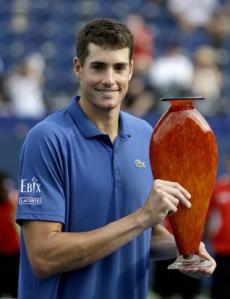
Pretty as a picture: Isner holds the very pretty Atlanta trophy (thanks to thehindu.com) John Isner and Dominika Cibulkova won the US Open series’ opening tournaments with dramatic 3 set wins that we can only hope were fore-shadowing.
Isner’s win will certainly have generated strong interest if the excited crowd were anything to go by. The American beat Kevin Anderson 7-6 (2) in the third before the home crowd, saving two match points when serving at 5-6, his big serve and forehand delivering under pressure against the equally big serving Anderson. At 6-6, Isner ran with the momentum and with the tie-break to win the title. It was Isner’s first trophy since his victory on the Houston Clay. The American plays comfortably and confidently before his home crowd, perhaps due to his years playing for College, and if can keep the form and momentum going, and, most importantly for the injury prone Isner, his health, he might finally get the success in a Major he works so hard for.
Meanwhile in Stanford, Dominika Cibulkova upset Agnieszka Radwanska to win her third career title. The Slovakian came back from a set down to outhit the world number four 3-6, 6-4, 6-4. The 5’3″ player never gave up the challenge of putting away Radwanska, also coming back from 2-4 down in the third to lead 5-4. Four championships points came and went but on the fifth one a backhand cross-court winner finally did the trick. The win was not just a fine chapter in Cibulkova’s career but was also fine revenge for the double bagel she was forced to eat by Radwanska back at the beginning of the season in Sydney. Back then Radwanska was still doing what she does, or used to do, best: beating who she is supposed to beat. However, since her loss to Robson in Madrid, she has been losing to those same players. If she cannot pick up the titles she was winning when the opportunity arose, then maintaining her top four status will be tricky. Unless she is able to stop the rut soon, a tumble down the rankings as suffered by Jankovic and Wozniacki may be the result of too much play the last couple of seasons. And as those case studies demonstrate, getting back up to the top echelons of the pro game is even harder than getting there in the first place.
Watch highlights of Cibulkova’s revenge over Radwanska in the Stanford final
Once again the illogical nature of the Tour came to the fore as tournaments were played on clay. One of those tournaments was played in Gstaad and won by Mikhail Youznhy, the Russian defeating Hasse. But Youznhy’s win was overshadowed somewhat by the defeat of a rather important player in Swiss sporting history:Roger Federer. The Swiss world number five lost 3-6, 4-6 to Daniel Brands. It was Federer’s first appearance there since 2003 at tournament where he played his first professional match. It was another shock loss for the homeboy. Saddled with a bad back, the task of getting used to his new racket and the loss of confidence the three defeats will bring him, not forgetting the comprehensive defeat to Tsonga at Roland Garros, Federer will do well to get his game and health together in order to put in a status-worthy performance this US Open series and in the US Open itself. Being Federer, he could win the whole thing or go out in the first few round, the latter possibility unthinkable a few months back. The last three defeats might prove not just to be a false dawn but the harsh reality in the light of day, an early departure for the Swiss as likely as him raising the trophy.
Meanwhile, in Umag, Tommy Robredo, who entertained us with his run at this year’s Roland Garros put an end to another fine run on the red stuff as he put paid to Fabio Fognini’s 13 match winning streak in the final, winning 6-0, 6-3 to win his 12th title in what is proving to be a mightily impressive comeback.

Tennis from a fan's point of view
[
[
[
]
]
]

 thetennisreview