-
The inbetweeners

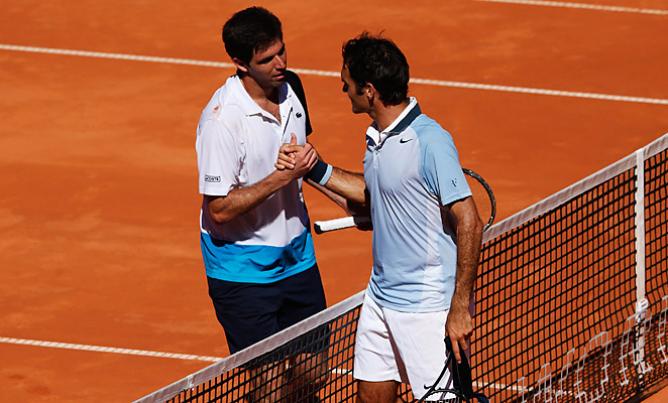
Federico Delbonis shakes Federer’s hand after defeating him in Hamburg. (Thanks to tennisworldUSA.org) The two weeks in between Wimbledon and the start of the US Open Series are puzzling ones indeed. With tournaments played on grass and clay before the impending Hard court slam, the answer as to why the two surfaces on which completed Majors are played are still on the schedule is not clear. Why the players are not getting another two weeks to lead in to the season’s final major still a mystery. So, it was only typical that two weeks which seem strange on the tour should yield some strange results for players who should be known as the inbetweeners, their results out of context of the tour, helpful only in their match play, points and prizes, which on second reading is very helpful overall. Indeed being an inbetweener is not something to be looked down on. Just a little strange, that’s all.
First, the 7-6, 7-6 defeat of Roger Federer to the Argentine Federico Delbonis in Hamburg was a strange result. It was Federer’s first loss to a player outside the top 100 at a regular tour event since Gasquet beat him at Monte Carlo ’05. But more tellingly it was Federer’s second loss in a row to a player outside of the cut off for Majors after his loss to Stakhovsky at Wimbledon. Like Stakhovasky, Delbonis qualified for the tournament and also like the Ukrainian, the Argentine was not afraid of the Swiss, holding his nerve in the breakers to get a famous win. It was both unusual to see Federer in a tournament so soon after Wimbledon, being as he is typically resting up after winning the trophy, and to see him going down against such an unheralded opponent. However, it seems, if recent results are anything to go by, we might have to get used to it. Federer, too, will have to get used to his new racket if he wants to do well in the US Open series and avoid further defeats to players who for nearly a decade would have thought it a career achievement to win a set against the now ranked number five player in the world, a strange situation for a man who has spent the best part of the last decade at the top of the rankings or at worst second best.
Another strange sight was seeing Serena Williams competing in the Bastad International event, only the sixth international of her career. Like Federer, Serena was ousted early from SW19 and had points she needed to make up for. The American world number One kept her formidable 2013 Clay court run going to 28-0 as she took the title, beating home girl Johanna Larsson in the final, without dropping a set. It was also strange to see Williams reaching her 51st win of the year so early in the season. Unfazed by the disappointment of losing her Wimbledon crown, the American is continuing on with her new found consistency as she seeks to put herself firmly in the Greatest of all time conversation with a career which at 31 years of age keeps hitting new peaks.
New peaks were certainly hit by Fabio Fognini, the most successful of the inbetweeners. How strange it must have been for him, previously titleless, to win back to back titles in Stuttgart and Hamburg. Another welcome strangeness for the Italian will also be his career high ranking of 19. The popular clay court specialist will not mind that the Grass season is followed up by two tournaments on his favorite surface bereft of many of the top players who are somewhat sensibly preparing for the upcoming hard court swing. Who knows how much confidence these titles will give him and what further foreign lands they will take him to tennis-wise.
Other players who will not be complaining of the tennis tour’s puzzling scheduling are Mahut who took the title in Rhode Island, Vinci who beat Errani in Palermo, Carlos Berlocq who won in Bastad, Ivo Karlovic who won the Claro Open Columbia, Simona Halep who won the Hungarian Grand Prix and Yvonne Meusberger who won the Bad Gastein Grand Prix. All these inbetweeners took home much deserved titles in a strange time for a sport whose scheduling is the strangest of the world’s top professional sports, a schedule stuck between tradition and modern economics, a schedule that puzzles all those but the inbetweeners who make it their own.
-
Jimmy Connors joins team Sharapova

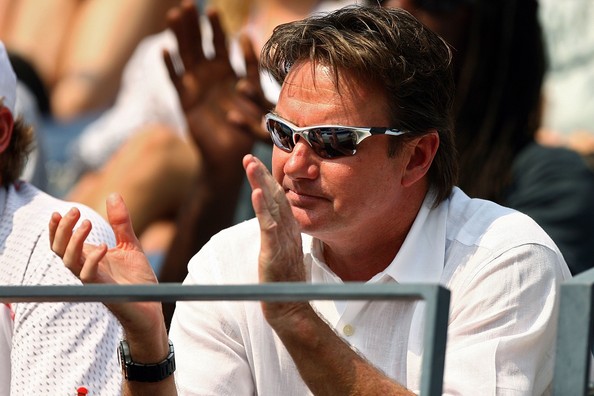
Jimmy Connors coaching Andy Roddick at the US Open 2007 (thanks to zimbio.com) Maria Sharapova has announced Jimmy Connors as her new coach. It is a partnership to get the mouth watering. One of the most pumped up intense players on the WTA tour being coached by a former ATP player famous for the same qualities.
It is not Connor’s first time as a coach on the tennis circuit. The American coached Andy Roddick from July 2006 to March 2008 and helped him make the 2006 US Open final before leaving for ‘logistical reasons’.
While Sharapova is not in the dire straits Roddick was in when Connors became his coach, the Russian does have a major problem she has not been able to solve in Serena Williams. Roddick, too, was unable to get one over Roger Federer, being 0-11 down where he teamed up with Connors and 0-17 down after they split, though Roddick did score his first win over Federer a few weeks after the split. Sharapova has been unable to beat Serena in 12 meetings since 2005 and has lost two high profile finals to her in Miami and at Roland Garros this year. Some of the losses have bordered on humiliation for the Russian and unless an answer comes soon her losing streak to the American may be as much a talking point when her career comes to an end as her history-making career Slam.
Sharapova will be hoping the super competitive Connors will be able to guide her to a solution and secure some memorable wins over the current women’s number One. Maria could not have hired anyone who is likely to empathize with her more than Connors, a man who left it all out on the court as famously as Maria does. How their partnership pans out will be a fascinating talking point over the next season, the success of it being determined by whether Maria can beat Serena and also whether she can win another Major other than Roland Garros.
-
Hingis hits up the Hall of Fame
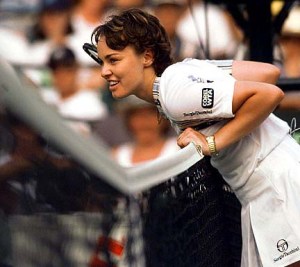
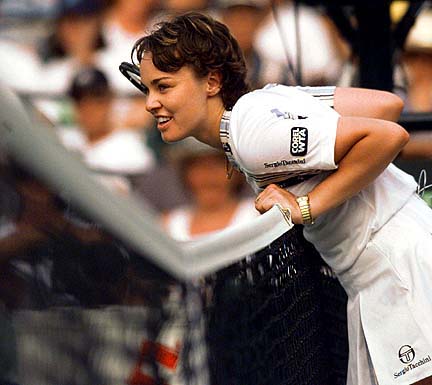
The Swiss Miss at her best (Thanks to http://www.datacomm.ch) Today The Hall of Fame in Newport, Rhode Island inducts the five time Major winning Martina Hingis. The woman who sat atop the rankings for 209 weeks, the fourth most of all time, won 43 WTA titles, won 53 matches at the Australian Open, (4th best of all time), made 12 Major finals and proved to be the most consistent, arguably the most talented and charismatic player in a Golden age of the WTA deserves her legendary status to be made official. Thetennisreview looks back at some of the highlights and the lowlights of her career, though to be fair even her lows were in their drama and ridiculousness still peaks few other could reach.
Best match: Versus Serena Williams, Quarter-finals, Australian Open 2001
Not just the best match Hingis competed in, but one of the Greatest of all time. At the time, Hingis was the world number One without a Slam, playing at her best one, and in the form of her life. Meanwhile Serena was having a sophomore slump after her ’99 US Open breakthrough win, a final in which she beat Hingis. With the history of trash talking and the threat Serena posed to Hingis, this match was much anticipated and did not disappoint, delivering a battle of styles and wills. A gripping third set saw Hingis fight back from 1-4 down like her life depended on it, and certainly her career did, to win the highest quality of encounters 8-6 in the third.
Best performance: Versus Mary Pierce, Final, Australian Open, 1997
It’s your first Major final, your biggest rival is removed early in the draw, the number one ranking rests on your performance, you are facing the 1995 Champion and a woman back in good form, the formidable Mary Pierce. Most fold, a few rise; Hingis is one of the latter. The 16 year old did not blink on her way to beating Pierce 6-2 6-2 to become the youngest winner of a Major. And the tennis reviewer was there in the flesh to witness it. Hingis did not put a foot wrong. She mixed it up, played inside the court and frustrated the hell out of Pierce, denying her the rhythm and balls she liked to whack away for winners. It was a win that showcased the hard and flamboyantly clinical stuff of which Miss Hingis was made and that set the tone for the legend-making career that was to be hers.Most infamous moment: Versus Steffi Graf, Final, French Open, 1999
Unforgettable. Infamously, so. The greatest drama the game has ever seen. We could go on. And we could watch it over and over. The sight of Hingis crossing the line to point out what she believed to be a bad call to the jeers of the crowd and the dismayed impatience of Steffi Graf, a woman whom Hingis had accused of being past it, is a sight no one who appreciates drama in their tennis can tire of. It did not stop there either. The Graf comeback, the underhand serve, the tear-filled fleeing of the cauldron she had set alight to herself, it was by far and away the best Major final ever and its star villain Martina Hingis gave an Oscar-worthy performance.Why we love her: What is there not to love about Martina Hingis?
Why some hate her: The very reasons we love her.
Why some are indifferent: No one is indifferent to Martina Hingis. But love her or hate her, you cannot deny she is a legend of the game.
With such a history and status, the induction is sure to be memorable. A full report will be forthcoming; tears, no doubt, too.
-
Maria splits with Thomas Hogstedt
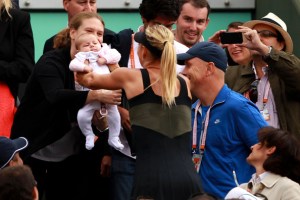
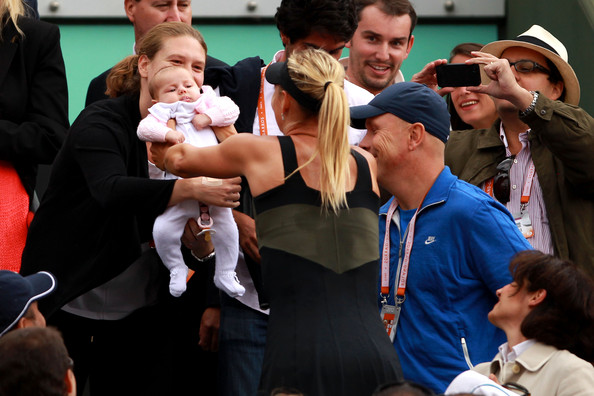
Thomas and Maria at the peak of their partnership, the 2012 Roland Garros win. (thanks to zimbio.com) Maria Sharapova has split from her coach of three years, Thomas Hogstedt.
The split will come as a surprise to some and a relief to others. Bringing Thomas in as her coach brought Maria the improvements in her technique that enabled her to modify her game to accommodate the shoulder injury that took her out the game in 2008 and saw her struggle until Indian Wells 2011. But while there were some significant improvements there was one key issue that was never resolved.
Starting with the positives, the serve improved enormously from the double-faulting mess into which it had descended. As a result, Maria’s ground game grew to be as solid as it had been in her peak years and Maria made the 2011 Wimbledon final and 2012 Australian Open final.
But it was not on the medium paced courts where her biggest successes with Hogstedt came. The two worked on her movement on the clay, Maria’s then weakest surface, to such a successful degree that Maria won the Italian Open 2012 and 2013 plus a whole host of other clay tournaments. Moreover, Maria was able to win the one slam that had eluded her and which her detractors said was beyond her, the French Open. The Career slam complete and with a brief stint back at number One, Maria was back in the elite and forever in the history books as one of only six women to win all the tennis Majors.
But things were not perfect for the ever-hungry Maria Sharapova, particularly concerning her rivalries. While she has managed to make the one with Vika Azarenka more competitive, she has not been able to solve the puzzle that is Serena Williams. Maria was, it has to be said, unable to beat Serena before the injury and teaming with Hogstedt, but she was not able to beat her under his guidance either. No less than 13 defeats have been inflicted on Maria by Serena since 2005 and over half of them have come in the last 15 months. With the clay puzzle solved, the Serena one is still too much even after all this time, and a solution is more likely to come under a new coach.
The defeat to de Brito at Wimbledon may have been the clincher for Maria in making a decision that had been on her mind since the Roland Garros final, a match that was thought to be the one she had the best chance of winning. It was her second consecutive early defeat at Wimbledon. Unable to reach the finals at another Slam other than Roland Garros since Melbourne ’12, Maria’s progress has somewhat stalled outside of Clay. In addition, Marion Bartoli’s success at Wimbledon after a huge shake up on the coaching front may have also been inspiring.
Whatever the reasons, Maria is a shrewd woman and she has announced that a new coach will be announced the next few days. Whoever it is will not have been chosen without some careful consideration and the results will be keenly anticipated by a tennis world that loves a shake-up and would like very much to see the top two women in the world have a healthy, exciting rivalry and not the grim one-sided massacres to which we have grown wearily accustomed.
-
Tennis 101 from Wimbledon 2013

Bartoli taught us all a big lesson: perseverance is rewarded(thanks to bbc.co.uk) These are the lessons, some new, some revised, from Wimbledon 2013.
1. The Grass season needs to be longer.
The ATP and WTA tennis seasons last ten months. A tenth of it is played on Grass with half of that time taken up by the world’s most recognized tournament. A tournament that does not even have a Masters or a Premier warm-up. It does not make sense. And it results in the chaos we saw at this year’s championships. Unprepared, the players, fresh from three months on the clay, and mostly overly versed on hard, gallop across the court, slide into shots and out of the tournament. While it makes for a crop of new faces, it means the world’s best tournament is somewhat of a crap-shoot, maybe not in the winner’s circle but in terms of the vanquished opponents.2. The Grass is too slow.
It breaks the heart to see offensive players like Berdych and Lisicki move inside the court, hitting the ball hard and flat, only for their big shots to come back time and time again and either send them back and get them on the run until forced into error or passed at the net. This is not how grass court tennis was meant to be. Leave the defense to the medium hard courts and the slow red clay. Let the big-weaponed attacking players thrive on the grass before that style of game dies out for good and tennis is a one surface game it was never born to be.3. Perseverance is rewarded.
Not the defensive style just criticized above, instead the never giving up on a dream. There are few better examples than this year’s women’s champion Marion Bartoli. The Frenchwoman made her first final in 2007 and came back year after year only to be thwarted in her plans. This year the players fell down one by one, the draw opened up and Bartoli stormed through it without dropping a set. Andy Murray is another fine example. After last year’s disappointment, the man who lost his first four Major finals came back to win his second of seven contested.4. Women’s tennis’ next generation is looking good.
Puig, Robson, Stephens, de Brito and Bouchard all put in good performances. Puig saw off Errani, de Brito beat Sharapova, Bouchard saw off Ivanovic, Robson knocked out Kirilenko on her way to the last four and Stephens made a run to the quarter-finals. Encouraging stuff from five players who in future years could very well make up five of the last eight places in Major draws.5. Jingoism sucks.
We know Murray is British and the British men have not had a champion for 77 years but few outside Britain really care and anyone watching the crowd when Murray played must have felt a little uncomfortable for his opponent. Henman Hill, which can be heard from the courts, does not make it any better, either. While home players deserve home support, the calling out between points and the cheering of rival’s errors all condoned by the host broadcaster is not acceptable in a sporting event.6. And sexism sucks, too.
Britain has had a Wimbledon Champion in the last 77 years. Her name is Virginia Wade and she won in 1977, and in the Jubilee year, too. How’s that for pressure? And how’s that for recognition?7. And sexism sucks, too, II.
The less said about Inverdale’s comments about Bartoli the better but really in 2013? Bartoli could not have stuck up for herself better the way she coloured Inverdale true.8. Tennis is amazing.
The performances this tournament were amazing. While the surface is slower than it once was, in the first week, when it is at its fastest, players such as Brown, Stakhovsky, Darcy, Knapp, Robsosn, Lisicki, Janowicz and Berdych all played the brand of flat, hard and aggressive tennis to get the heart pumping and take us back to the days when tennis was hard and fast and amazing.9. Wawrinka is wonderful. First round loser or not, it was still good to watch him play for three sets.
10. We love Del Potro.
11. Tennis is AMAZING.
-
Top fives from SW19

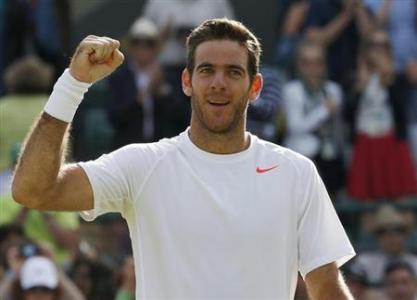
The delectable Del Potro played in the best match of the tournament and captivated the tennis review more than anyone else this Wimbledon (thanks to in.reuters.com) Thetennisreview selects its top fives of Wimbledon 2013. This being the 21st century, all men and women are judged equally. Did someone say Long live Virginia?
Top five matches:
1) Del Potro versus Djokovic. Men’s Semi-final.
Us Del potro fans are a little bit biased yes, but anyone who liked a good comeback story was going to like this one. You had the comeback of Del Potro from being down and out in the fourth to take maybe the best set of the Championships and force the match into a fifth and you had the comeback story of Del Potro himself, now well and truly back in the last four of Majors where he belongs after wrist surgery. The match had it all: the world number One and favorite versus a former US Open champion; a clash of styles in the Serbian’s solidity and intensity and the the Argentine’s big hitting and laid-back style; the highest quality tennis and a topsy turvy nature that could not fail to beguile even the most casual of fans.2) Lisicki versus S. Williams. Women’s fourth round.
The idea Lisicki might fulfill her potential this year at SW19 started in this last sixteen encounter. The German’s comeback from 0-3 down against a woman compiling a resume to challenge the GOATS told us something new about the 23 year old 23rd seed: She not only had the game, she had the mind as well. It was the most exciting match of the women’s tournament and a big shock, too. Drama and quality, tennis fans could not have asked for more.3)Radwanska versus Lisicki. Women’s semi-finals.
The ultimate clash in styles. Radwanska’s consistency, touch and smarts versus Lisicki’s explosive movement, explosive game and grass court wiles. The two battled in the third all the way to 7-7 before the game that should win did, the naturally aggressive one of Lisicki’s breaking Radwanska and then the big serve delivering the goods and the win, proving that while it may take perfect execution against the best defense in the game, offense still trumps defense on grass.4) Knapp versus Kerber. Women’s second round.
Another clash of styles, an early round upset but only on paper. Knapp’s huge game should win out against Kerber on grass and it did but not before both women played the match of the first week, going at it until 9-7 in the fifth and proving the depth in the women’s game makes the equal prize money debate pretty one-sided in favor of the women.5) Murray versus Verdasco. Men’s quarter-final.
However much Murray’s passivity infuriated you, the big serve and style of his opponent Verdasco helped ease the pain. Once Murray came back from two sets down to tie it for two sets all the result was never in doubt but watching the two play out the fifth to the backdrop of a crazed Center court crowd was nothing less than fascinating and inspirational stuff for a sociology thesis best kept for another blog.Top five performances.
1) Darcis defeated Nadal. Men’s first round.
Steve Darcis’ defeat of the former Champ set the whole ball rolling for the first week massacre. It was the performance of a lifetime from a man who had played five grass court matches to his opponent’s zero. The practice had clearly done him good. Attacking from the get go, the Belgian did not let up on his struggling opponent to put him away in straights.2) Stakhovsky defeated Federer. Men’s second round.
Defeating Federer in the second round of a Major when he has not lost before the last eight in 36 Majors was always going to take a great performance. When Stakhovsky won the second set of this contest, the crowd sensed an upset might be on the cards and the Ukrainian served and volleyed his way to proving their senses right.3) Larcher de Brito beat Sharapova. Women’s second round.
Side to side de Brito moved Sharapova, grunting on every ball, it was like a visit from Christmas past for Maria. She had done the same to Serena Williams back in 2004 though in very different circumstances. This match proved as much a coming out party for de Brito as that day had done for Maria. de Brito took Maria’s weaknesses and pounded them into submission with her own strengths in a performance that promised much and we hope on which will be delivered.4) Marion Bartoli defeated Lisicki. Women’s final.
Fear is not a word Bartoli knows. For many women the prospect of a Major title without a top player standing in their way reduces them to wrecks; Marion Bartoli came out swinging all the way to a 1 and 4 win. The Frenchwoman could not have performed better in the biggest match of her life.5) Murray defeated Djokovic. Men’s final.
A straight sets win in an event not won by a male home player for 77 years was something few thought Murray would pull off. But he did. He played the match of his life, his running forehand, serve and defense at their optimum. His opponent Novak Djokovic may not have gotten out of his shell for the first two and a half sets but he was kind of jammed in by the Scot. And once Novak did fight back, the Scot did not fall off but just sat even tougher to take the Wimbledon trophy.Top five players.
1) Juan Martin Del Potro.
His tennis is beautiful to watch on grass. The nonchalent way this 6’6” man strides into those ground-strokes and pounds them down the lines for winners is something I could sit and admire all day. Few men can hit through these slower-than-ever courts but Del Potro has the balls and timing to do it, and it is a praise-worthy spectacle indeed. His comeback against a better grass court player in Djokovic in the last four was the most captivating moment of the tournament and so he gets the best player prize.2)Marion Bartoli.
Coming out of the wreckage that was the lower half of the women’s draw and winning the title without dropping a set, this run had destiny written all over it.3) Andy Murray
Putting aside the hype, the publicity, the crowd support, Murray achieved his second Major in the last year against a sensational backdrop which must have been hell to put to one side. But he did it and for that he should be, whatever you think of him and his game, applauded.4) Sabine Lisicki
Two come backs from breaks down in the third against last year’s finalists swept the crowd off their feet. Lisicki proved she was quite the personality as well as one of the fiercest strikers of the ball in women’s tennis.5) Jerzy Janowicz
Armed with a game to get the grass court purist’s hearts pounding, the giant Pole was a pleasure to watch. As much as I hoped he would make the final, Janowicz could not survive Andy Murray, which is no shame as few can, but the way he led 4-1 in the third at a set all before he wobbled suggests that once also armed with experience he will be able to soldier on from such a privileged position and win himself some silverware. -
Notes on a freak show

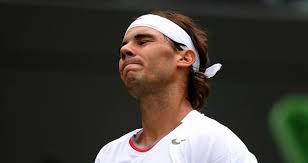
Nadal’s shock defeat got the balls spinning at a very weird Wimbledon (Thanks to www1.skysports.com) Tennis Major review: Wimbledon 2013
Rating 3.5/5
Part freak show, part propagandist exercise, part train wreck, part sporting event, the 2013 Wimbledon tennis championships was never less than entertaining, surprising and worth watching, but there was a certain relief when it was over, for the neutral fans anyway.
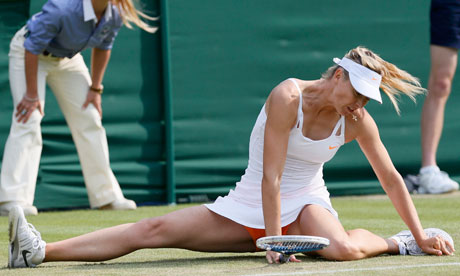
Steve Darcis got the ball rolling and the heads spinning at a Weird and shock-ridden Wimbledon as he knocked out the two time former Champion Nadal in straight sets. It had a domino effect. Withdrawals, retirements and upsets piled up on top of one another. Errani, Ivanovic, Kirilenko, Isner, Wawrinka, Cilic all fell but the real cries of timber came as Azarenka, Sharapova and Federer hit the ground, literally at times as photos of a slidden Sharapova testify.
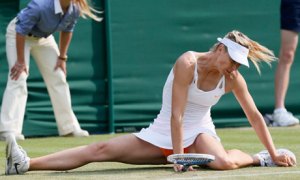
A fallen Maria (Thanks to guardian.co.uk) With grass being the freak surface it now is, with only five weeks of a ten month season played on it, the players come to it unprepared. They are then unforgiven by a surface that still requires the movement of a ballerina rather than the gallops into open stance groundies performed by most of the hard court proficient players who failed to clear the first post one after another.
As the big names were erased prematurely from the draw sheet, lesser-known names like Bouchard, Kubot, and Puig became less so, while names like Robson, Janowicz, Stephens, and Lisicki of whom great things are predicted, grew even bigger in the spotlight. These names should be the big ones in years to come, their success in this tournament sure to be repeated.
In the women’s draw, a name we have seen again and again over the years, appeared seven times before being immortalized on the Champion’s board: Marion Bartoli. The Frenchwoman surprised everyone by emerging from the train wreck that was the bottom half of the women’s draw to take a title there for the taking, a prospect that frightened the hell out of her stage-fright struck opponent, Lisicki. Where this victory takes Bartoli we do not know but tennis fans will have enjoyed being taken with her on quite a ride over her career and this victory will remained etched in the memory for some time.
Meanwhile, in the men’s, the final was played out by two names we have gotten used to competing for Major titles the last 12 months: Murray and Djokovic. It was the former who was engraved on the trophy and in the British sporting history books.
And it is a name that will ring in the ears of anyone who watched Wimbledon on the Scotsman’s home broadcasting channel. Even in matches he was not playing, his name was mentioned time and time again. Viewers watching not from Britain must have been doing so with the TV on mute. Worst of all, for those who were listening, during the lamenting of no British winner for 77 years, hung the forgetting of Virginia Wade in 1977.
This final’s excitement lay solely in the unveiling of Britain’s second post war champion. The match itself was a tame affair, the Serbian world number One Djokovic failing to perform. At times Murray did not let him but when Djokovic did get ahead he fell back again.
Unfortunately for this year’s Wimbledon, a lack of exciting matches was its Major flaw. While it had some riveting performances and the upsets were hugely entertaining but compared to last month’s French Open, in which the men’s tournament in particular had a couple of fistfuls of classics, this Wimbledon’s men’s tournament had only one, the Djokovic and Del Potro semi-final and three in the women’s (Knapp-Kerber, Serena-Lisicki, Radwanska-Lisicki). Not even a fistful. Indeed, while the shocks and injuries of the first week made it one of the more memorable Opens in years if not decades, it was memorable for all the wrong reasons.
A lack of nail-biting contests, and chewed off nails are what we hope for rather than lying down in shock at de Brito drubbing Sharapova on a freak surface that borders on irrelevance, means that Wimbledon 2013 will go down as infamously unforgettable rather than famously so.
-
Murray mows down Djokovic on the green grass of Wimbledon
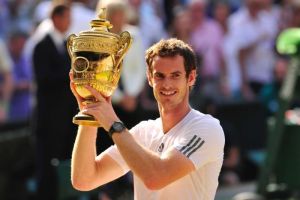
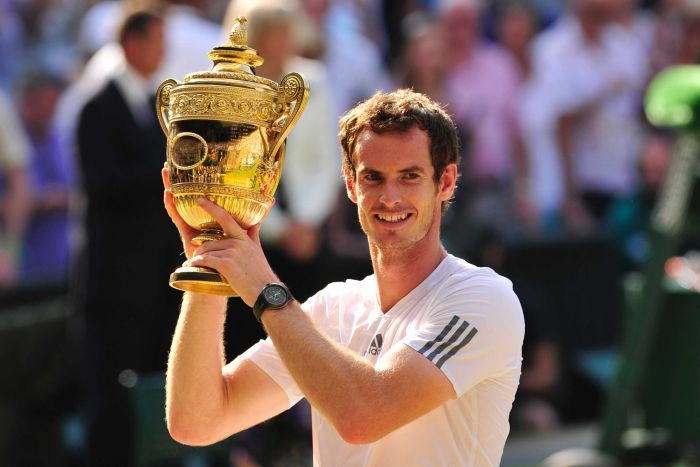
A sight few expected to see: Murray holding the Wimbledon trophy. (Thanks to abc.net.au) Andy Murray is the 2013 Wimbledon Men’s Champion. Seizing the momentum that had been building his way since last year’s final, Murray went the one step further he had been promising to go by beating Novak Djokovic in straight sets, 6-4, 7-5, 6-4, to win his second Major trophy.
Murray was the Media favorite to win but not necessarily among tennis fans. Djokovic after all has a greater haul of Major trophies, including the 2011 Wimbledon title, has twice been the year end world number One and has two WTF trophies. In comparison, Murray has one Major and has been as high as number two. Many thought that Djokovic’s tougher draw and overall game and mentality would see him through. But on the day, anything can happen, and Murray has beaten Djokovic enough times to know when the Serbian is not at his best and there to be taken.
This year’s Wimbledon finals was one of those days. It was Djokovic who was trying to end the greulling rallies played at the back of the court early by going down the line or moving forward, a key factor in deciding their 20-stroke rally matches. But he either missed or Murray ran them down and got them back with too much interest for Djokovic to pay back. As the Djokovic errors mounted up, it was Murray who had the chances, and after a messy start to the set where the two exchanged breaks, it was Murray who took them, at his defensive, solid best, breaking in the heart of the set and before settling down to take it 6-4.
A set up, this is where he had been the year before against Federer, and the hysteria that had been present that day had not been dampened by memories of what had happened next. But when the Serbian seemed to get his act together in the second to lead 4-1, those wounds were once more opened. But if anyone was going to do it, it was going to be the Serbian. A fightback was what we expected of Djokovic, the most consistent player of the last couple of seasons. But Murray’s proved those wounds were well and truly healed, breaking back and going on to take the second set 7-5.
Leading two sets to love, just as he had done in their US Open encounter, Murray broke at the start of the set only to be broken back as Djokovic, his back to the wall, customarily moved up a gear. Djokovic then broke again to lead 4-2. Were we going to have to endure another five set tussle between these two, we wondered. And on an unusually hot Final’s day, would the outcome be the same as it been that blustery New York night? In a battle of wills in the heat Djokovic has proven himself to be the number one competitor and a five setter would see him rise to the challenge rather than wilt. But the World number One failed to find the solidity that is his hallmark, surprisingly melting down instead in the third and dropping his serve. With Djokovic proving to be unable to capitalize on his break, it was Murray who was the one who was going to take advantage of matters, in this case his opponent’s fragile state. At 4-4, Murray broke again to serve for the Wimbledon Championships.
It was never going to be easy for Murray to serve for the Championships at the All England Club where the Scotsman is the focus of the Media and the public’s attention. 77 years is long enough to wait for a British champion and the time seemed right for the waiting to end. Britain had a man playing for them who had surpassed any other Briton’s tennis achievements since Fred Perry and a man who had the momentum behind him having been to the final the year before, reached and competed well in another Major final in Melbourne and proved himself to be a world class Champion. Sensing a Champion in the midst, the crowd were on their feet after every point Murray won, cheering every Djokovic error, determined to push him over the finish line even if his often criticized passive play did its best to see him stumble.
But stumble Murray did not. Despite the frightening sight of Djokovic saving his best for last, going for the lines and painting them for winners to save championship points, a sight no one wants to see from the best come-from-behind player in the game, Murray held firm. On his fourth Championship point Murray held his nerve while Djokovic made yet another error, his 40th of the match, (Murray in comparison made only 21), and finally Murray achieved what he had worked so hard for: his name on the Wimbledon trophy.
All the praise from the British media, all the bonuses and new sponsors, all the sportsman of the year awards will mean next to nothing compared to the joy he will feel at being known as a Wimbledon Champion. In one of the most individual of professional sports national pride has little meaning outside of the Olympics or national team competitions. These players do it for themselves and Murray has, with the help of Ivan Lendl, become one of the best players in the world at shutting out the outside world, zoning in on what he wants and getting it. The fact that Britain, represented on the terrace that was Center Court by the crowd and the BBC, wanted it too is secondary.
Andy Murray has what he wanted and for that he must be congratulated, and if anyone really believes he did it for them, too, he can be thanked. We should, however, definitely thank him for giving the Wimbledon final a Champion’s worthy final performance. He certainly could not have performed much better, reacting as he does so well to his opponent’s play, finding it wanting and extracting from himself the performance necessary to achieve his goal. What other goals he has in his sights, now that the biggest has been achieved, will surely come as a matter of course. At 27, and in a sport where 27 is the new 17, Murray has the time and now the experience to go one better than just being known as the first man to win Wimbledon since Fred Perry but to become known as the Best British-or-and who knows what state his ‘nation’ will be in when he winds down his career in his 30s- Scottish- player ever.
-
Bartoli’s brilliant Major breakthrough at Wimbledon
The biggest smile on the day was Bartoli’s (thanks to bbc.co.uk) We had to ask ourselves, and Marion Bartoli would have asked the loudest, whether or not we were dreaming. Or was this a parallel universe we had slipped into, as smoothly as Bartoli had slipped through the draw, as inconspicuously as possible, a universe where 28 year olds written off time and time again won Major trophies in draws lit up with the likes of Serena, Sharapova and Lisicki.
It was not a dream. We pinched ourselves. We were still there, on Center Court, sharing Marion’s joy at winning her first Major, her much desired and oft fought for Wimbledon trophy. In 2007 she had been beaten 4 and 1, today she was the victor 1 and 4. Parallels indeed. Back then Venus had assured Marion she would be back one day to win. The years rolled by, the final appearance was never repeated. The likes of Lisicki, Pironkova, Lucic, all fine grass courters, had stood in her way.
This year the dangerous obstacles her side of the draw had been felled before they could bring about her own fall. Azarenka, Sharapova, Lucic all out before the third round. The up and coming Stephens lacked the experience and the bite to see her off in the last eight. Flipkens blinked so much she could not see in the last four. In the final stood Lisicki, dangerous and proven on grass yes, but a Major final Virgin and Bartoli knew only all too well how mercilessly those nerves would come down on Lisicki, as mercilessly as her own double-handed ground-strokes would, hit flat and on the rise, from well inside the court.
Inside the court, and she was as inside the court as she was in the moment, playing the match point by point, is where Bartoli stayed the entire match. Once the nervy opening games were out the way, both players conceding their serves with double faults, not a ball was struck by Bartoli without the sole purpose of moving forward and striking the short balls brought her way by her flat strokes and angles for winners. For Lisicki, already seemingly done in by the occasion, this even greater factor, a hungry and worthy opponent on the other side of the net, was too much. Before Bartoli knew it she was a set up, to the tune of 6-1.
It was a tune that looked like being repeated in the second. A sad tune for Lisicki it seemed, the German tearing up 1-3 down in the second as another double fault made her dreams of a Wimbledon title seem more a nightmare. Bartoli, smelling the fear of her opponent, looking for the nerves to inject the needle and put her to sleep, carried on striking the ball as if all her chances were dependent on how fine and ferocious those flat and angled strikes were; the correct attitude, as well, for they were.
At 5-1, Bartoli served for the Championship. And Lisicki woke up from the nightmare and began to lucid dream, going for her shots and breaking Bartoli. Lisicki continued to control proceedings, fighting off championship points with her serve and forehand and holding serve to force Bartoli to serve for the Wimbledon title a second time.
The French woman did it and she did it with an ace on her third Championship point no less. She fell to her knees before embracing Lisicki at the net, and then came the most explosive movement of the day, the run to the player’s box. She climbed in and hugged her support group, Amelie Mauresmo among them. The biggest hug though was saved for her father, fitting for the day when her biggest performance had been delivered, a day so late in her career, at a time her father was not her coach but very much her Dad.
As Bartoli spoke of how it felt to live your dream and raised the trophy we all wondered what tennis world we were living in. A tennis world of dreams and yet a very real one, too; one were the last woman standing is also the most deserving winner in the draw. One where that woman in none other than Marion Bartoli. A tennis world where you can win your first Major after a record breaking 47 attempts. A weird and wonderful record to hold for a world and wonderful player in the very weird and wonderful world that has come to be Wimbledon.
-
Djokovic and Murray to duel in Wimbledon final
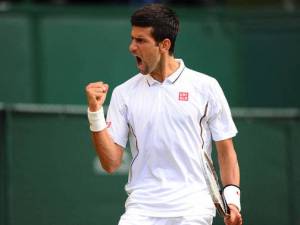
Novak Djokovic goes into the final against Murray as the favorite (thanks to http://www.thebacklot.com) Novak Djokovic and Andy Murray will play each other for the 2013 Wimbledon title. It will be their fourth meeting in Major finals overall. Djokovic leads the series 2-1. The world number one took the first encounter at the 2011 Australian Open, Murray prevailed in the 2012 US Open encounter and Djokovic won this year’s final in Melbourne.
Novak Djokovic took his place in the Championship match beating an inspired Juan-Martin Del Potro who refused to go away, saving two match points in the fourth set before finally being outdone by the ever so solid Djokovic.
It was a classic match, one that will go down as one of the best ever Wimbledon men’s semi-finals. After losing a tight first set, Del Potro hit some of his huge ground strokes to break Djokovic and take the second set 6-3. In the third, the Argentine had chances to take the tiebreaker but a smash dumped in the net was all Djokovic needed to pounce and nab the third set and break away in the third. But Del Potro, his big serve and massive groundies down the line on fire, fought on, his love of the big match clear for all to see, and saved match points before taking the fourth. Credit must go to the Serbian top seed for staying positive and his never say die attitude saw him break Del Potro in the heart of the fifth. He never looked back, his second Wimbledon final ahead of him.
His opponent in that final, Murray, beat the Polish dark horse Jerzy Janowicz in four sets. It was the Polish man’s first last four appearance in a Major. Not that you would have known it from the way he played the first set, his huge serves setting up the short balls he glided to, knocking them away with volleys or dinking them over the net. The Pole took the first set and then, after dropping the second as his serve wobbled, shrugged off the laspse to lead 4-1 in the third.
At that point, he wobbled once more. And the experienced Murray was ready for him. A more aggressive Murray than the one who had the critics seething in the quarters broke back and then went to work on the Pole’s big match inexperience, cutting him down with his consistency and variety and coming in when the time was right to take the match in four.
Predicting the final is a hard one as while Djokovic’s career achievements far surpass those of Murray, on the day they practically cancel each other out. The two are often only separated by who decides to inject some risk-taking into proceedings; the match decided on whether or not the gamble was successful or not.
This being Wimbledon and played in the UK, one thing will certainly divide them: the home crowd. History will separate them, too. Djokovic is, after all, a former champion and the memories of that 2011 victory over no less than Rafael Nadal are not so far away and will surely be evoked come Sunday. Those memories will be as important in a battle of the minds as the muscle memory that allows Djokovic to play his very best when he is seemingly down and out.
It is this factor that might be the deciding one in this duel. The Serbian has greater self-assurance when the going gets tough, and the going will certainly be hard to chew in this encounter. Expect matters to be close and expect the crowd and Murray to do their best to see the All England Club get its first Scottish champion. But the more telling expectation we have is with Djokovic in Major finals, of which he has won 6 of 9. We have come to expect an uber-solid, self-possessed and, most importantly, mentally tough performance; the kind that should ultimately win out over Murray and the majority of the Center court crowd.

Tennis from a fan's point of view
[
[
[
]
]
]

 thetennisreview