-
Sabine sinks Radwanska to make first Major final
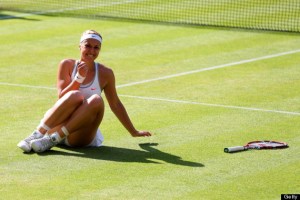
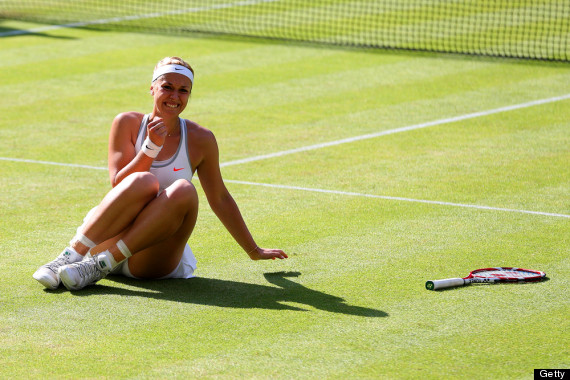
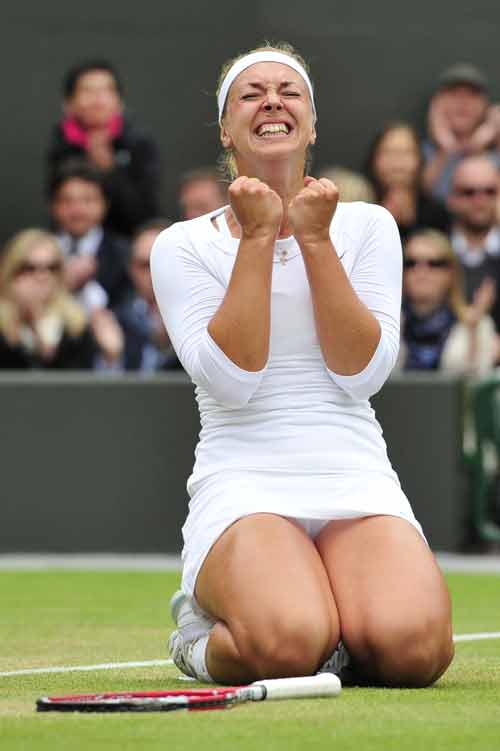
Sabine Lisicki celebrates making her first Major final (Thanks to the huffingtonpost.com) Sabine Lisicki made her first Major final beating the woman who came second to Serena last year, Agnieszka Radwanska.
It was the German’s second Wimbledon semi-final. And the experience of her first one two years ago, a match in which she under-performed and lost to Sharapova in straights, seemed to have done her the world of good. Sabine started the match confidently and relaxed, staying with the ever consistent Radwanska, into the middle of the set. At 3-3 Sabine’s fiercer ball-striking and explosive movement separated the two as she broke Radwanska on her fourth break point.
The German broke ahead and served out for the match at 5-4, saving a break point with a forehand drive at the net and sealing the set with a service winner, her weapons out and firing.
Radwanska though has a couple of weapons on her own, less explosive but as effective. Her consistency and her ability to change the direction of the ball and disrupt the rhythm of their opponent came to her rescue as the increasingly nervous Lisicki, her first Major a set away, began to wobble. Opportunities like this are what Radwanska has grown rich on and she filled her pockets eagerly with Lisicki’s errors until she had drawn the match level at a set all. The momentum her way, the Pole’s pockets began to bulge as the German’s error count rose and it seemed like only a few seconds had passed before Radwanska was 3-0 to the good in the third.
With Radwanska unlikely to falter, the match took on a sense of inevitability. Lisicki is after all known for her implosions as much as her explosions. But this Wimbledon, against Serena, she also made a name for herself as something of a fighter and it was this name she wanted to go by in this match, too. Lisicki broke back and then broke again at 4-4 to serve to make her first Major final.
It was a first for Lisicki. All the years had been leading up to this though. Her big serve, her movement, her ever constant presence inside the court and the last eight and last four appearances were not enough though. Radwanska broke her and leveled the match for 5-5. The sense of a classic was now upon us. Both women’s strengths were at their optimum, the occasion and their desire in accordance.
At 7-7, it was Lisicki who broke again. For the second time, she would serve out for the match. The first time had been nerve-wracking enough and had taken its toll. The second time proved less so. Lisicki struck the ball hard and with conviction to lead 40-0. Radwanska fought off the first match point as she returned serve with depth down the line and then struck the ball that arrived in her hitting zone for a clean winner.
But Sabine is one who learns quickly. On the German’s second match point, the German did not leave any openings for her opponent. Sabine served out wide and won the match on her second stroke, a forehand down the line off the short return. Lisicki sunk down into the court, her sinking of the second seed and brief favorite sinking in. Her first Major final ahead of her, the moment overwhelmed her in the most positive of ways. For her opponent though, the curt handshake and swift exit told of the disappointment of a chance believed missed. But how much of a chance did she really have against a woman armed with weapons and belief and a sense of timing not just on her shots but of her destiny?
Ahead awaits Marion Bartoli. A test indeed. But one that has every chance to be passed. How Lisicki handles it will remain to be seen. But coming back from breaks down in the third against Serena and Radwanska in the spotlight of the World’s premier tennis tournament suggests she might handle it rather well and what might be better to ask is how well she might handle the Venus Rosewater Dish as she raises it above her head.
-
Murray wimps past Verdasco to make the last four

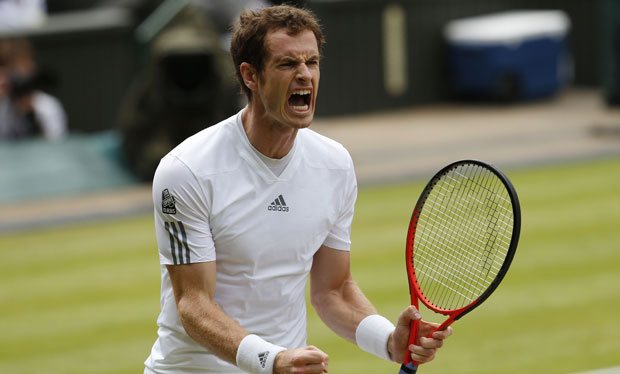
A pumped-up Andy Murray (Thanks to radiotimes.com) Andy Murray could not have tried harder to lose his quarter-final meeting with Fernando Verdasco and his Spanish opponent could not have tried harder to aid him to victory.
Dropping a passively played first set on a double fault, Murray then dropped the second. While the 31 year old Spaniard played his part, too, whacking that forehand with all his might and serving better than he ever has in his career, the Scot put up little to no opposition against a man as wary of the net as himself and who is well past his prime, a condition we are led to believe the Scotsman is well and truly in.
Two sets down, Murray moved up a gear, playing more aggressively when he had to, as he is prone to do, rather than at the outset of a match and thus relieving us the pain of sitting through such a passive game. Murray came back from a break down and took the third set and then the fourth, the crowd cheering on not just his rare winners but his opponent’s errors and double faults, too, turning a gentleman’s game into a playground of thugs.
In the fifth set, matters picked up. Verdasco found his form again and unleashed his forehand while Murray was at his consistent, workmanlike best, coming forward now and then for show, and the two were engaged in a good old fashioned dogfight. Amid the cacophany, one wonders how either men could think, but they were able to keep it together to get to a 5-5 final set showdown. With the ‘support’ of the crowd and the history of an opponent liable to lose matches he should win, Murray emerged the winner, the final point an example of how Murray likes to ply his trade, and when the slower courts make that plying most profitable who can blame him. Murray ran side to side and retrieved his opponent’s blows, sending them back pace-less and tepid into the middle of the court until his opponent’s warm form boiled over and an error gifted Murray the match.
Murray, a man for whom the modern conditions of the game seem made for, has made many a business end of a Major playing such insipid tennis. At some point, with the exception of last year’s US Open, he comes up across a player who won’t stand for it. He should beware of Jerzy Janowicz waiting in the next round. This is a man fresh and hungry who will feast on a Murray who thinks crumbs will be thrown beyond the baseline. Janowicz will love nothing more than to roast and devour a Mandy Burger come Friday. And tennis purists will be there to feed off the fatty scraps.
-
All eyes on Agnieszka: Wimbledon semi-finals preview
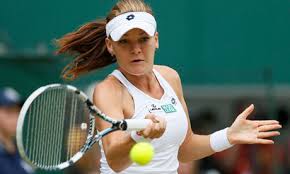
All eyes are on Agnieszka Radwanska (Thanks to guardian.co.uk) For Agnieszka Radwanska to win a Major, it was commonly thought, Serena Williams, Vika Azarenka and Maria Sharapova would all have to be removed before the last four. One of them she could perhaps handle, particularly Sharapova over whom she has had some big wins, but two of them would always be too much.
At this year’s Wimbledon, Agnieszka Radwanska has been presented with a draw void of those three women. A bigger opportunity could not have come the way of last year’s Wimbledon finalist. Standing in her way of another final is the formidable German Sabine Lisicki, the Giant killer of Wimbledon, and quite the Grass court Giant herself. It is quite an obstacle.
Agnieszka can overcome it of course. She beat the German handily last year on the hard courts of Dubai and has the kind of game that can dismantle the German’s. While Sabine could, in theory, overwhelm her should her big serve and forehand hold up and her desire to move forward remain firm, should she wobble slightly, Radwanska will be there, ready and waiting. Lisicki has to come out firing. A slow start and Agnieszka will race ahead and be too consistent to overcome.
For Agnieszka, the circumstances of being the highest seed left and to many the favorite will be her first real test at a Major. No one expected her to beat Serena in last year’s final but this year a defeat will be seen as a failure. However the manner in which she took a set against Serena and the way in which she has maximized her game to climb into the elite suggests she can handle the pressure well and should be able to deflect it as easy as she does the pace of the hard hitters like Lisicki.
On the other half of the draw Marion Bartoli and Kirsten Flipkens will battle it out. While Marion is a former finalist and made the Quarters by beating Serena in 2010, her presence in the last four is somewhat of a surprise. She has barely been able to win consecutive matches this season and is undergoing a huge change in her coaching life with the absence of her father on her team. Yet the draw opened up for her, and there have been fewer fiercer opportunists than Bartoli, and Bartoli has moved through it comfortably, removing the much-hyped Sloane Stephens in straights. But while Bartoli might be a surprise face at this stage of her career, Kirsten Flipkens is the real shock, coming as she has out of the Azarenka part of the draw. Flipkens has never been to the last four of a Major but the Belgian has the game to do well on grass and the guts to beat the big players, and few come bigger than Petra Kvitova, the 2011 champion, who may be struggling of late but is still a top tenner and whose champion status can never be removed.
The two have never met before and the match could go either way. Bartoli though is likely to emerge the winner. She has the experience and loves the big stage and it does not come bigger for her than Center Court. In 2007 Bartoli beat another Grass-loving Belgian in the last four in Justine Henin and this year her aggressive game played inside the court should be too much for another one.
-
Sabine shocks Serena in SW19 last sixteen

Sabine Lisicki celebrates her shock upset of Serena Williams at SW19
(Thanks to mid-day.com)Wimbledon has been a happy hunting ground for Sabine Lisicki over the years. But in this year’s last sixteen she stalked and captured the biggest beast in the grounds, a head to mount on the wall in pride of place, above that of Kuznetsova in 2009, Li Na in 2011 and Maria Sharapova in 2012: Serena Williams.
The coincidence that in each of her last four appearances, Lisicki has beaten the reigning Roland Garros Champion is strange only in terms of the draw shaping up that way. That it should be a player like Lisicki is not strange at all. Few players on the tour have a game more suited to grass than the German. A high risk game glistening with big serves, silky quick steps and flat drives, it flows and shines like a sun struck stream when on and jars and creaks like a door in need of oiling when off.
And when on, it is very hard, on grass, to turn off. Especially if you have been nurturing your game to succeed on the clay. Two weeks is simply not enough to be up against Lisicki on her favorite surface and in the mood to do some stalking, mounting and beheading. Lisicki came out firing, breaking early and holding serve to take the first set. Such a performance was clearly not beyond the German but delivering it when up against Serena had seemed unlikely considering the world number one’s recent form.
The shock of dropping the first set having sunk in, Serena started to play like the woman being argued as the Greatest player of all time since winning her second Roland Garros title. Her face frozen, she raced through the second set, forcing her opponent into error and knocking her of the fine form she had found, and led by a break in third. Normal business seemed in order.
But Lisicki loves the Center Court at Wimbledon and fuelled by memories and desire, she broke back. Once again Serena broke. And once again Lisicki fought. With both women fighting their hardest, the rallies grew in intensity and spirit and the crowd lived through every point, as caught up in the will of both players as the players themselves.
At 4-4, Lisicki broke Serena once more to serve for the match. The German did not blink. The shock of the tournament, quite a status considering the upsets that have befallen the SW19 favorites, rang out through the center court as the Umpire announced the score of 6-2 1-6 6-4 in Lisicki’s favor. The popular German beamed and Serena congratulated her with the natural dignity of a five time Champion, the ignominy of losing early in a tournament she was the odds on favorite to win erased by the smiling Lisicki’s career-making performance. The world number one waited for Lisicki to pack her racket case and the two exited the court, Serena leaving first, leaving Lisicki to enjoy the victory and sign a plethora of signable surfaces from balls to programs to T-Shirts.
Lisicki’s name, in a draw now absent of Serena, Sharapova and Azarenka, might find itself engraved somewhere else come next Saturday: the Venus Rosewater dish. Her history at Wimbledon means such a result would not be too surprising. Of course, she still has three matches to clear before that dream would be fulfilled. The first obstacle, Estonia’s Kanepi, is also armed with weapons and a mindset to succeed on grass but does not have the same level of experience and will probably find herself mounted on a wall along with all the other hunted heads of Lisicki.
-
Stakhovsky shakes off Federer on center court
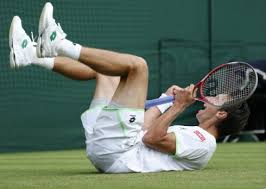
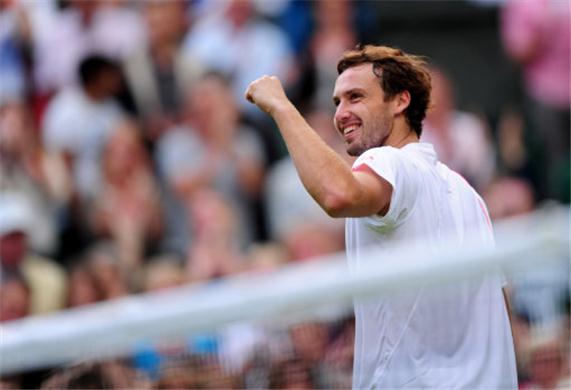
Sergiy Stakhovsky celebrates a historical win over Federer (Thanks to london24.com) Sergiy Stakhovsky put an abrupt and shocking end to defending Champion Roger Federer’s 2013 Wimbledon quest in the second round. It also ended the Swiss’ 36 Quarter-final Major streak, the Ukrainian doing what Simon was so close to doing less than a month back in Paris.
Stakhovsky was not intimidated by history or the Center Court where Federer has lifted seven trophies. Nor was he put off by the seeming death of serve and volley the last decade, resurrecting a style of play once practised by Federer on these courts and which came back to haunt him.
Neither was he deterred when he lost a tight first set on the tiebreaker. The 116th Ranked Stakhovsky took the second set to a tiebreaker, too. A shanked forehand from Federer earned him set point. Fittingly, Stakhovsky sealed the set with a forehand volley, proving that style could still be a success.
How successful though, we had no idea. The third set was close, too, but a gap was growing between the two players as Stakhovsky grew in confidence and broke Federer at 5-5 before serving out for the set.
In the fourth set, Stakhovsky hit new heights, playing the best tennis of his career as he broke Federer at 1-1 as Federer netted a forehand passing shot from the Russian. The defending champion broke back and then held set point at 5-6 but was denied by Stakhovsky’s fearless volleying skills, defying Federer’s attempts to pass him with the stellar sturdiness of a late 80s Stefan Edberg.
In the tiebreaker. Stakhovsky got the mini-break with a winning backhand down the line on the run and then held on to the mini-break to hold match points at 6-4. Federer saved the first to get matters back on serve. But a long rally proved too much for the Swiss who hit a backhand down the long out.
The score read out, 6-7, 7-6, 7-5, 7-6, Stakhovsky fell on his back, the first purposeful slip of the day, as the realisation of his being the first man to make Federer fall before the last eight of a Major since Roland Garros 2004 sank in.
It could be for Federer, who at 32 has seen a gradual decline in his performances at the Majors the last few years, the start of the inevitable fall from the top of the game that befalls all the legends. It might also be the win that starts up Stakhovsky’s stalling career.
Whatever it comes before, what it was was a great match that had the crowd on the edge of their seats and put the final curtain on the most dramatic and wretched day the Wimbledon Championships has ever seen.
-
De Brito buries Sharapova on Graveyard of seeds
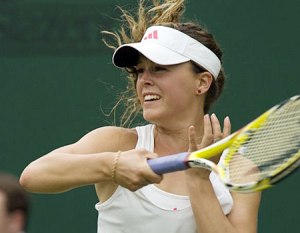
de Brito strikes a forehand on her way to beating Sharapova (Thanks to metro.co.uk) Michelle Larcher de Brito, the 21 year old Portuguese qualifier ranked 131, beat the world number 3 and 2004 Champion Maria Sharapova 6-3, 6-4 in the second round of Wimbledon on Court two, the infamous Graveyard of seeds.
Not only did de Brito outgrunt Sharapova, she outplayed her as well. De Brito jumped out to a 4-1 first set lead striking the ball with a ferocity of which Maria would have been proud. De Brito muscled the ball with all the power her 5 ft 5 inch frame could muster, and more. And, smartly, she moved the ball from side to side, keeping the ball away from Maria, getting her on the stretch and forcing her into error. De Brito never lapsed from her plan, breaking Sharapova to love at 4-3 before serving out the first set to take it 6-3.
In the second set, de Brito did not let up. She broke Maria at 1-1, the Russian double-faulting on break point. De Brito continued to move Maria side to side until she got the error or found the open court. Trailing 3-4, Maria took an injury time-out but it did not deter the young Portuguese who survived being broke point down, helped somewhat by Maria’s netting the return.
Maria being Maria, she kept on going for her shots, and at times it paid off as she fought off four match points. On the fifth match point though Maria was once more unable to get to the ball pounded away from her, hitting a forehand error on the run, and de Brito had a famous win.
In victory, de Brito finally fulfilled somewhat on the promise she had shown back in 2009 when her ranking reached 76 and she reached the last 32 of the French Open as a 16 year old in a game desperate for young stars. Since then she has struggled with her game and languished on the ITF circuit and in the qualifiers of the WTA. This win comes on the back of years of struggling and perseverance and mirrored the early glory days of Sharapova herself in its intensity and ferocious driving. For Maria, who complained after slipping three times and told the Umpire the court was dangerous, it was yet another bad loss on a surface on which she has had little success since her victory in 2004 other than her 2011 runner up placing.
How she will recover remains to be seen while how de Brito moves on, in a women’s tournament marked by the rise of the new era of WTA ‘youngsters’ aged 19-22, will be eagerly awaited.
-
Bouchard bombards Ivanovic on Center Court
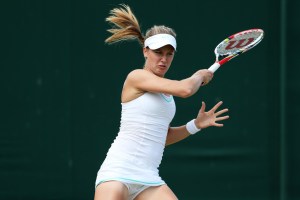
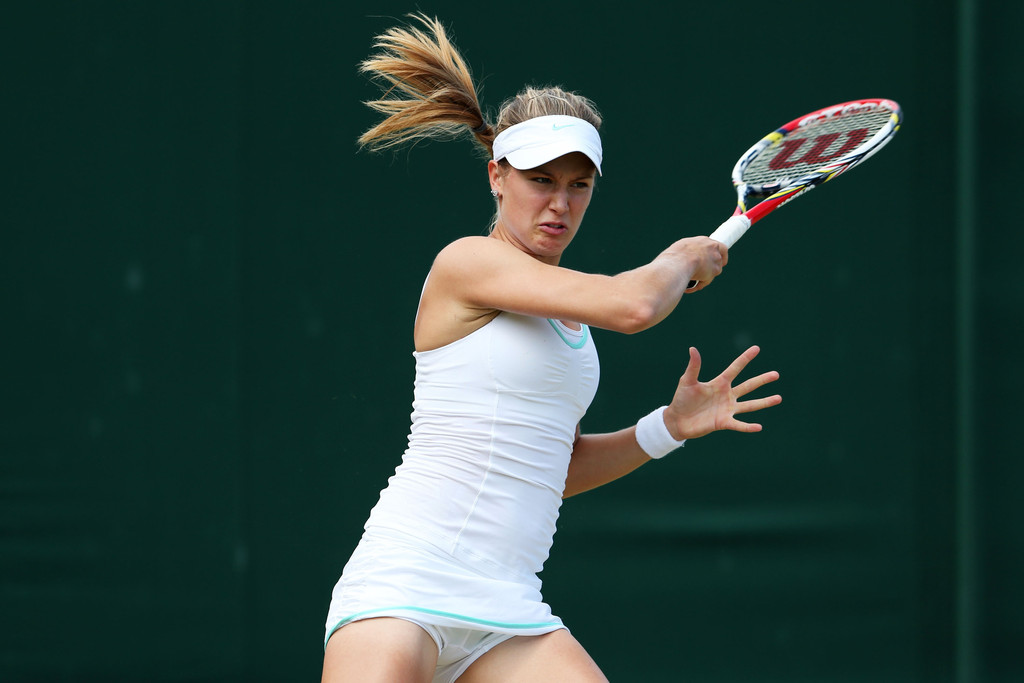
Eugenie Bouchard strikes a forehand (Thanks to http://www.zimbio.com) Eugenie Bouchard, the 19 year old Canadian and 2012 Junior Wimbledon Girl’s champion, beat twelfth seeded Ana Ivanovic 6-3 6-3 in 63 minutes in the second round of Wimbledon.
Called to Center Court 15 minutes after the withdrawal of number two seed Vika Azarenka, the 19 year old, a month younger than Laura Robson and ranked 66, played her Center court Ladies’ debut like it was her backyard and not the Grand ballroom of tennis, racing into a 3-0 lead, the Canadian’s patience and shot selection bettering the inconsistent Ivanovic.
Bouchard served out for the set and broke Ivanovic again at the start of the second. While Ana broke back for 2-2, the Serbian was broken again and could not take her own break point opportunities at 2-3, hitting a return into the net, once again going for the first strike when her timing was off. Bouchard on the other hand was the model of smarts, winning the game by setting up the winner with a deep ball before moving forward to strike a forehand winner of the short return to move ahead 4-2.
Serving for the set at 5-3, Bouchard faltered, double-faulting to hand Ivanovic the break point. The 2007 semi-finalist took the opportunity with a backhand down the line winner.
But serving to stay in the match, it was Ivanovic who double-faulted to hand her opponent match point. Bouchard overhit the return on the first one but on the second she hit the return deep to Ana’s body forcing Ivanovic into error and sending herself into the Wimbledon third round in only her first Main draw appearance.
-
Wimbledon: The second round preview

Gulbis celebrates last year’s Berdych upset
(thanks to blogs.bettor.com)
The stand out match of the second round men’s draw is Tsonga versus Gulbis. Both men have given great performances over the years on the Grass. Tsonga has had greater success than Gulbis with his defeat of Federer in 2010 but Gulbis played brilliantly in his defeat of Berdych in last year’s first round. While Tsonga has more flair than Gulbis and will attack the net more, Gulbis has the greater power and could just blow Tsonga off the court. However the Latvian is inconsistent and Tsonga will pounce if Gulbis gets off to a great start only to falter later on.Prediction: Tsonga to beat Gulbis in four sets.
On the women’s front, the stand out match ups are Kvitova versus Shedova and Bartoli and McHale.
Kvitova and Shedova could see an upset. Shedova plays an aggressive game and is the player who won the Golden set last year. Kvitova may be the 2011 Champion but has proven to be wildly inconsistent and has not performed well all year. If Shedova gets off to a fast start, Kvitova’s confidence, already fragile after the disappointments of the last couple of seasons, might go away. Shedova, with her experience of shock defeats, beating as she did defending champion Li Na at Roland Garros 2012, will not be affected by nerves and will be hungry for the upset.
Prediction: Shedova to win in straight sets.
Marion Bartoli can play badly better than anyone. Only a couple of players play a better bad match than she does and she can get matches deep into the third and then a few flashes of inspiration can win her the match. Her recent poor form suggests that she is ripe for the upsetting and Christina McHale, one of the leading up and coming players on the tour, will be ready to do her best to knock out the 2007 runner up. Bartoli though will relish the fight and will somehow find a way to take advantage of her opponent’s inexperience.Prediction: Bartoli to win in three torturous but tantalizing sets.
-
First round review: the performance round

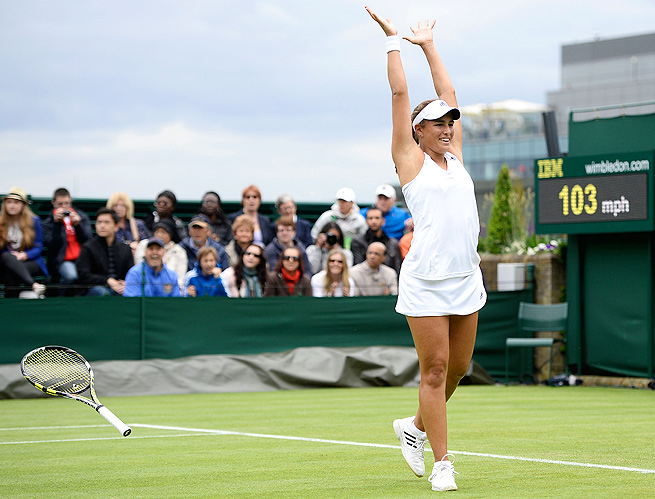
Monica Puig celebrates her upset of Errani (Thanks to sportsillustrated.cnn.com) The first round of Wimbledon was one characterized by the quality of a few performances. Devoid of epic five setters, or even a thrilling four setter, what stood out in this year’s first round was the play of a few underdogs, on paper if not class.
On day one, Monica Puig started it off as she knocked out Sara Errani in straights. This was a shock on paper at least, Errani being seeded fifth. However Puig, playing in her first Wimbledon main draw played like she was used to defeating such highly seeded opponents in Majors and not like a virgin on the Grass. And it was Errani who conceded a Golden set in last year’s championships, so her defeat was not entirely unpredictable.
The same cannot be said of the big shock of the first round, one of the biggest in Wimbledon’s history: the victory of Steve Darcis over fifth seeded Nadal in straight sets. At most, one would have expected a classic five setter and when Nadal went down two sets to love that is what most people expected. For Nadal to lose in straights to a man ranked 135 was unthinkable. But it happened because Darcis, who has had some success on the Grass in his career, played the match of his life; all those years on the tour and his aggressive mindset culminating in a performance that will likely overshadow all others the first week.
The final great performance of the first day was Hewitt beating Wawrinka, again in straights. Wawrinka is a hugely talented player having a career year but the 32 year old Australian, whose career years are a decade behind him, delivered what he loves doing: a performance to get the fists pumping on a Wimbledon show court. The man who defeated Federer in the Halle final three years ago played with the heart and gras court skills that saw him win the title in 2002 to knock out the Swiss number two.
On the second day of the first round one performance thrilled the crowd more than any others: Laura Robson’s straight sets defeat of tenth seed Maria Kirilenko. Robson played with utter conviction to move into the second round, playing first strike clean hitting tennis worthy of a Davenport and exciting in us ideas of her pulling off, if not this year then in the near future, a 1999 Davenportesque Wimbledon run.
-
Robson KOs Kirilenko in Wimbledon first round

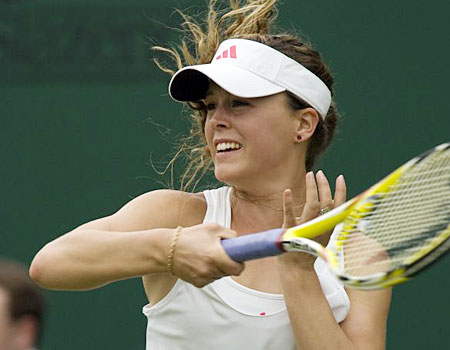
Robson on the run (thanks to http://www.wimbledon.com) Laura Robson did something we had not seen at Wimbledon for some time in beating tenth seeded Maria Kirilenko on court number one in the first round. Not only did she take out a highly-seeded opponent on a big court but she did it with the conviction one has come to expect of the uber-confident young Eastern Europeans of the last decade or that was so common with the young Americans of the nineties.
A season that started so well with her epic win in Melbourne over Kvitova but dwindled into a series of early defeats perked up again on the big stage, a stage Robson likes shining on, a factor missing from British female players the last couple of decades.
From 3-3 in the first set Robson did all the things she did well and better than she had done for a while. Robson served big and moved forward to put away the short balls. She went down the line on both wings to hit winners. And she did well with her weaknesses, too; her movement much improved. Romping into a 4-1 lead in the second set, Robson looked like it was she who was the top tenner and not her experienced opponent, a player tasting top ten success for the first time the last month.
At 4-1 Robson stumbled and her opponent took the chance to execute her game plan, taking the ball early and moving Robson side to side, a game plan that until Robson had begun to think about the prospect of an upset had been subdued by the inspired Briton’s play. With that play now dipping, Kirilenko broke Robson for 3-4.
Fortunately for the British fans and Robson, the lapse was just a temporary and very human glitch; Robson picking up her game again to hit the ball with all the cleanness and precision of a perfectly programmed machine to hold serve for 5-3.
At 5-4, Robson served for the match. Kirilenko did her best to get back into the match, moving Robson side to side and coming in to strike a forehand winner to take the first point but Robson was not to be denied. Playing with her strengths, she was also in control of her weaknesses. Try as Kirilenko might, she could not exploit them. At 30-15, Robson ran side to side to chase down the deep balls struck by Kirilenko and sent them back with interest to force the net-waiting Russian into error on the volley to get her first match point. A nervous Robson faulted on the first serve and had to throw the second service ball twice. She hit it in though and then took on the deep return to her body to hit a forehand cross-court winner, her 31st winner of 62 points won, to seal the match 6-3 6-4 in 1 hour and 18 minutes.
Robson now has a chance to move through the draw and take Kirilenko’s place in the last sixteen where a scheduled encounter with Serena Williams awaits. For a woman who has taken out the likes of Clisters, Li Na and Kvitova in Majors on the big courts, such a prospect will fill her with the correct concoction of nerves and excitement to allow her to compete with the confidence and clear-thinking, clean-hitting play we are coming to expect of a very un-British and very world-class female tennis player.

Tennis from a fan's point of view
[
[
[
]
]
]
 thetennisreview