-
Dashing Darcis dices up Nadal in Wimbledon first round upset
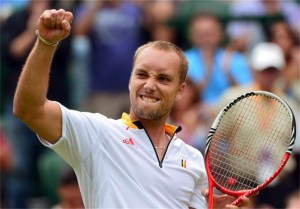
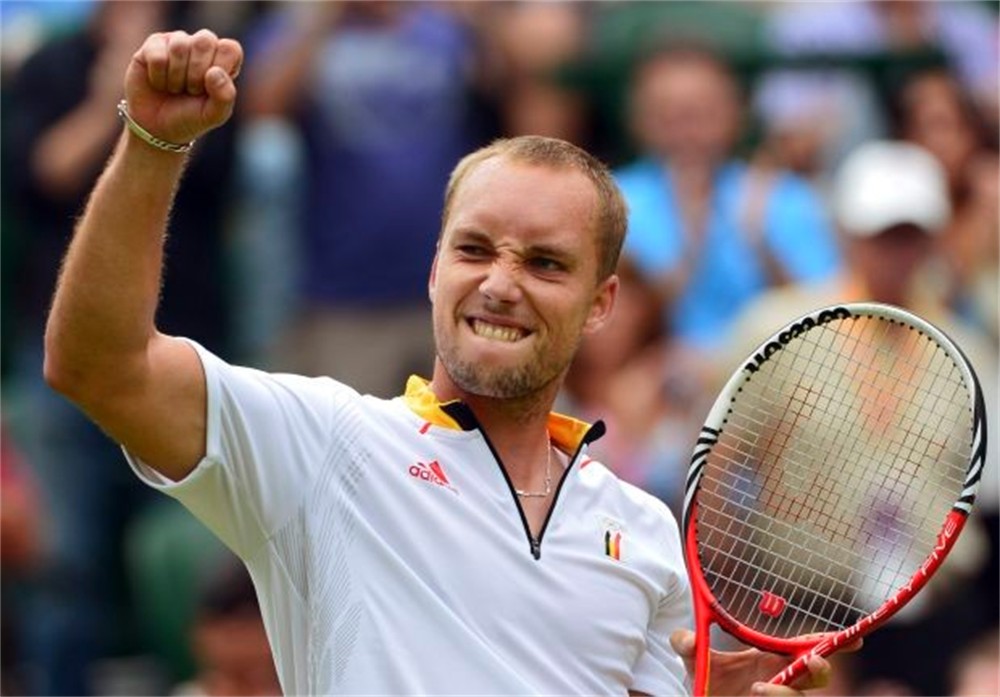
Steve Darcis celebrates
(thanks to http://www.spelaspel.se)Steve Darcis, the 29 year old Belgian ranked 135 in the world, has not been up to much on the ATP tour this season, winning only one main draw match. But today, playing against the two time former Champion Rafael Nadal on court number one, Steve Darcis got up to something quite big, winning as he did 7-6, 7-6, 6-4.
Darcis’ grass court form did not come out of nowhere. In 2012 he made the semi-finals of Eastbourne and, a couple of months later, he beat Tomas Berdych in the first round of the Olympics. Darcis’ game, one which has taken him as high as 44 in the world, has strengths which grass rewards. First, there is his big serving, which in this match delivered 13 aces and won him 74% of his first serve points. Then there are his powerful ground-strokes struck from inside the baseline and followed up with forays to the net. Such qualities made him a dangerous opponent in the first round for an opponent who had not played a professional match on the grass this season. But dangerous is about as far as most people thought it would get for Nadal, the very recently eighth-time crowned Roland Garros champion and a five time Wimbledon finalist.
Darcis was certainly in the right place at the right time for a historic win. Nadal, as his defeat to Lukas Rosol last year testified, is most vulnerable in the first week of Wimbledon when the Grass is at its fastest, its bounce at its lowest, more trying on the knees. But Rosol was a rare breed, an opponent blessed with great grass court skills and the strength of mind to seal the deal, succeeding where many had failed. Close escapes by Nadal against lowly ranked players such as Hendrick, Hasse and Petzschner in final-making years were down to the Spaniard’s improved serving and slicing skills and his refusal to go down without a fight but in those days the knees were able to better withstand the pressures of playing on grass. Last year and this year though Nadal has not proven to be the superman he once was.
Darcis though was stronger than he has been for a while. In the first set, Darcis stayed with Nadal all the way to the tiebreak, and the closer matters got, the louder the murmurs of an upset grew. Those murmurs became quite excitable when the Belgian got the better of his illustriously decorated opponent, the prospect of an unlikely upset ahead.
Darcis grew in confidence, his play more fitting of the status of the fifth seed than a man struggling out in the hundreds. The Belgian kept on playing aggressive, high risk tennis, breaking the Spaniard at the business end of the second set. But Nadal, reminding us of his famous never-say-die spirit, broke back. In the tiebreak though it was Darcis whose game was more alive, producing as he did the more attacking-minded play, play which saw him take the set and lead the Spaniard by two sets to love.
Inspired, Darcis went on the break Nadal in the opening game of the third set. And run as Nadal did, he could not run enough to chase down the flatly struck backhands and heavy forehands that fired his way and past him. Darcis held his nerve where others had failed as he ran away with the lead. The Belgian held his serve to put himself into the position to serve out for the match at 5-4. Darcis, who had been smiling throughout the match earned himself three match points and sealed what will go down as one of the biggest upsets in Wimbledon history with an ace.
His victory lit up on the scoreboard, Darcis’ face was lit up with yet another smile. Only his second victory at the Championships, a historic one, too, being Nadal’s first first-round defeat in 35 starts at Majors. A famous victory worth smiling about, one wonders how big the smiles were on the faces of Murray and Federer. In a game where match-ups are everything, the removal of their Major bete-noir will aid their title hopes no end. Darcis though might have something to say about those chances, his inspired play and confidence suggesting he will not shy away from removing those smiles off their faces and keeping his own lit up on the Grass courts of SW19.
-
Murray and Federer win Wimbledon warm-ups
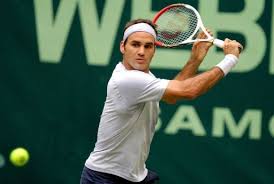
Federer gets ready to slice in Halle (Thanks to france24.com) The Grass ‘season’ is already one week old and a quarter finished. After three months of playing on clay the players move to the Grass no sooner as the red clay has been brushed off Rafael Nadal’s shoes. The players have about the same amount of time to get their games together for the Grass with only a couple of warm-up tournaments for what is still the sport’s most prestigious event, despite the sparing use of its surface, Wimbledon.
They don’t have to adapt too much though, a few hours practising slicing and getting down for volleys being more than sufficient. It is after all no secret that the Grass is not as green as it once was for attacking players; serve and volley having been weeded out more than a decade ago, the seeds sown for the modern game of tennis to bloom.
That Roger Federer should have blossomed in that time frame is a blessing for the game, covering up the slowing down of the grass as well as the tarpaulin protects Wimbledon’s Centre court from becoming mud. Federer’s all court talent would bloom on whatever surface he played on and while Nadal and Djokovic’s successes in SW19 have raised questions, Federer’s victory last year over Andy Murray, whose variety, hands and touch are complemented by the still lower bounce of the Grass, drew enough oohs and aahs to silence those who still hanker over aces and forays to the net but who have been bowled over with Federer’s all-court beauty.
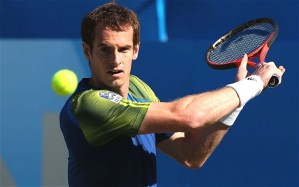
Thus with the grass season rolling round again, we started from where we left off in July 2012, with Roger Federer and Andy Murray winning the big warm ups in Halle and Queen’s club. While neither title is a Masters, with Grass being excluded from that series despite the game’s premier title being competed on it, they are the most important warm ups historically and timing-wise, being played in the first week of the season and so meaning those playing at the business end have a week to practice and rest, some match play in hand, before the Big W.
Federer and Murray’s victories had similarities. Both played against distinguished and proficient grass court players in Youzhny and Cilic respectively. And both went down a set to love. But being as they are the more skilled and being of superior grass court pedigree, both Federer and Murray pulled through, their consistency and better match play also telling factors. For Federer it was his seventh title in Halle, and his first title of the year. For Murray it was his second title of 2013 and his third title at Queens. Both men’s victories point promisingly to another successful Wimbledon run for both men on a surface which while much changed is still a tennis court and so still rewards the classiest and most flairsome of games.
-
Lessons from the French
So, with the French Open over, what did we learn from the finale to the 2013 Clay season?
1. Rafael Nadal is the Greatest Clay court player ever…ah wait. We already knew that. But we learned he, the greatest champion at any of the Majors ever, is even Greater than we thought.
2. Serena Williams is a bona fide GOAT contender. She has two of each Major now, like Navratilova. She is having another dominating period a decade after her first. She owns all her rivals. There are no more asterisks. All she can do is add to her tally and strengthen the arguments in her favor.
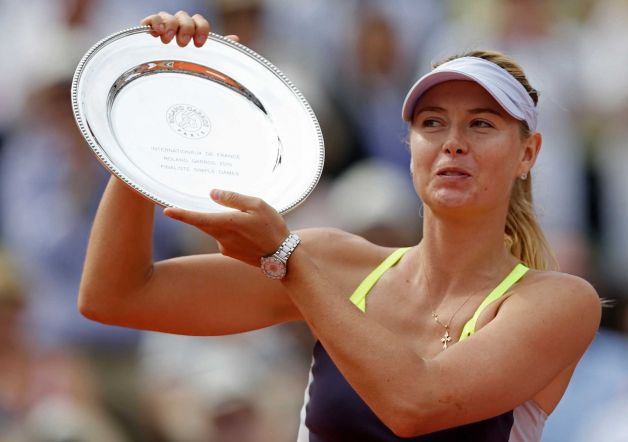
3. Maria Sharapova is tennis’ greatest loser. No one loses with more dignity. Each loss to Serena makes her even more human and an even greater player.
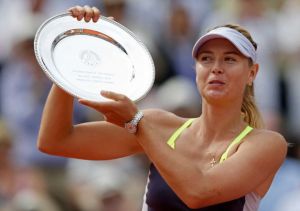
Maria Sharapova, dignified in defeat (thanks to mysanantonio.com) 4. Richard Gasquet is not done. Not at all. He may not have delivered on his promise and the seasons are closing in on him but his aggressive play in his last sixteen defeat to Wawrinka suggested the best is yet to come. And if that means we get to see his delicious backhand again and again then that is a huge thing to be happy about.
5. Stanislas Wawrinka is wonderful. Ah, we learned that in Melbourne so it doesn’t fit the ‘lessons’ criteria. Still any excuse to write Stanislas Wawrinka is wonderful will do.
6. Tommy Robredo will go down as one of the game’s biggest fighters. That win against Gael Monfils started it, that victory over Amalgro sealed it. Age and struggle seems to have swelled the Spaniard’s heart and his emotional responses to his wins told us of depths that we hope to see gone to again.
7. Clay rules. But yeah we knew that already, too. Match after match we were treated to spectacular twisty turny tennis that tennis fans deserve to see and enjoy. Roll on Roland Garros 2014!
-
Nadal defeats Ferrer to win eighth title at Roland Garros

Nadal falls on his back after winning a record eight Major title at Roland Garros (Thanks to telegraph.co.uk) Rafael Nadal defeated David Ferrer in straight sets to become the first man in tennis history to win eight titles at one Major.
Nadal was the heavy favorite before the match but the start of the match suggested it would not be as easy as some had predicted. The match began in a scrappy fashion. Nadal broke for 2-1. Ferrer broke back. At 3-3 Nadal broke again, and then again, quelling the dogged Ferrer resistance at 5-3 before serving out the set.
In the second set Nadal went on a winning spree from 1-0 30-30 to lead 3-0, the winners, particualrly on the forehand falling from his racket like rain drops from the sky. Ferrer managed to get back into the set to take the fourth game, saving two break points. Ferrer then threatened to break Nadal but Nadal saved Ferrer’s fourth break point with a cross-court backhand after perhaps the best rally of the match where Nadal showcased the retrieving skills and the ability to magic defense into offense that had made him the seven time champion. A service winner and a backhand down the line winner and Nadal led 4-1. Nadal went another run now, his forehand at its aggressive best, a political protest in the stands and Ferrer’s own doing its best to derail him but failing as he once more broke with a cross-court forehand winner to lead 5-1.
At this point bodyguards ran onto the court to deal with a protester who had jumped onto the court with a flare. Nadal took a few seconds for the fuss to die down, no less than he would usually take between serves, and then proceeded to get on with business. But the incident had disturbed him, putting out the fire in his own game. A double fault handed Ferrer two break points. Ferrer seized his chance, taking the first with a backhand volley winner. But Ferrer fell apart in the next game, going down three break points and misfiring on a forehand cross-court to hand Nadal the set.
Nadal started the third set as he had ended the second. Focused and full of flair, he broke Ferrer with a forehand volley to lead 2-0. Ferrer fought back though, earning three break points. Nadal saved the first with a forehand down the line on the stretch. But a Ferrer angled return pulled Nadal too far out the court and the defending champion netted the backhand. Having broken back to get back into the set, Ferrer’s serve did not let him down this time as he served out to love.
At 3-3, Ferrer earned a break point with a backhand down the line winner. But he could not convert, his forehand going long on the next point and then going long again two points later to hand Nadal the game. Serving at 3-4, Ferrer tried his best to withstand the Nadal onslaught of forehands but the pressure was too much as he made errors and on his second break point he double faulted to gift Nadal the opportunity to serve his way into the history books.
Nadal keeps the ball deep, draws errors and after two hours and fifteen minutes a service winner out wide brings him two championship points. The seven time champion makes it eight times. A serve out wide, the ball comes back to his strike zone and fittingly Nadal confirms his status as the greatest clay player in history with an angled forehand cross-court winner.
Nadal falls on his back and covers his face. After seven months out of the tour, this was the seventh title since his comeback last February and while he was always going to be the favorite to win here, his absence from injury and the continuing fine play of Novak Djokovic had cast some doubts on his chances. Nadal, as he has done over and over in his career, proved all the doubters wrong in winning his eight Roland Garros title and his twelth Major title. Still only 27, if Nadal’s knees can hold up, the limit to how many Coupes he can bite his teeth into are limited only by how many more French Open he competes in. And the potential to end his career as the Greatest player of all time and not just on clay are only limited by his own mind and hunger, two aspects which he proved the last two weeks were as strong as those teeth that never seem to chip on those trophies.
-
Serena sails to sixteenth slam in Paris
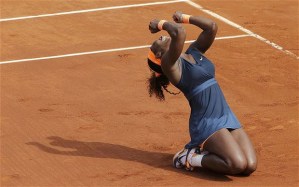
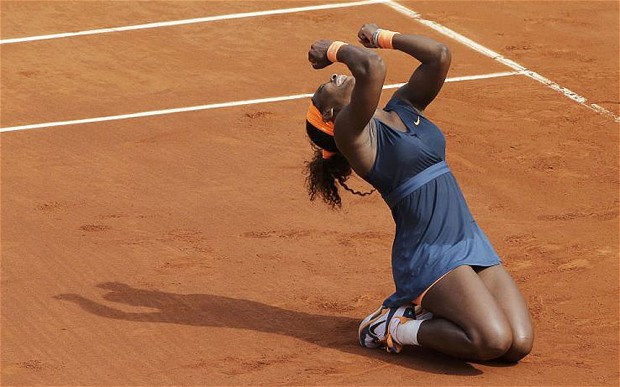
Serena Williams celebrates winning her second French Open (Thanks to telegraph.co.uk) Serena Williams won her second Roland Garros title and her sixteenth Major in Paris today. The American not only capped off what had been an all consuming clay season but also further stamped her dominance on rival Maria Sharapova. And in conquering her demons at Roland Garros in such devastating fashion, Serena went some way to answering questions about her potential status as the greatest player of all time.
At the start of the match, the Russian looked like she had it in her to do something about her own demons: that nine year dominance her rival has over her. Coming back from 0-40 in the first game to hold serve, Sharapova then broke and held to 40-15 in an eighteen minute opening streak which delighted the crowd, keen not to have paid through the nose to witness through their fingers yet another thrashing. Serving into Serena’s body, hitting wide to her forehand and down the middle, the Russian could not have executed better and her performance was rapturously received.
However demons in the deadly shape of Serena are hard to defeat unless one’s weapons are at their sharpest and the Sharapova serve, the weapon she would need to be at its best if she were to slay Serena, did not hold up. Sharapova failed to get in enough first serves and Serena took advantage, playing some sharp returns to break for 2-1. With the match back on serve, Serena then broke again with a return winner to lead 3-2 and held serve for 4-2. Sharapova though, desirous to defend her title, kept hitting wide to the Serena forehand and earned the errors to break back for 3-4 before holding for 4-4.
This encouraging resistance from Sharapova was, despite the crowd’s support, short-lived. For not even the will of 15,000 people and Sharapova was enough to prevent Serena from achieving her goal through the execution of her best game; a game improved and driven by her will, a game too much for the Russian to overcome on a couple of crucial fronts. First, the Sharapova serve was just not good enough when up against Serena’s return, one of the best in the business. Secondly, the Sharapova ground game was not up to the task of challenging Williams’, its predictable nature feeding the William’s strengths, only too evident on break point at 4-4 as Serena took on a high bouncing flat ball into her strike zone and hit an angled forehand winner to lead 5-4 and serve for the first set. She did it with the conviction one would expect from the greatest women’s server of all time.
A set to the good, Serena just got better. Her return piled pressure on Sharapova and at 1-1 Serena got an early and ominous break. Serena’s own serving made it more so, her service games as simply won as her serves were struck. And while Sharapova worked hard to win her own service games, she never looked likely to get the break back. At 5-4, Serena Williams served for only her second Roland Garros title. Two aces brought her to 30-15. A serve out wide and a backhand winner off a short return and she had two championship points. Fittingly, for a player of her serving ability, Serena Williams sealed her sixteenth Major title with a 198 kmph ace.
The world number one spun around and fell onto her knees. She shook her fists and roared at the skies. After her disastrous exit in the first round last year, Serena Williams had re-invented herself; no longer the greatest could-have-been player, she turned herself into a contender for the title of greatest player ever as she won three of the last four Majors to bring her haul to sixteen.
While the jury is still out on whether or not she is the greatest of all time, her celebrations were worthy of her coming a step closer. Not only had this victory achieved that though, she had also exorcised demons, demons that drove her to a title that had proven so elusive and whose swirling around her had raised questions as to her ability. Having defeated those demons in such convincing style, one wonders just how high she will climb up the Major titles list, the last bastion of the Greatest ever argument, the list that if she can sit atop all arguments will be laid to rest as she takes her place where so many believe she belongs.
The question is: does she believe? Perhaps that is the last demon; the one we now wait to see defeated.
-
Nadal and Djokovic magic up dramatic tussle in Paris

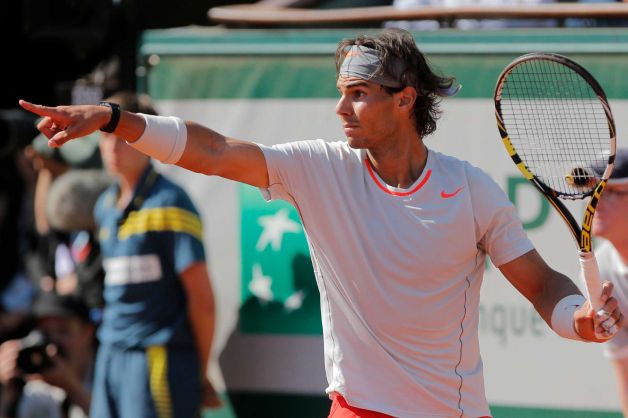
Nadal points out Djokovic touching the net (Thanks to stamfordadvocate.com) Before Roland Garros ’13, there was only one name on people’s lips regarding the question of who could prevent Rafael Nadal from winning the tournament: Novak Djokovic. When the draw was made and the two were pitted to meet each other in the semi-finals, those same lips said it was the final before the final, the match of the tournament. For now, for we still have to see the final, those lips are, arguably, right.
One wonders if Nadal is a practitioner of the dark arts for the conditions the match was played in could not have suited him better: 28 degrees, not a cloud in the sky; the court was dry, the balls bouncing high. He broke Djokovic in the middle of the first set, his forehand proving to be the weapon most on fire. Nadal steamed ahead, breaking early in the second set, too, in what was a masterful display by the seven time champion.
Novak Djokovic has his own mastery, too. He is a master of comebacks. No matter how down, he is never out. After his coach gestured him to follow through further on his shots, he did just that, the improved technique adding fuel to his fightback. Finding form on his own forehand, the Serbian broke back. He then broke again and successfully served for the set. A set all, both men playing well, the drama ahead looked assured.
The drama was closer than we anticipated. Early in the third set, on a break point for Nadal, a Djokovic cross-court backhand is called long by the umpire who, along with a close-by Nadal, sees marks which hawk-eye shows are not there. Nadal is awarded the break and runs away with the set 6-1 as Djokovic deflates, the air out of his just pumped up chest fizzling out. Let down it seems by the pinprick of questionable officiating, his play becomes as passive and hopeless as Nadal could have dared to magic up.
In the fourth set, 6-5, Nadal serving for the match, the winds pick up, and Djokovic begins to inflate again, his back being against the wall pumping him up. The Serbian breaks a Nadal struggling with both serving into the wind and with an opponent who seems to have conjured up the Nadal-beating Djokovic in Monte Carlo. In the tiebreak, Djokovic, nailing forehand after forehand, breaking down the Nadal backhand, plays the kind of tennis he should have done from the beginning, to win the breaker and take the match into a decider.
Djokovic breaks early in the fifth. Nadal breaks back. Djokovic breaks again. The drama is escalating. At 4-3, Djokovic serving, it peaks. Djokovic retrieves a drop shot only to fall at the net, his racket touching it before the ball has bounced twice. Nadal points out the breaking of this rule. Djokovic argues with the umpire that the ball was already out the court. The umpire though has studied the rule book more closely. He does not see for the illusions Djokovic attempts to cast and gives Nadal the point. Nadal goes on to break back.
Service games are held and three times Djokovic serves successfully to stay in the match. At 7-8, after being informed that his request for the courts to be watered down is not going to happen, Djokovic falters, the wall he is up against finally seeming to hard to climb. A set that had been played at a high level, Nadal’s forehand as strong as ever, Djokovic at his aggressive best, ends on a dud game. Djokovic errors, a netted smash, one of a few too many in the match, while other errors are produced under the onslaught of a Nadal playing in his element, and the Spaniard breaks him to love to win the match.
The match was a microcosm of sport, Nadal claimed in his post-match interview. Just like in Australian ’12, the momentum had swung back and forth, and the outcome could have gone either way. Back then it was Djokovic, today it was him. Humble words. That may have been true in Melbourne but on a court where Nadal has lost only once in his career to a man who hit him off the court from first ball to last the chances of Nadal losing to a game plan less than that are far less than his modesty allows him to admit. No doubt he will compete against Ferrer as if the many lips that spill words of his inevitable victory are the babblings of madmen. Only Ferrer, though, can prove that to be the case. A trip to the local sorcerer, some sips from a potion, and who knows what magic the first ranked Spaniard Ferrer can conjure up. It is sport after all, as Nadal so keenly proclaims, and as shown in this match between Nadal and Djokovic, spells and trickery can conjure up some mighty magical moments.
-
Maria the victor over Vika
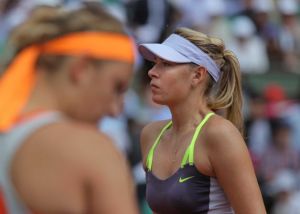
Maria Sharapova and Vika Azarenka face off in Paris (Thanks to mysanantonio.com) Facing Vika Azarenka is a nervy affair for Maria Sharapova. The Belorusian has inflicted some heavy defeats on the Russian the last few years, her more consistent ball striking and superior movement getting the better of her rival in some very one-sided encounters. For Maria to defeat Vika she has to play her aggressive best, going for winners, taking risks. If Maria is having one of her good days, like she did in Stuttgart and Istanbul last year, her ferocious strikes paint the lines and she can take the victory. If not, the errors mount, the nerves jangle as loudly as the grunts and we get Melbourne ’12.
This was their 13th meeting, a head to head led by Maria 7-5, and their first of the season. On a surface which Maria has flourished on the last few years, the Russian started out the favorite and quickly demonstrated why she deserved that status as she took the first set 6-1, taking control of the points early and overpowering the number three seed. This was how she had to play to win this match and she could not have executed her game any better.
But against Vika, matters are rarely that simple.The Belorusian can hunt down more balls than most and can expose her opponent’s weaknesses ruthlessly. Leading 3-2 in the second, with Maria serving, Vika held a break point. She went to work, hunting the ball down and hitting it back with depth and spin until she found what she was looking for: an error from Maria, this one from the backhand.
Vika keeps working away, holding her serve. She does not have to do all the work though; a rattled Maria helps her along. At 5-2, Maria serving to stay in the set, she stopped the point at 15-30, claiming the ball was long, a claim the umpire did not support. Down 15-40, Maria saved the first set point with an ace. On the second one, she went for too much on the second serve, hitting a double fault to save Vika from sweating it out for the set.
A deciding set and with Maria in this mood, it could go either way. We have to wait to find out which way it will go though. Rain comes and the players are brought off the court, a twenty five minutes delay for a couple of minutes downpour. The two come back on court, warm up all over again, the umpire re-introduces them and the battle recommences.
Maria seems more settled after the break. A word or two with the coach re-affirming what she seemed to have forgotten: her aggressive play on clay, executed firmly, calmly and patiently, will overwhelm Vika. Maria gets to work and breaks at 1-1. But in the next service game Maria double faults twice to go down 15-30, preferring to go for it on her second serve rather than be outdone by Vika’s returning. A backhand cross-court long from Maria and she is down a break point. She saves the first with an ace. Another backhand cross-court long and another break point. Maria serves out wide and hits a forehand winner off a short ball. But she cannot string together two winners in a row, erroring where in the first set she was winning. On her third break point down, Maria double-faults again, once more gifting her opponent an important point.
Unfortunately for Vika, she cannot capitalize, making errors of her own to go break point down. Maria takes her chance, hitting a forehand cross-court winner to move ahead 3-2. She fights off further break points in her next service game and strides out of trouble with an ace. At 4-2, Maria strikes a huge backhand return to break Vika and serve for the match.
Maria goes down 0-30. A welcome ace, a running backhand down the line winner, a forehand down the line winner and Maria has a match point. She errors, a missed backhand down the line. On her second match point, her backhand hits the net. Back and forth goes the score, break points, match points, and back and forth swings the Sharapova game. Winners, errors, service winners, double-faults. It is the latter which decided matters, two double faults at deuce dropping her serve.
Vika holds, steady as ever while Maria hits error after error. At 5-4, Maria has another chance to serve out for the match and prevent it going 5-5, as nervy a situation as a Major semi-final can be. Maria serves out side, steps into the court and fires a forehand winner. She hits a service winner. An onslaught of ground-strokes forces Vika into error. Three points she could not have played better in a row when she most needed them. Three match points. She needs only one. An ace and the nerves are settled. Maria Sharapova is into her second Roland Garros final in a row. And there awaits the nerviest of nervy affairs for Maria: a match against Serena Williams.
-
Tsonga tames Federer in three

Tsonga celebrates his win over Federer (thanks to telegraph.co.uk) Roger Federer’s exit from the French Open was as tame and brief as his fight to make it to the quarters had been wild and long. And his opponent Jo-Wilfried Tsonga’s game was as clear and clean as Federer’s was unkept and error-ridden.
That it should be Tsonga who beat the 2009 Roland Garros Champion is both a surprise and not one. Tsonga has beaten Federer in a Major, at the Wimbledon quarter final stage in 2010 no less, and he has the aggressive, powerful, all-court game that on its day can beat the best in the world as multiple wins over Federer, Nadal and Djokovic testify. Yet despite his ability, the Frenchman often flatters to deceive, playing well up to a point before going away, or not appearing at all. For evidence witness his loss to Djokovic at this stage of Roland Garros last year when he failed to convert no less than four match points on his way to defeat, or look at his Major record since the Australian Open 08: nine exits before the quarter final.
But armed with a new coach in Roger Rasheed, Tsonga has improved his weaknesses, namely his backhand, and harnessed his strengths. And playing a Federer on a reduced schedule in the quarters of his home slam was a great chance to show off his improved game.
And show off he did. Fighting back from 4-2 in the first set, his heavy forehand attacking the Federer backhand and breaking it down, his forays to the net whenever the chance arose putting the Swiss under pressure, Tsonga did not let an opportunity to shine slip. He broke at 6-5, a missed forehand down the line from Federer gifting him his fourth set point and a shanked Federer forehand handing him the set. With his own aggressive play and Federer’s errors, Tsonga capitalised further in the second set, breaking to love in Federer’s opening service game. The Frenchman did not look back. At 5-3, two more Federer forehand errors gave him two set points. He took the first one with a service winner to lead the number two seed by two sets to love.
A deflated Federer tried to change things up a little by coming to the net more but he missed more than he won and before he knew it he double-faulted on break point. Federer rallied in the next game, the smell of imminent defeat putting some spring back into his step, breaking Tsonga with a forehand return winner off a second serve. From a man who can never be written off, this fightback looked promising for a while as Federer stayed with the Frenchman for the first half of the set. At 3-3 though a missed Federer smash and another forehand error handed Tsonga two set points. Federer tried to stave off the first with a drop shot but Tsonga retrieved it and sent it back at Federer, accidentally hitting him in the process. At 5-3, with Federer serving to stay in the tournament, the Swiss hit a backhand volley long and Tsonga held two match points. Federer saved the first with a smash, a brave move considering his previous failure. Perhaps such play might save his skin. But it was not to be. Another error, a backhand hit long, and Tsonga was into his first French Open semi-final.
Unlike in his disaster a year ago, Tsonga did not blink, but the lights were not shone in his eyes. His eyes were certainly shining though after winning the match. A semi-final in his home Major against David Ferrer, against whom he has a 3-1 head to head lead, is a prospect he can look forward to. And if he can produce his best tennis on the day as he had done against Federer then there is a very strong chance that France may have its first male finalist at the French Open since Leconte in ’88, and who knows, maybe their first champion since Noah thirty years ago in ’83, a time before Jo-Wilfred Tsonga was even born.
-
Wawrinka wins a battle beyond backhands alone
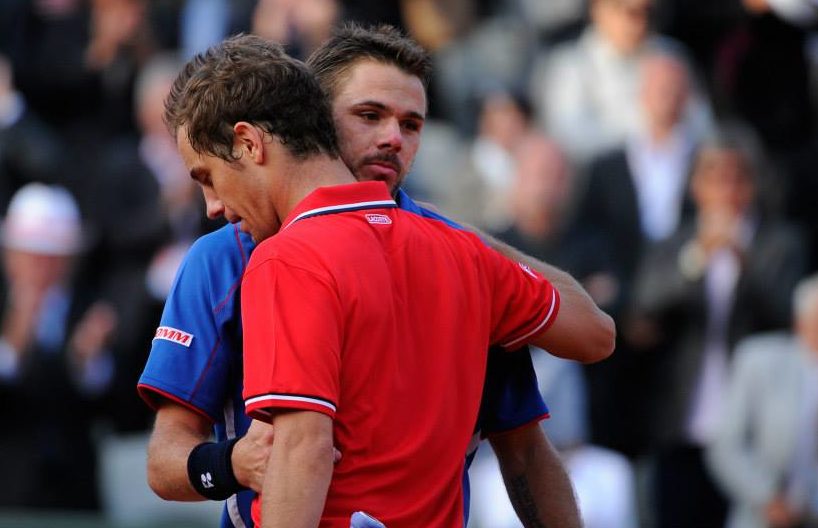

The battlers congratulate and commiserate at the net (Thanks to tennis.sportrightnow.com) Stanislas Wawrinka and Richard Gasquet battled for four hours and twelve minutes in the last sixteen of the French Open in a match that went beyond a battle of the backhands alone. This was a match that would be settled by not only their strengths but their weaknesses, too. For while both men are famous for their single handed backhands, they also share infamy. Each man has let slip winning leads in Major matches: Wawrinka against Djokovic in Melbourne this year; Gasquet on four occasions enduring the nightmare of losing matches from a two set lead. Such defeats linger in a player’s psyche as much as their knowing their famed shots can decide matches and, in a match expected to be close, how each man handled the pressure, and fear, of winning would be as much a decisive factor as finding enough angle on a cross-court backhand to open up the court.
With Gasquet being French and with the history of hype he is weighed under, the pressure was greater for him before the match even begun. The paper also piled on the pressure being as he was also the higher seed at seven to his opponent’s nine, an opponent the top eight seeds would have most feared facing in the last sixteen. Wawrinka has been one of the form players of the season and while Gasquet has also enjoyed success, winning two titles, Wawrinka’s play in Melbourne and recent run in Portugal and Rome has been more illustrious and, more importantly, a lot of it on red clay.
The first set was as close as it could be between two such well matched players and the quality was as expected. It was Wawrinka who seemed to be getting the better of the two, holding multiple break points and hitting more winners; but, crucially, on big points and longer rallies, more errors, too. And in the tiebreak Gasquet’s superior defense got the better of the Swiss number two’s attack as the Frenchman got a mini-break and led 6-4. Wawrinka’s saved the first with a forehand cross-court winner but could do nothing about the second. Gasquet won the set with a service winner and then roared and fist pumped like he had not just won a set but the match.
Perhaps Gasquet, knowing that his fitness was inferior to Wawrinka’s, felt that the outcome of the match lay in who would edge a tight first set. He certainly played that way, accomplishing what Wawrinka had failed to do on seven attempts in the first set on his first opportunity, breaking the Swiss at the start of the second set, Wawrinka’s backhand unable to handle the variety of depth and spin of Gasquet’s defense, a defense that broke down his offense. Now, the rhythm all Gasquet’s, the Frenchman was full of confidence, not only defending as he is famous for, but attacking, too, finding the angles on his backhands and moving forward, too, showing off his fine forehand. Breaking again for 4-0, the Frenchman was handling the pressure better than anyone had anticipated.
Wawrinka holds for 4-1 and then calls the trainer. How Gasquet would handle this interruption would be crucial. He handles it well, holding serve. At 5-2, he serves for the set but was broken by an opponent full of confidence and desirous to give as good an account of himself as he can. At 5-4, Gasquet serves for the set again. Wawrinka held more break points. Gasquet serves down the tee and moves forward, drawing an error from Wawrinka. The Swiss errors again on the next point, clumsily sending a volley long. Another set point at a point of the match where Wawrinka is gathering speed. Gasqeut rises to the occasion, serving an ace. He celebrates accordingly. A two sets to love lead in a big match in a Major. A height he has reached before; a height best not looked down if he wishes to climb further.
But it is, of course, not all about Gasquet. Wawrinka wants to climb further, too. And, grabbing the momentum he was building in the latter stages of the second set, he begins his ascent, an ascent he angrily begins to take on as drama unfolds that threaten to overshadow the drama of the match itself. At 2-2, Wawrinka serving, a call comes so late on the serve that the point is already in play and Wawrinka in a winning position. Play stops; Wawrinka erupts. He demands for the line official to be changed. Fuelled by the sloppiness, Wawrinka’s game sharpens. Two service winners, a cross-court forehand winner and the game is his. Wawrinka asks where the new line judge he was promised was, gets some strapping, and then gets on with the business at channeling his anger with the officials, his injury, his-self. It is business he deals with brilliantly, breaking Gasquet at 5-4, a down the line forehand winner sealing him the set.
A match that had looked in the second set to be something of an anti-climax now hit the peaks predicted in pundritry; a twelve minute game at 4-3 Gasquet serving so exquisite that if ever an argument were needed to defend a tennis fan’s love of the game, this game would be given as evidence and the Judge and Jury would collectively overturn the case and start working on their single-handed backhands. It was a game not just decided on that shot alone; a game where every shot in the book was played, a text-book perfect rendition of forehands, volleys, drop shots, single handed backhands, lobs, smashes, flavored with flair and passion and from Gasquet a much welcome show of aggression, none more crucial than the game point he held when he served out wide and then moved forward to clinch the game with a backhand volley winner.
After such a game, the quality might be expected to lessen, but the winners kept coming. At 5-6, Gasquet serving, Wawrinka with a backhand drop shot that Gasquet rescues but hits long. In a set seasoned with points decided on winners and nothing else, it was fitting that Wawrinka, after working his way into the point with his backhand should unleash a forehand down the line winner to level the match at two sets all against an increasingly fatigued looking Frenchman.
By now, Gasquet must have felt not just tired but dizzy. Dizzy with the excitement of playing so aggressively in a big match and dizzy at how his two sets lead had slipped away. Wawrinka, too, must have been giddy. He had been the runner-up in as equally a thrilling contest in Melbourne against Djokovic where he had led by two sets to one only to look down. The crowd were dizzy, too, and had to hold on to the railings as the match went deep into the fifth set. Service games were held with relative ease, the points being kept short more often than not to reserve energy for the business end of the match. And when that came at 5-5, the crowd were on their feet as Gasquet held two break points. The first one Wawrinka saved at the net, turning the rough passing shot fired at him into a silky winning volley; the second one saved for him when Gasquet overhit a forehand. A service winner and a forehand down the line and Wawrinka had survived the first crisis point of the set.
At 6-7, Gasquet serving, it was the Frenchman’s turn to be the fittest. Wawrinka’s winners, of which there were 92 over the course of the match, kept coming, from the drop shot and the forehand down the line. At 15-30, Gasquet who had done so well to not buckle under the pressure at 4-5 and 5-6, now slipped. And it was quite a fall: a shanked backhand from a short ball. 15-40. Wawrinka has two match points and a chance with a second serve. The Swiss takes it with another forehand down the line winner.
The two congratulate and commiserate at the net, patting stomachs and the backs of heads, at the end of this, only their second meeting and first since 2006. How we will wish for more! In a match that went beyond backhands alone, where all that was missing and yet was not missed was a grinding double-handed backhand, tennis fans were given the match they deserve, a match that neither of the battlers deserved to lose; a match where they and tennis won.
-
Federer fights past Simon for 36th Major quarter final in a row
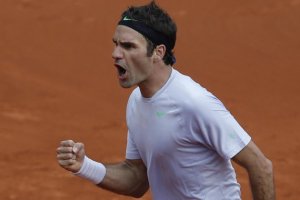
A fighting Federer survives Simon threat in Paris
(thanks to news.yahoo.com)Roger Federer has not lost before the quarter-finals of a Major tournament since Gustavo Kuerten beat him in straights in the round of sixteen at Roland Garros in 2004. In his fourth round match against Gilles Simon at this year’s French Open that record looked set to continue as the Swiss raced through the first set 6-1, making tennis look, as he is prone to do, as simple as abc.
Simon, however, did not shrink away as many have done when faced with an on form Federer, preferring instead to make Federer do advanced calculus rather than recitations of elementary school songs. Simon summoned up his defensive skills to stay with the Swiss in the second set and at 4-3 30-30 the Frenchman was ready and waiting when Federer started to error, first on the backhand and then on the forehand. Simon’s reward for being patient was to serve for the set. Having been shrewd enough to hang in the match until a chance came his way, Simon did not waste this chance and took the set 6-4 as a backhand slice from Federer went long.
In the second set, with the Swiss serving at 2-2, Federer slipped when running to retrieve a Simon forehand. Simon took heed of the omen and hit another huge forehand for 0-30. A backhand down the line winner into the service box and he had three break points. A long rally on break point and Federer hit a backhand long to gift a Simon, a man only too eager to tear open his present, a break.
At 4-2, another Federer error and a more aggressive than usual Simon had break point, a chance he wasted as his passing shot hit the net. Another Federer error though and another break point. The Frenchman hits a drop shot. Federer runs it down but he nets his attempt at retrieval.
5-2 and Simon is serving for a two sets to one lead over a man who has not lost at this stage of a Major for nine years. On Simon’s second set point, earned courtesy of a service winner, Federer moves him around before moving forward but he cannot execute. Federer’s cross-court backhand lands in the net. Simon has the set and a two sets to one lead. One more set and he will, in ending Federer’s quarter final streak, create history.
The prospect excites him. The aggression he has been displaying escalates; the prospect of putting away Federer pumping him up. Service winners, forehand winners, backhand winners hit through the court, applauded by the home crowd.
But it does not prove to be enough. There is after all a good reason Federer does not lose before the quarters of Majors: He is Roger Federer. The Swissman, the second greatest clay-courter of the last ten years, the winner here in ’09 and four time runner up, does not suffer the disadvantage of playing a home player either, for the French crowd love him as much as they do their own. Federer gets a break point at 2-3. Federer hits a forehand crosscourt then a backhand down the line to force an error, a tried and tested tactic over the years of competing at the deep end of Majors. Federer has the break and he does not look back. The sting back in his tail, he hits winners down the line, drop shots, winning volleys. It is the first set all over again. A reprisal of Federer in first. At 5-2 Federer has set point and wins the set as a Simon backhand hits the net.
The fifth set, Federer serving first. He states his intentions, serving out to love. Simon serves and goes break point down. The Frenchman goes for Federer’s backhand. Federer hits slices and top spins, switches to inside out forehands, going cross court with Simon before changing the direction, going down the line, then down the middle. Simon steps forward. He has a chance. He goes for a cross-court forehand, the shot that had gleaned winners in sets two and three. This is the fifth set though, a set in which Federer is leading. The fifth set of a Major last sixteen match, the kind of match that Simon knows Federer just does not lose. Simon overpresses. The forehand fires wide where it had once been hitting lines.
Fed holds and it is 3-0. Simon survives a long deuce game despite Federer’s attempts at an exhibition of how to play tennis. One rally alone sees Federer hit a drop shot, a volley lob, a backhand down the line and forehand cross-court combo. Simon saves break point with some magic of his own: a forehand volley that clips the line.
With matters more competitive now, the two hold serve until at 5-3 Federer has to hold to win the match. Simon threatens him with a backhand down the line winner for 15-30. Federer hits an ace down the line. 30-30. Federer nets a volley. 30-40. Break point Simon. Federer hits a service winner. An ace and it is match point. A netted Federer forehand down the line and it is deuce. Simon sensing history could still spin his way attacks the Federer forehand and is rewarded with a break point. But Federer hits a huge serve and then comes in to smash away the short return. Deuce. A Simon forehand goes wide. Match point number two for Federer. The players trade ground-strokes. Simon misses a forehand down the line. Game, set and match Federer. His 36th consecutive quarter final at a Major. Fighting like this when his historic run is threatened, how many more he can Federer his way into remains a feat the tennis world eagerly awaits to see.

Tennis from a fan's point of view
[
[
[
]
]
]



 thetennisreview