-
Robredo run rolls on at Roland Garros

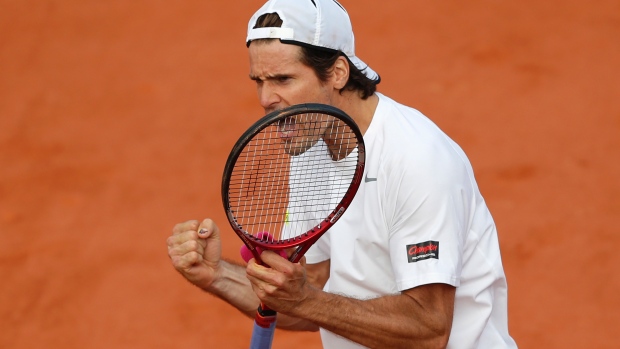
A pumped Robredo celebrates (thanks to abcnews.go.com) Tommy Robredo came back from two sets to love down and from a break down in each of the last three sets to overcome Nicolas Amalgro in the fourth round of Roland Garros. If that feat were not impressive enough, this was Robredo’s third match in a row coming back from two sets down.
This rousing run began in the first round with an easy three set opener against Zopp. In the second round, Sisling took the first two sets before Robredo ran away with the last three. Then in the third round came Monfils who had four match points in the fourth set but was undone by Robredo’s aggressive play on those points, play that swung the momentum his way as he ran away with the fifth set 6-2.
Such experience in these matches meant that going down two sets to love did not faze Robredo. The 31 year old Spaniard, who is on the comeback after injuries and was ranked outside the top 400 a year ago, has also been to four Roland Garros quarter-finals, won a Masters 1000 and been around the top of the game on and off for close to a decade. Inspired by his recent return to form and powered on by muscle memory and the memories of past successes, Robredo competed with all his heart after going down a break in the third set to come back from 1-4 and clinch it 6-4.
In the fourth set Robredo once more went down 4-2. Again he kept on hitting the ball consistently and with a high margin for error, mixing up the depth, pace and spins, and sliding into his shots like a thief’s hand into a velvet pocket as he stole the fourth set from under Amalgro’s nose 6-4.
Amalgro, who may have at this point been being haunted by the nightmarish memories of letting a two sets to love lead slip against Ferrer in the Melbourne quarter finals, went up again in the fifth 2-0. But yet again the patient Robredo kept sliding and hitting away, some particularly fine back hand down the line passing shots boosting his spirit, to break back.
With the pattern of the last two sets in place, it looked likely that Robredo would win. However Amalgro broke again only to once more be broken as he went for too much to soon on his shots while his opponent constructed the points masterfully, waiting for the right opening to finish with a winner or force an error.
At 4-4, Robredo broke again to serve for the match, a prime position to be in. In a match like this though, this meant little. What had meant something however was Robredo’s desire. It was, as it has been all week, loud and clear. Robredo held firm and served out with relative ease to clinch his fifth Roland Garros quarter-final, inflicting on his opponent another heart-breaking defeat but more importantly winning for himself another marvellous memory which can only help him as he goes on to compete against another compatriot, David Ferrer, in the last eight.
-
Haas inches past Isner on thirteenth match point

Tommy Haas celebrates on his way to converting his 13th match point versus John Isner (thanks to ctvnews.ca) John Isner looked like he might have finally solved the conundrum that was long five setters. It has become a problem that seemed unlikely after his 70-68 win over Mahut at Wimbledon. But tough losses to Matthieu at Roland Garros ’12 and Falla at Wimbledon ’12 only too brutally highlighted the major flaw in his game, the return of serve. But against Harrison in the second round in this year’s French Open, Isner came back from two sets to love down and won 10-8 in the fifth, breaking at 9-8, his return game for once not weighing down his overwhelming strength, that killer serve that bolts down from six foot nine and a very long arm.
In the third round on Saturday, Isner went two sets to love down again against veteran Tommy Haas. He managed to reduce the deficit to 1-2 but in the fourth set, serving to stay in the match, he was match points down. On his serve this predicament is not so troublesome and an unflustered Isner saved it with a characteristic huge serve. Isner is cool as ice when saving big points on serve and his weapon does not let him down. That was a welcome strength against Haas whose flair and strong return saw him reach match point no less than 11 times on the Isner serve in a ten minute game. It was the Haas backhand that was doing the trick, devouring the angle of the Isner kick serve and using it to go down the line for a winner to give him the opportunity to take the match. But a match point on the Isner serve is an opportunity as inviting as snatching diamonds from an alligator’s jaw. Each time the American bolted down another huge serve which either gleaned a service winner or gifted him a short ball for him to step in on and punish with weapon number two, the forehand. Back and forth the two went in this fashion: Haas finding the angle on the return or finding the open court to hit down the line winners to earn match point, Isner unleashing the serve to level matters at deuce. Finally, serving into the deuce court, Isner found a winner on his serve and had game point. A trusty huge delivery and it was 6-6.
Losing 11 match points is hard to recover from. But Haas did well and got another match point and on his serve. Losing match points on Isner’s serve is, considering the fierce quality of the delivery, forgivable. Losing them on your own serve is less so. Haas missed the first serve. And then he missed the second serve. His twelth match point thrown away on a double fault. Isner’s serve did not let him down now, and neither did his return, going on as he did to take the tiebreak.
Two sets apiece, the puzzle seemed to be cracked indeed as Isner began to make the game look ridiculously simple. The big serves went in and earned him service winners or short balls or balls into his hitting zone. The return was working, too. At 1-0 with Haas serving, Isner played smart at 30-30. He hit the returns back into the court and with angle, away from Haas who made some errors. Isner broke and held again to lead 3-0.
A historic win was on the cards. But while the Isner game when on looks so simple and effective, it does not take much on clay for a man of Haas’ skills and talent to dismantle. It just takes one glitch. At 4-2, 30-30, Isner dumped a volley into the net. He saved the break point with another volley attempt, brave after the failed one before, and fortune favored him. Such play is the mark of Isner. His problems are not mental, far from it. They are technical, the weaknesses in his game as devastating as the strengths. And those weaknesses are even more vulnerable against a man of the strengths of Haas, a former world number two and one of the last of the all-courters. Haas worked his way to another break point opportunity and won it with a forehand cross court winner that whizzed past a net approaching Isner.
At 5-4, Haas serving, Isner, disgruntled by the clicking of cameras during play, managed to block out the distraction to return smartly, again hitting an angled forehand to get an error for 0-30, and earned a match point as Haas errored on the forehand. But Haas worked out way out of trouble, that forehand coming to his rescue, booming through the court for a winner.
With both men having had their chances and lost them, and with the match going deep into the fifth, it was now a battle of stamina. And of the two men, Haas is the superior, and so it proved. While Isner survived break points at 5-5, the longer the fight, the more the man who had battled from 0-2 in the previous round was less likely to repeat that feat. At 8-8, Haas once more returned the Isner serve down the line for winners to break a fatigued Isner. It did not take much now for Haas to serve out for the match. Isner’s returns were now as wretched as his back seemed to be and Haas won his thirteenth match point as an Isner return went wide to see Haas win what may turn out to be the match of the tournament. Haas, at 35 years old, now has a fourth round encounter with Mikhail Youzhny to look forward to while Isner has a few weeks to work out why when it seemed the puzzle piece had been found and fitted it was his greatest strength that went missing.
-
Monfils budges past Berdych in five

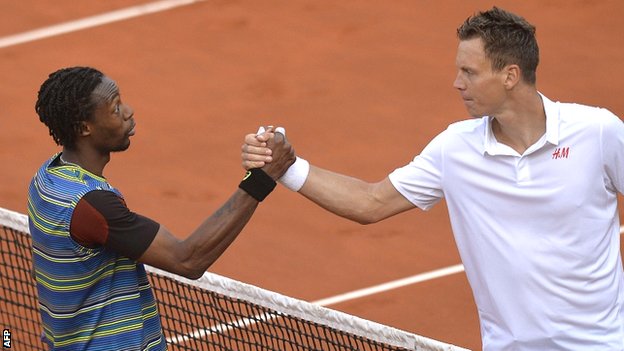
Monfils and Berdych shake hands at the net (Thanks to bbc.co.uk)
The draw could not have been tougher for fifth seeded Tomas Berdych: Gael Monfils in the first round. Perhaps cruel is a better word, considering Berdych’s recent fine clay form. The Frenchman in his home Major, the tournament where he has had his greatest successes, on a surface on which he plays better tennis than the Czech.That is not to say Tomas plays badly on the clay. His win over Djokovic in Rome attests to his prowess on the stuff. But Monfils’ athleticism, his reach, his shot-making, and his consistency are just better suited to clay than Berdych’s clean hitting forward moving game.
Luckily for the fans, both men showcased those fore-mentioned positive playing traits in almost equal measure and, rare for a tennis match, at the same time, in a match that could not have been closer or have gotten the French crowd more pumped-up to perform their Parisian waves.
Monfils edged the first two sets, proving the pundits who predicted an upset had solid grounds on which to do so. The 81st ranked Frenchman, beset by injuries throughout his career, has been in good form on clay in his home country, winning a challenger a couple of weeks ago in Bordeaux and making the final of Nice last week. And while Monfil’s presence in big matches might have been lessened by his loss of form, his big match temperament had not been hit at all. The man who made the semi-finals here in ’08 and the quarters in ’09 and ’11, losing each time to Federer, found inspiration in those memories and played the solid, athletic, flairy tennis becoming of the top tenner he once was.
Berdych though is a top tenner right now. The Czech was not playing badly either, despite the two set deficit, and it seemed only deserving that he would level matters up. Maintaining his composure, the Czech won the third and fourth sets on tiebreaks, the fourth one as good a dominant display as any you are likely to see. Berdych’s pedigree was positively posing, a dizzying display of big forehands and superb volleying.
The match level, the crowd waving, the French Open had its first round classic, a match that would be made even sweeter were the home player to win. It was not long before that prospect teased us. In the final set, it was Monfils who had his chances at 1-1 but could not take them as Berdych’s serve and volleying prowess saw him through. Then came chances for Berdych at 3-2 but Monfils, characteristically keeping the errors low and the points prolonged, fought them off. He had to fight of cramps, too, as the match went deep into its fourth hour.
At 5-5, after a raucous wave from the crowd, with each rally long and deep and being won rather than lost, it was going to take one of the men to do something special to separate himself from the other. It was Monfils who stepped up. A forehand winner down the line got him to 15-30 and aggressive play that saw the Frenchman take the middle of the court and draw an error from a hurried Berdych earned the Frenchman two break points. Another error, a Berdych volley finding the net rather than landing into the open court as had been the fashion, and Monfils had the break and would serve for the match.
Monfils does not have the reputation of a closer, though. But in this match with a ranking of 81, a season littered with early exits, he was not really supposed to be serving out the match against the 5th seed in the first round of a Major. An ace over 200 kmph was a good start. On match point, a serve out wide and a deep forehand to Berdych’s backhand side that drew an error was a great finish. The Frenchman turned to his entourage and beat his fist on his chest before clasping hands with Berdych at the net, a respectful and warm congratulations worthy of a match that was by far the most difficult of the first round caliber wise and had equaled if not even bettered that caliber in its quality of play.
-
Federer’s best last chance in Paris?
The 2013 French Open could very well be Roger Federer’s best last chance in Paris.
Not his last chance, mind. As long as Federer plays, he is in with a chance. Anything could happen in tennis, check 2009 Roland Garros for proof. But his best last chance, most likely.
The draw was kind to Federer. Has never been kinder in fact, the last few years. Since Melbourne 2010, Federer has made three major finals from thirteen played, winning two. Twice Berdych has gotten the better of him in the quarters, Soderling and Tsonga at the same stage and one time apiece. In the semis, Murray and Nadal have beaten him once. The other four times? One man has overcome him: Novak Djokovic. In 2010 and 11 in New York, in Australia in 2011, and in Paris last year.
This year, Soderling and Murray are not in the year. Neither is Del Potro who pushed Federer to five here in last year’s quarters. Tsonga and Berdych are there, though. Federer would meet them in the quarters and the semi-finals respectively. But both players, susceptible to early defeats, have to get there first. Were to reach their seeded positions though, Federer would still be the favorite to beat them. Toughened up by match practice in Madrid and Rome plus four or five set matches in Paris, Federer’s superior clay court prowess and pedigree should be enough to see him through. The biggest danger would of course be Berdych who fresh of a win over Djokovic in Rome is capable of great play on the clay. Still, Federer is Federer, a finalist here as recently as 2011 and the second best clay courter of the last decade. Federer also knows better than anyone that time is running out, that semi-finals of slams, as he has learned the last few seasons are rarer than they once were and finals even more so. He will also be mighty pleased that Nadal and Djokovic are nowhere to be seen at this stage.
For the tennis Gods were certainly kind to their favorite son, Nadal and Djokovic being placed at the opposite end of the draw. If they meet in the semi-finals, it will be most hotly awaited last four contest seen at a Major for many a year. Most likely they will meet, though Novak has the possible pertinent question of Grigor Dimitrov to answer in the third round. He should answer it quite confidently though. Five sets in a Major and three sets in a Master’s are a world apart and Djokovic is better than anyone at surviving the liveliest of threats in the early rounds of a Major. Djokovic should do just that to take his place in the last four against Nadal. Only one year ago these two played their fourth consecutive Major final. And Djokovic has the bragging rights of beating Nadal three times on clay, in each of the Masters 1000 finals, and being the player to put an end to Nadal’s eight year win streak in Monte Carlo. While beating Nadal in five sets in Paris proved beyond Djokovic last year, that Monte Carlo win coupled with Nadal not having played a Major since Wimbledon last year suggests this is the World number one’s best chance to put Nadal away and get another chance to complete the career Grand Slam.
Federer will certainly be hoping it is Djokovic who makes it out of that brutal semi, preferably in five long sets and the second scheduled match. Against Novak he has a chance. Their 2011 semi here when Federer beat a red hot Djokovic will still be fresh in his memory. And though Federer suffered a lackluster defeat to Novak here last year, the Swiss has had his much needed rest and if he is going to produce his best tennis it is going to be in the finals.
If Nadal is on the other side of the court, then Federer’s chances are as bad as thetennisreview’s. Anyone who watched the Rome final last week will know what to expect. But, and this is as big a but, this is the year when Nadal’s chances of making the final are lesser than they have ever been and Federer’s higher. And if Nadal is knocked out by Djokovic, Federer has what will be his best last chance to win in Paris, a second title that will be cheered by the Federer-loving Parisians and which may prove to be the final crowning moment of arguably the greatest career in tennis history.
-
Sharapova one Major away from second tier greats
If Maria Sharapova wins Roland Garros 2013 not only will she defend her title and win her fifth major, she will lodge herself firmly in the list of second tier greats of the game.
Right now she sits at the top, by virtue of her career slam, of the third tier, with the likes of Clisters, Davenport and Sanchez-Vicario. But seven matches away, one tier up, a place awaits among Hingis, Venus and Henin.
It will, though, not be an easy group to take a place among. In Maria’s way stands history and a woman who is both the favorite for the title and the favorite to beat her in every match they play.
Starting with History, in Maria’s ten years on the tour, she has never defended a Major. That does not mean she won’t, of course. But it raises questions as to the likelihood of her doing so. Defending a slam is as hard as winning the first one. You are the marked player, the pressure is firmly on your shoulders. Maria has never even reached the final of a slam won the previous year. That is somewhat down to her injuries and her game which as overwhelming as it is on her best days is extremely exploitable on her worst.
The next obstacle, and the biggest, is Serena Williams. 15 times they have played and only two of those times has Maria emerged the victor. Both those times came nine years ago. In the past 12 months, 6 times they have played and just one set has been won by Maria. Should they meet in the final, Maria will have to play the match of her life and hope Serena is having one of those days.
Should they meet, though. Serena has not been to a final in Paris since even longer ago than the last time Maria beat her. 2002 to be exact. She has not been to a semi-final since 2003. Srebotnik, Kuznetsova, Stosur, Henin, Razzano, Capriati, the good and the great and the greatest, herself, have put paid to her prospects over the years. And this year in her side of the draw looms a player who has the game to join that list of names: Li Na. If Serena gets past her, it is most likely, if their Rome final last week is anything to go by, she will play Sharapova in the final.
If that natch happens, we are either going to see one of the following spectacles: a) a beatdown of the highest order inflicted on Sharapova by Serena (not for the squeamish) or b) the match of the year as Maria, for whom red clay has yielded her greatest successes the past couple of seasons, defeats both history, Serena and her own mental block against Williams to win the title.
Either way it will be fascinating.
-
Nadal destroys Federer in Rome
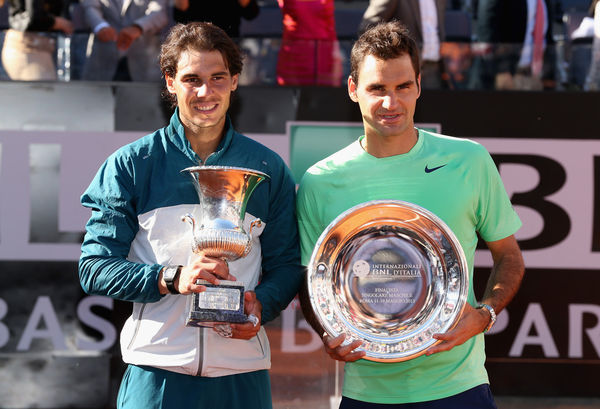
Photo courtesy of wttttw.pixnet.net Rafael Nadal destroying Roger Federer in a Clay court final is not news. We’ve seen it before, when Federer was in his prime, too. Neither man’s fans will forget Nadal’s destruction of a prime Federer in the 2008 French Open final to the loss of 4 games.
Nadal winning his seventh Italian Open final, there’s nothing new about that either.
The only news worthy aspect of the whole torrid affair was Federer making the final, his first of the year, the longest he has been final-less in his career since we care to remember. True, he may not have had the most difficult of opposition. Janowicz and Paire are worthy adversaries but Masters 1000 winners and men with remarkable clay resumes they are not. Even lacking match practice Federer has enough class and experience to make his way past them.
Nadal, as we all know, is an altogether different proposition. Even on Federer’s best surfaces in his best days, the Spaniard has proven a disastrous match up. Defeats in Miami in ’04, in Dubai in ’06, at Wimbledon in ’08 are testament to that. The huge top spin laden groundstrokes relentlessly fired by the Spaniard to the Swiss’ backhand coupled with the insurmountable mental hold gained as the Nadal wins built up, an even heavier factor than those afore-mentioned forehands and backhands, proved over and over to be the undoing of Federer and on his least decorated surface in his least prolific days anything other than spirited resistance would have been a surprise.
Matters looked grim from the outset. Federer won the first game on serve but in the third was broken as Nadal’s tried and tested formula proved its obvious genius once more as a shanked backhand errored from the Federer racket. Five games later and Nadal had the first set 6-1. Nadal broke early in the second and dreamy memories of Roland Garros ’08 for Nadal and his supporters were nightmaring their way into the minds of Federer and his fans. At 6-1, 5-1, the prospect of Federer’s worst ever defeat in a big final was a few shanked backhands away.
Nadal is a Federer fan though as much as the best of us, in fact, better than the best of us. No one loves the Swiss, respects him more than Nadal. The Spaniard dropped his serve and then put up little resistance in the next game. There you go, the ’08 French Open will go down as your soundest beating, he said. And then, some mercy shown, he promptly resumed his more familiar role of Rafael Nadal, Federer destroyer on Clay as he served out for the match to claim another Masters 1000 title, a record 22nd, and another defeat of Federer, his 20th.
No news is good news as they say, except in the media when it’s kind of necessary. And no news, when it’s Nadal beating Federer on Clay, is only bad news for the Swiss. And, as unconsoling as it is, it is not just bad news for Federer. Nadal’s win does the news hungry sports media no favors, either. The sole beneficiaries are Nadal himself, his fans and the odd sadist who likes to see their history made at the expense of one of the sport’s greatest talents, his rare ignominies in the game dished out by his bete-noir, bloody and mostly merciless, on the dark red clay courts of Europe.
-
Serena’s slow clay success in Rome
Serena William’s 6-1, 6-3 defeat of Vika Azarenka in the Italian Open final was another question answered to her critics and an affirmation to her fans. Her win in Madrid, so the whispers went, was questionable. It was not real clay, not like the clay, say, in Paris. The altitude of the host city made the balls faster, were more suitable for her game. Let’s see her win on real red clay in Rome before we start talking about her chances in Paris.
Let’s indeed, her fans can now retort, were retorting before the final was even played. This Serena is as dominant as the Italian Open winning one of 2002, the same Serena who won her one and only Roland Garros title. This Serena was not once doubted by her fans. Or, most importantly, by herself.
The growing serenity we have seen from her since her run to last year’s Wimbledon title was ever present. As her game struggled in the first set, with four of the seven games going to deuce, she kept her cool. It was clear she was not in the best mood, her shrugs, her laments the equal of her errors and missed chances. But she did not go over the edge, did not go to the places we have been spared since last year’s French Open disaster, the dark places as thrilling for the spectator as her game on form. It was to the latter she led us, freeing her feet before they were weighed down in the swamp. Keeping it together, she edged out the close games, and as she did she was rewarded for her calmness, her form improved.
The first set went her way 6-1 and she broke early in the second. The games were not so tightly contested, her backhand was on, and she hit 47 winners to take the match 6-1, 6-3.
It was a statement indeed. Yet another title to her collection, her 51st. And a red clay one, too. Slow red clay, at that. Little can be said now against her pedigree on the stuff. And a lot might be said by the lady herself come the second Saturday of Roland Garros should she keep the momentum going and continue what is a quite remarkable reprisal of the Serena of 02/03, and one which may even better the original.
-
Rafa whips Wawrinka in Madrid
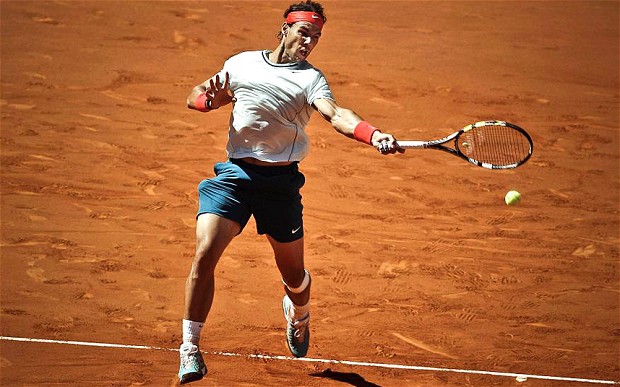
Nadal on the defense in Madrid
(Thanks to thenews.com.pk)Having broken all the clay court records there were to break, Rafael Nadal now has only his own personal ones to better. This year, in Madrid, he recorded another personal clay court achievement, claiming both Barcelona and Madrid in the same season for the first time.
All that can stop Rafael Nadal and his history-making is himself by way of an injury or his opponents outplaying him, and the former has more chance than the latter, though both factors have gotten in his way in the last year. Injury kept him off the tour for seven months and Novak Djokovic beat him in his much-favored Monte Carlo a couple of weeks ago.
But in Madrid neither injury or an opponent of the the Nadal-defeating-ability of Djokovic reared their troublesome heads, well not for too long anyway. Ferrer was two points away from defeating Nadal in their quarter-final but one moment of poor decision making when he failed to hit the ball into the open court and hit it to Nadal’s forehand instead put paid to his chances.
Once that dangerous obstacle had been overcome, Nadal was not bothered again. His surprise semi-final opponent Andujar, a wild card compatriot ranked outside the top 100, only managed to put up any resistance in the second set.
In the final, Wawrinka was unable to do much more, going down 2-6, 4-6. A combination of Nadal intent on making his own history and Wawrinka feeling the tiredness of a ten match win streak over two weeks of great form meant the final was another Nadal procession on his way to further underlining his status as the Greatest player of all time in an ever deeper shade of red.
-
Serena makes it fifty it Madrid

Serena stands proud with her Madrid trophy
(Thanks to sports.terra.com)Serena Williams won her 50th career title in Madrid, beating Maria Sharapova 6-1, 6-4.
It was only her seventh clay court title in her 17 years on the tour. And her first red clay title since 2002 when she won the French Open.
The stars were certainly lined up for Serena, Madrid being the perfect place for her to accomplish a long-awaited red clay title. The blue clay she won on in Madrid last year was arguably about as clay-like as red is blue. And it is arguable as to how red-clayish these Madrid courts are. While the organisers had tried to make it as similar to Roland Garros as possible, the altitude of Madrid is a factor that they can do nothing about. If Serena’s game was ever going to be complimented by clay courts then these are those courts. And if she was ever going to have the perfect time of day and weather, well proof the stars were lined up shone for all to see. A sunny mid afternoon lay before her.
The Stars did not settle there, either. If Serena was ever going to have an opponent in the final against whom her game matched up perfectly, it was going to be Maria Sharapova. Maria hits balls with the pace and flatness Serena can tee off on. Unless Maria strikes the ball away from Serena, she is in trouble. Any balls in Serena’s hitting zone, any of them short and it is going to be put away for a winner, if not on that point, then the next one.
All Maria can do is hope Serena is having a bad day or, if Serena is playing well, mix up the balls she hits her way, a tactic she never employs, her brain frozen with fear, the memories of all those past losses seemingly as fresh as they were when dealt. And if Serena is playing her best game, then Maria can only do her best, which, unfortunately, is not as good as Serena’s.
Serena was at her best in the first set and took it 6-1. Maria fought though and led by a break in the second. We wondered if perhaps this might be a turnaround. After all, Maria is the defending French Open champion. But it was not to be. Serena took advantage of a 60% first serve percentage from the Russian and broke back.
At 4-5, serving to stay in the match, the stars took their final positions for Serena as Maria went down 0-40. Serena errored on the first championship point and then Maria errored on the second to conclude what was, unfortunately for those who like their tennis finals to have some competition, inevitable.
It was the Russian’s 12 th consecutive loss to Serena, her sixth since their meeting here last year. Some thought that she might be able to put a stop to this run seeing as red clay is her most successful surface of late. But Maria’s issues with Serena go beyond surfaces, styles even. This match up goes on in Maria’s head, each loss making an already hard task even more of a headache. And it makes the task of watching these matches even more painful for the spectator who would like to watch players competing in the big finals rather than playing out a psychological drama where one of the principals actresses has already lost the match before it even started.
There is hope though. This was Maria’s first final in Madrid and the slower clay of Rome awaits. Should that suit her better in a possible final encounter with Serena, then we might get what we want and what women’s tennis needs in the imminent Parisian showpiece: a final between the world’s top two which is as much about the here and now than what has been going on since 2005.
-
Medina-Garrigues fluffs up new balls in Madrid against Serena
If you want to see an example of unbelievably unprofessional behavior from a professional tennis player then look no further than the video above.
In the first set of Anabel Medina-Garrigues’ quarter-final match in Madrid against Serena Williams, Medina-Garrigues asks for the new balls at the change of ends. The parasol hiding her from the view of the umpire, she takes one ball and begins to rub it against her racket, fluffing it up. Yes, you read right. She rubs a ball from the just opened can, cans opened every seven games to let the game be played with bouncier balls that fly off the racket. Yes, those very balls that you hold up to your opponent before you serve to reassure them the game will be played in the best possible conditions. The ball-boy holding the parasol looks on at this untypical behavior, the fluffing up of said tennis balls. Medina-Garrigues throws the ball to the back of the court and sets to work on the next one. The tennistv camera is as transfixed by what she is doing as she is, moving in up close to show you what the umpire, the one person on the court who should be witnessing this, cannot, her view obscured by the parasol. Medina-Garrigues checks the back of the ball to see how fluffed up it is, fluffs a little harder and, when she is satisfied, gets rid of the ball before continuing in her quest to take away the advantage that the new harder balls would have had for her opponent and to make the balls how she would like them, nice and fluffy. Time running out, she rushes through the next few and then turns to see the camera on her. Her eyes narrow beneath her cap. She gets up, the parasol closes and Medina-Garrigues looks round again, perhaps to check she got away with it.
It would seem she had. The umpire had not noticed and neither had Serena (what a priceless reaction that would have been!) But as the match went on, the fluffing up did not prove to work out for her. Medina-Garrigues lost a tight first set. And though she won the second set to love, only Serena’s seventh love set lost in her career, and led by a break in the third, Medina-Garrigues fluffed up herself, dropping serve and losing the third set 7-5.
It was not only the match she lost either. As media interest grows in what she has done and debate mounts as to whether or not it was mere gamesmanship or out and out cheating, whatever reputation she has is nowhere to be found.
The case is still out for some on Medina-Garrigues actions but one thing is clear to The tennis review. That old line they tell you at school, the one about cheats never prospering, well that was never better illustrated than yesterday afternoon in Madrid as Medina-Garrigues went down in three to Serena Willians.

Tennis from a fan's point of view
[
[
[
]
]
]

 thetennisreview