-
Cincinnati 2016 Preview Gael Monfils Stan Wawrinka Milos Raonic Big Chance
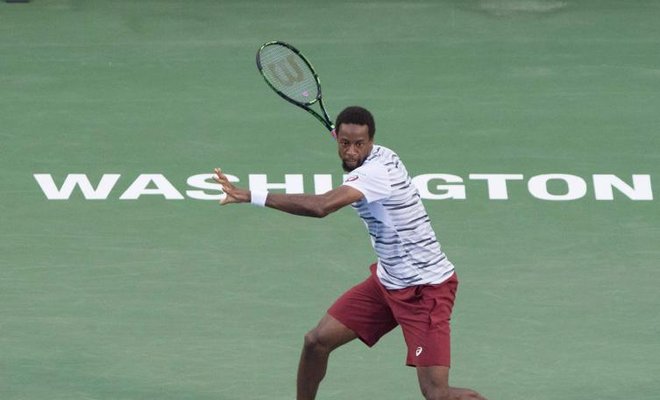
Photo Courtesy of http://www.arabnews.com With Andy Murray and Rafa Nadal’s Olympic efforts likely to take their toll, and with Novak Djokovic and Roger Federer absent, Cincinnati may prove to be the first ATP 1000 not won by one of the Big Four since Tsonga in Toronto ’14. The Tennis Review looks at the contenders most likely to earn themselves a confidence boosting title before the upcoming US Open.
Gael Monfils, seeded 9, Quarter-finals 2011.
Gael Monfils has really hit his stride in 2016. The world No.11 made the Australian Open last eight, the Monte Carlo final, won his first ATP 500 title at the Citi Open, and made the Rio quarters.
Monfils’ troubles, however, have not completely gone away this season- he was hit by a virus before Roland Garros, his career best Slam and dream title growing up, and he let three match points slip away in a third set tiebreak, double faulting on serve at 6-5, versus Kei Nishikori in Rio.
However, the one flaw in Monfils’ game hampering him reaching his potential seems to be gone – his tendency to play the clown- and a more serious Monfils could cause serious trouble for his Cincy rivals.
The Frenchman’ athleticism, effective and at times brutal serving, and great defense make him a real danger on fast hard courts, and his shot-making abilities mean that when he gets his racket on the ball, especially on the run, anything could happen.
In eight previous visits to Ohio, the Frenchman is 8-8, but he has had some tough draws- losing to Djokovic in 2011 in the last eight, to Federer in 2014. This year his draw could consist of Baghdatis or Pospisil in 2nd round, Thiem in the last 16, Raonic in the quarters, Murray in the semis, and Wawrinka in the final. As tough as you would expect from an ATP 1000, however, with some of those players on the road back from injury, good match ups for him on fast hard, and tired out from Rio, Monfils’ chances of another leap forward in his impressive yet still wanting career are looking as good as they ever have.
Stan Wawrinka, seeded 2, Semi-finals 2012, quarter-finals, 2014, 2015.
Wawrinka withdrew from Rio with injury, but the two time slam champ has been back practicing and is ready to play for what would be his 15th trophy overall, and his second ATP 1000 after Monte Carlo 2014.
Getting back on the practice court !! 👀🤔✌🏻️💦👌🏻💪🏻😎🏃🏻🏋🏻🎾☀️🔥💥📸🔝🐻😘🐼!! pic.twitter.com/VrqDvIQfxn
— Stanislas Wawrinka (@stanwawrinka) August 9, 2016
The Swiss is an impressive 10-0 in his last ten ATP finals, and if he makes the final in Cincy, he has to be the favorite to win. He has a potentially tricky last 16 match with Feliciano Lopez (if Lopez defeats qualifier Mischa Zverev in round 1), or Grigor Dimitrov, a last eight versus old foe Jo-Wilfried Tsonga, (if the Frenchman is not upset by the likes of Steve Johnson), Nadal in the last four, and Murray in the final. That would be a tough run to a title, but Wawrinka has been there, done that, and if he gets to within a match of the trophy, he will likely wear the ATP Champion’s T-shirt again.
Milos Raonic, seeded 4, Semis 2014.
Tennis is waiting for Raonic to win a big title- and the ATP counts ATP 1000s as ‘Big Ones’– and after his Wimbledon run, and his recent time off, an open draw at a fast court event like Cincinnati, one that rewards his huge serve and first strike approach, might be the one. Cincinnati has been kind to Raonic in the past, in his previous best run of play in 2014 he made the last four, losing to Roger Federer.
Raonic lost to Feliciano Lopez in his round of 64 opener last year, but the Canadian was on the comeback from injury and is in much stronger form now than back then. Raonic has proven he can beat anyone on the tour the last few seasons, and with the only top player he has not beaten, Novak Djokovic, out of the way, whoever he meets in the draw, the Canadian, if he has a great day, could win.
In his recent Canadian Open loss to Monfils in the quarters, Raonic acknowledged on his facebook page that forehand errors had cost him the match (read Raonic’s own words below). Raonic has shown himself, via social media and interviews, to be a very reflective player who learns from his mistake, and while Monfils is just the kind of player to force you into error, the Canadian will, in his words, do his best to not repeat that kind of slump again. The Canadian’s Cincy rivals had better be ready- what Roanic says in his gentle and well thought out manner tend to translate into brutal and concise on court executions.
Kei Nishikori, seeded 5, Last sixteen 2011, 2012.
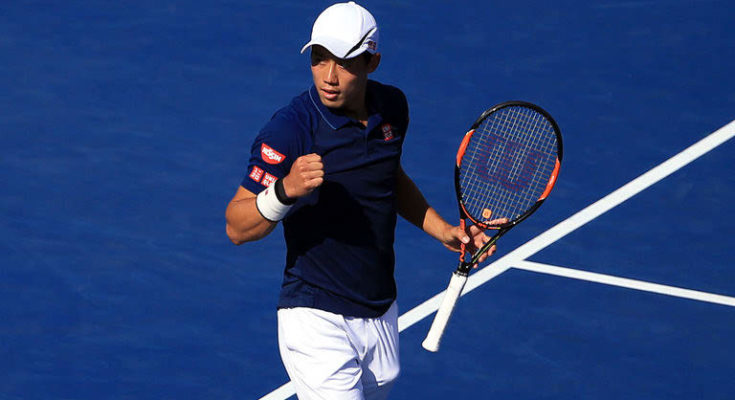
Photo Courtesy of pakrevolution.com In Rio, Nishikori recovered from letting his grip slip on his Bronze Medal match versus Nadal. Nishikori won that battle, one of the biggest of his career, and that feat alongside his recent Toronto final finish, could be what helps him finally breakthrough and win an ATP 1000 title after three attempts, thwarted by Nadal (Madrid ’14) and Djokovic (Miami ’16, Toronto ’16).
Nishikori has only played Cincinnati three times, and has not played since losing to Feliciano Lopez in his 2013 opener. That low attendance rate is due to the Japanese’ tendency to get injured, but with Nishikori currently healthy, this season could be the one where he puts in a career best Cincinnati showing.
Nishikori is in Murray’s quarter. The Scot has been a bad match up the last couple of years, and their recent Rio Semi-final illustrates why- Murray forces Nishikori to go for too much too soon. Nishikori has to come out playing athletic players with world class defensive skills on his own terms for his aggressive shot-making to win through, much like he managed to do versus Nadal for the two thirds of their Rio contest. It’s a big task, but Nishikori can tap into his big rival’s weaknesses or sub-par days on US hard courts, and if he can be patient, hang tough, and strike the ball at the height of his abilities, an ATP 1000 trophy breakthrough win could come his way in Cincinnati.
Marin Cilic, seeded 12, Quarter-finals 2012.
Cilic and fast US hard courts can be a devastating combo as his US Open 2014 run showed. The Croatian has been getting better and better all season- making the last eight at Wimbledon, the Geneva final, the last sixteen in Rio- and he has a nice section of the draw with a possible last sixteen meeting with Tomas Berdych against whom he is a favorable match up.
In 7 Cincy attempts he is 7-7 and has made one quarter-final in 2012 losing to Djokovic. Expect him to reach that stage or better it this season.
Tomas Berdych, seeded 6, Semi-Finals 2011, 2013.
New coach Goran Ivanisevic could be Berdych’s last chance to breathe some life into an oddly ailing looking career. On the surface, Berdych’s resume still looks fairly lively- he recently made the Wimbledon semis- but on closer inspection, his career is close to dead when it comes to beating his biggest rivals or competing for ATP titles- Berdych has not made one ATP final this season.
A second ATP 1000 title, 11 years after his first at Paris-Bercy ’15, at this stage of his career would boost Berdych’s confidence no end. With the possible Olympic fallout for the top players performance wise, and an absent Roger Federer, Berdych, still taking advantage of nice draws to make slam semis, could find himself with a great opportunity to do the one thing he has not achieved in his career besides reaching No.1 in the ATP rankings- win a slam title.
The Czech has a tough draw with fast court nemesis Marin Cilic in his last sixteen, Rafa Nadal and Nick Kyrgios as possible last eight opponents, and Wawrinka in the semis. However, if the draw opens up for him, the wisdom of Ivanisevic, a late bloomer himself as a slam titlist, could be a decisive factor in kickstarting Berdych’s 2016, and at just the right time.
Richard Gasquet, seeded 13, Quarter-finals 2015.
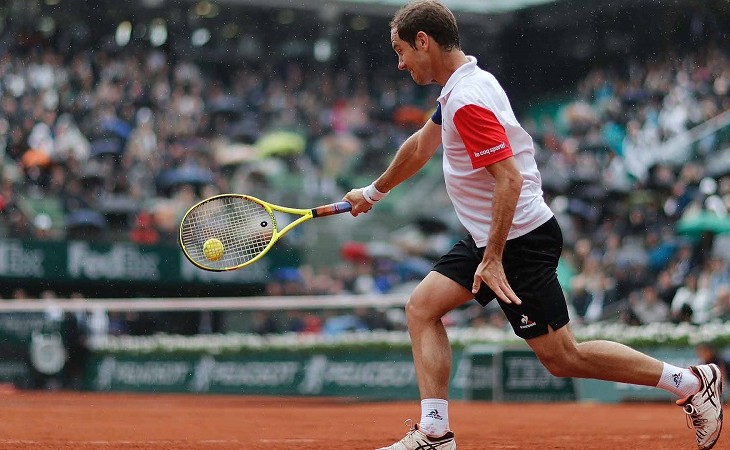
Photo courtesy of http://www.elinformador.net Gasquet is on another comeback from injury (back), but the Frenchman does really well on fast hard courts, and a refreshed Gasquet could get the better of Kevin Anderson in his second round, ( the Frenchman leads the South African 5-2) and a sure-to-be-exhausted Andy Murray in the last sixteen ( the two went three sets in their Cincy last eight clash last season with the Scot winning).
Kei Nishikori is scheduled for the last eight, and Gasquet’s 7-2 head to head record versus the Japanese makes him the favorite in that one.
The last four could put him up against Raonic (4) or Thiem (8). Raonic leads 3-1, but all their matches have been close. Gasquet leads Thiem 1-0. This is a nice chance for Gasquet, and while his lack of recent match practice might hurt him , his versatility, single handed backhand, and volleying skills could be the strengths that earn him a fourth shot at an ATP 1000 title (Gasquet was a finalist at Hamburg ’05, Canada ’06 and 12).
Promotion! Take advantage of our 2MinuteTennis.net™ promo offer. Enter promo code FREEMONTHTTR when you subscribe and get your first month FREE! Follow the link, enjoy Ryan Reidy’s video and online coaching and improve your tennis!
Take advantage of the UK pound by spending your US dollars and add some serious style to your tennis game when you purchase an Alison Van der Lande tennis bag. Email info@alisonvanderlande.co.uk with promo code TENNISC1 and your order and get 10% off!

-
Rio Olympics Tennis Review del Potro’s Spirited Run Just What Tennis Needed
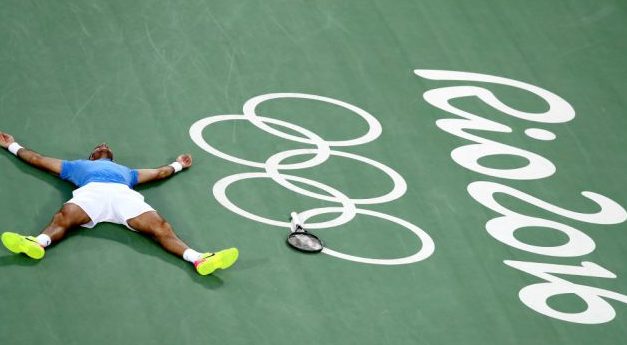

Photo Courtesy of http://www.outdoorblog.it Tennis at the Rio Olympics had the tennis world largely divided in the run up to the event. For some it was a glorified, pointless, literally so with the ATP not awarding any, exhibition that did not belong at the event. For others, it was, potentially, the biggest achievement of their career, an occasion where they could win for their country, and enjoy some team spirit. Thankfully, at Rio 2016, those who cared turned up, and while their best games may have left them by the medal matches, their hearts never left the court.
No points, no prize money, in an already busy Summer schedule, many tennis players and fans asked what the point was of competing in Rio. Even the ATP, who awarded 750 points to the 2012 London Gold medalist, did not give any this year after a disagreement with the ITF, rendering the tournament as good as an exho in the eyes of men’s tennis’ governing body. There was no prize money either, and a tennis career does not come cheap. Alongside the Zika virus and reports of a Rio unable to deal with the event, in an already crowded tennis Summer schedule, if you were going to skip an event, Rio was the one, and a host of players including John Isner, Dominic Thiem, Milos Raonic, Tomas Berdych, Stan Wawrinka, and Nick Kyrgios cited injury, ATP tour related priorities, and disagreement with both the inclusion of tennis in the Olympics itself or with their respective tennis federations as reasons for staying away.
For some players, Rio, however, was the one they needed to win in 2016, and, fortunately for men’s tennis fans, from the very first round, those who were in it to win it, showed just how deep they were ready to go. Juan Martin del Potro’s opening round defeat of Novak Djokovic will go down as one of the matches of the year, and the image of Novak Djokovic crying as he left the court may be more remembered than the one of him finally winning Roland Garros earlier on in the season.
oh my god. There’s nothing like the Olympics. https://t.co/g1ZOz8R9iR
— Ricky Dimon (@Dimonator) August 8, 2016
//platform.twitter.com/widgets.js
Other moments will live on, too. Matches as competitive as Cilic-Monfils, Johnson-Murray, Monfils-Nishikori, Nishikori-Nadal, and del Potro-Nadal. The kind of matches you might be lucky to see in one ATP tournament graced the Rio courts day in day out, providing a highly entertaining back story to the main tale- del Potro’s return to top flight tennis.
Del Potro’s run was just what tennis needed right now, an era of Djokovic dominance and few breakthroughs at the very top of the game. del Potro is one of the few players who unites tennis fan-bases, one of its few active slam champions, and the sight of him coming back from one surgery after another, and harnessing one of tennis’ greatest shots, that forehand, to defeat Djokovic, and then Nadal, in another classic, to make the final, was a reminder that raw talent and desire could overcome match fitness, and very nearly, three of four of tennis’ dominant pros.
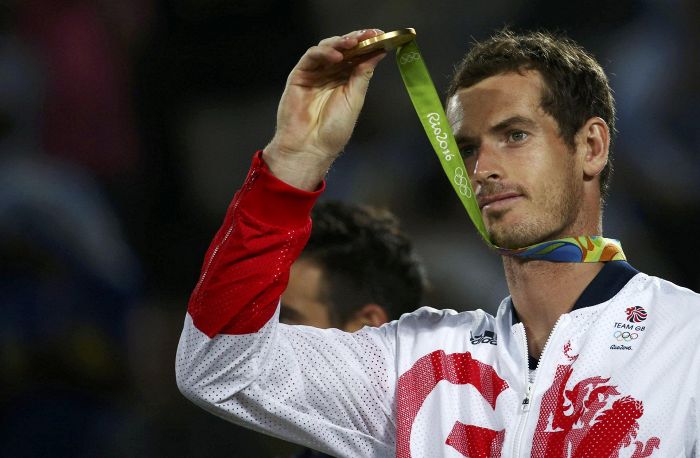
Photo courtesy of http://www.hs.fi Much like the Olympics will end up overshadowing many ATP events this season, del Potro’s silver medal, which the Argentine said post-match was as good as gold for him, may shine, in some eyes, even brighter than Murray’s Gold.
At the very least, after the way del Potro and Murray both gave their all in a fight for Gold, both medals will carry the same weight when it comes to effort.
The match the two rivals contested, the love child of a slam final and a deciding tie in a Davis Cup final, was worthy of any championship match any tennis organisation could come up with. Neither player, by that stage, could play to their full potential with the conditions so humid and the emotions running so high, but neither gave up, however much their legs wanted to, feeding off the crowd and their desire for the medal on the line.
What Murray and del Potro served up nourished tennis fan’s need to see a match played like either competitor would rather keel over than let a ball pass them by. All the way to deep in the fourth set, there was the feeling del Potro might find another wind and sail over the finishing line, and while Murray’s doggedness won out, this really was a match where both players, and ultimately tennis, won, and the lack of points and money made their achievements even more rewarding.
While del Potro would have been a more fitting Champion for an event played in the sporting world spotlight rewarding years of hard work behind the scenes yet relegated to a sideshow in men’s professional tennis itself- Murray, after all, is part of the pro tennis status quo for a good half decade now– the Argentine’s finish has nonetheless brought a tennis champion well and truly back to life, and with it, for the meantime, tennis, too.
The knock on effect of del Potro’s run will have many sports fans appreciating tennis for its Olympian values, ones at the heart of any sport, no matter how professional they have grown, and perhaps draw some new fans to the sport or turned casual ones into long-term. Meanwhile, the Cincinnati Open, courtesy of Murray, Nadal and Djokovic spending all their energy in Rio, could see the first non Big Four winner of an ATP 1000 title since 2014 Toronto, and a rested del Potro could make another spirited run at the US Open where he has been awarded a wild card.
That del Potro Spirit, the one that drives his desire to overcome adversity as much as it does his forehand winners, that’s the kind of spirit tennis needs, and what the Olympics gave us- a spirit worth its weight in whatever color medal you end up with.
Así terminó la semana más increíble de mi vida. #Gracias❤️🇦🇷pic.twitter.com/XwEJhSS8ny
— Juan M. del Potro (@delpotrojuan) August 15, 2016
Promotion! Take advantage of our 2MinuteTennis.net™ promo offer. Enter promo code FREEMONTHTTR when you subscribe and get your first month FREE! Follow the link, enjoy Ryan Reidy’s video and online coaching and improve your tennis!
//platform.twitter.com/widgets.js
Take advantage of the UK pound by spending your US dollars and add some serious style to your tennis game when you purchase an Alison Van der Lande tennis bag. Email info@alisonvanderlande.co.uk with promo code TENNISC1 and your order and get 10% off!
-
Juan Martin del Potro On Fire on the Forehand Knocks Novak Djokovic Out Of Rio
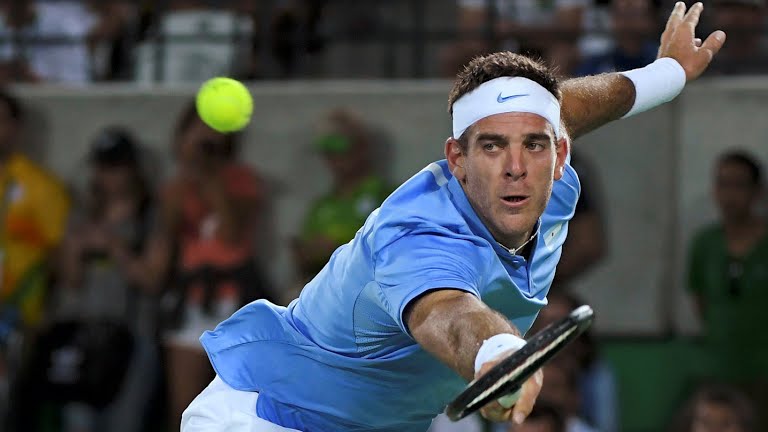
Photo courtesy of twitter.com Juan Martin del Potro in the first round of a hard court event, and not just any old hard court event but the Olympics, and in South America, too, as Novak Djokovic found out, is about as tough a draw as tennis delivers. The Tennis Review looks back on a match which brought tennis at the Olympics alive, and brought back to life one of the game’s most vintage shots.
If you were playing a tennis parlor game and the question was “Which tennis shot would you want to play for your life”, and you had recently watched Juan Martin del Potro hit Novak Djokovic out of the Rio Olympics first round 7-6, 7-6, the question would not even be finished before you answered “The del Potro forehand”.
That forehand drew as much admiration as a tennis shot can- and in the age of Federer that is saying something- as it withstood the pressure Novak Djokovic put on it, and, more crucially, turned the pressure onto the top seed.
The Serbian is always vulnerable to an opponent armed with an aggressive arsenal and mind-sight, and del Potro’s forehand and his willingness to step inside the court and up to the net threatened to out-play Djokovic from the very first point.
del Potro’s forehand did not falter once as it hit through the Serbian. The Argentine played so loose with his signature shot that you could have been mistaken for thinking that he really was playing at an exhibition- the view of some of tennis at the Olympics- and not for his own personal pride, and, even more crucially, and those who remember del Potro in tears as he earned Olympic Bronze for Argentina in London 2012, his country.
Not only did the forehand perform, the del Potro backhand held up to the Djokovic onslaught of slice, spins, and depth. del Potro rallied with Djokovic on that side, waiting for the right moment to hit the forehand inside out, pounced, earned the short ball, and then hit a winning shot or forced an error. The Argentine did not always have to wait, though, to work his way round to the forehand- time and again, Djokovic tired of hitting backhand to backhand, and, perhaps sensing he was not going to break down the del Potro weakness, decided to go for the strength, only to find that was not for the taking, either.
All the way to the tiebreak tennis fans were treated to del Potro’s inch perfect hitting and strategy, and the sight of a Djokovic unable to work his way to a break point on the del Potro serve, and at 2-2, the Argentine attacked, coming to the net, and forcing Djokovic into error. At 6-4, a forehand winner down the line earned the first set for del Potro before a crowd who were thriving as much as del Potro was at the sight of him hitting his best form since his comeback earlier this season.
The onslaught from the Argentine continued into the second set as del Potro held break point at 1-0, but Djokovic never let del Potro break into a winning stretch, staying with him all the way to another tiebreak.
With Djokovic a tiebreak away from his much yearned for goal of Olympic Gold being snatched from him, the world No. 1 decided if he was going down, he would go down on the attack. At 0-1, on both his service points, Djokovic approached the net, but he did so by hitting to the delPotro forehand, and each time a winner, unsurprisingly considering how strong del Potro was on that side, passed him at the net.
At 6-2, del Potro serving, the Argentine crunched his forehand over and over, but it was not another thrilling winner or forced error that earned him a famous victory- it was a forehand that clipped the net and fell too short for Djokovic to track down.
GRACIAS!!! 🇦🇷🇦🇷🇦🇷 pic.twitter.com/h6LBQVD3n6
— Juan M. del Potro (@delpotrojuan) August 8, 2016
//platform.twitter.com/widgets.js
Anyone who doubted how much the Olympics means to some tennis players will only have to see how Djokovic and del Potro embraced at the net and left the court to understand the emotions the occasion produces- the hug they shared, like the last time they met playing for medals, at London 2012, and the tears both men shed as they waved their thanks, and goodbyes, to the crowd were what one would expect of a slam final not the first round of an event played for no points or prize money but for Gold, silver or bronze, medals which may mean little to those who stayed away, but for those who came, mean far more than their individual weight, but the sum of all the medals of their countrymen combined.
oh my god. There’s nothing like the Olympics. https://t.co/g1ZOz8R9iR
— Ricky Dimon (@Dimonator) August 8, 2016
//platform.twitter.com/widgets.js
-
Five Questions With Saboor Khan On Life As A Tennis Ballboy
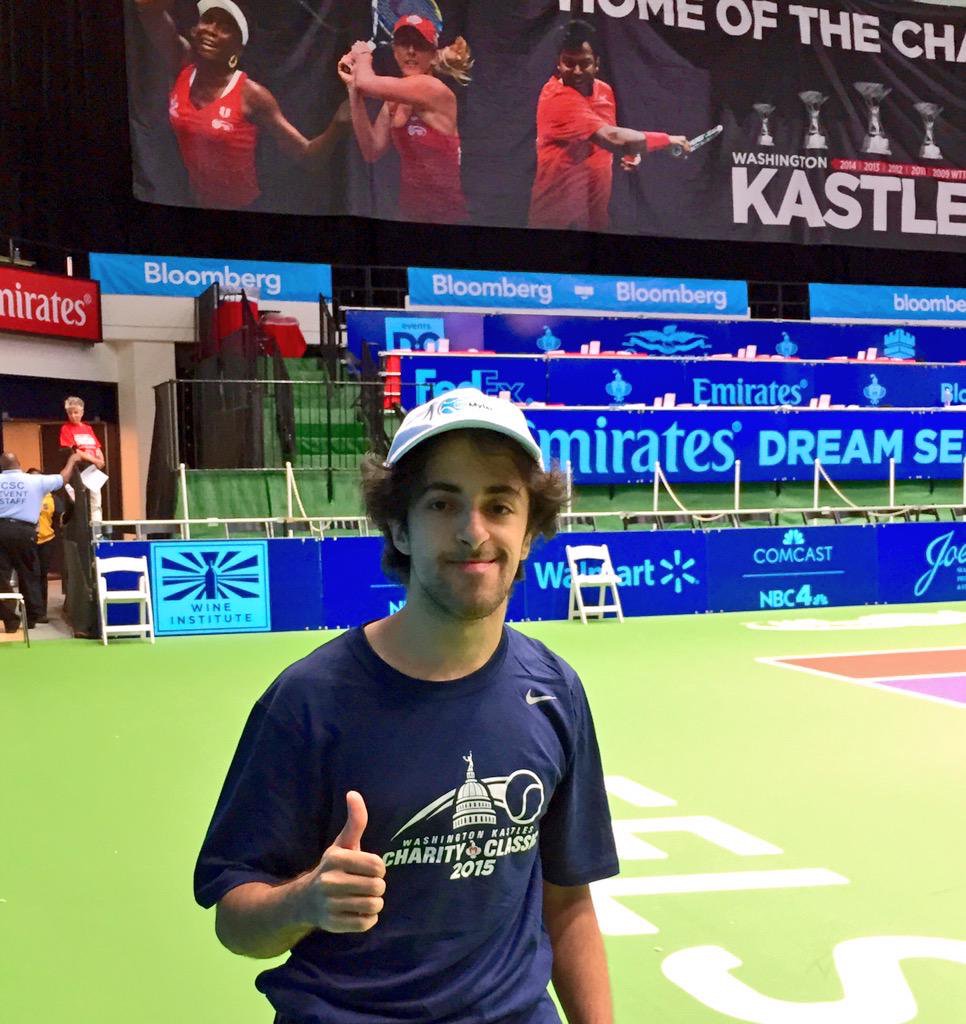
Photo courtesy of Saboor Khan Ever wondered how it feels to be a ball-boy at a professional tennis event? We talked to Saboor Khan about his experiences.1. How did you get into ball boying?I first got into ball boying when I made the tryouts. They choose the people who are good.2. What has been your most memorable ball boy experience?Everything is memorable when you are a ball boy. It’s something you can never forget. You are doing this job and feeding the ball to world class athletes. Being ball boy for Kastles.3. What do you like the most about ball-boying?You get to see the match right behind the player. If you get a chance one should try this. Great experience. That is what I like most about ball boying.4. What tips would you give someone about to start out as a ball boy?Just stay calm and do your best during the tryouts. Practice is the key. So if you have a tennis court near you then go there and do the motions. Also you can learn from TV.5. Do you play tennis,and has being a ball boy improved your game in any way?I have been playing tennis since childhood. I started at the age of 5. I love this sport. I will teach my kids when I grow up and I want them to become a pro. Being ball boy is good because then it improves your hand and eye coordination so that could help you with your game in tennis. They go together. Once you get the hang of it then you will love it. Everyone should get the chance. -
Rogers Cup Review Novak Djokovic Staying Strong at No.1 His Rivals Still Have Far to Go
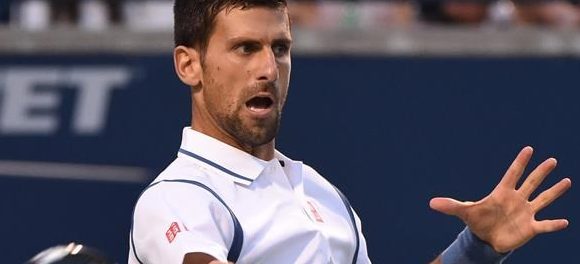

Photo courtesy of infotel.ca Novak Djokovic’s run to the Rogers Cup 2016 title was a firm reassertion of his grip on the No.1 ranking and reminded the tennis world that when it comes to being the best in the game he is not going anywhere soon while his rivals still have a long road ahead of them.
When Novak Djokovic went out in this season’s Wimbledon third round to Sam Querrey, and Andy Murray went on to take the title, it looked like the world No.1 might find himself seriously challenged for the first time since Roger Federer had the top ranking in his sights in the Summer of 2014.
At the Rogers Cup, Djokovic, at times, looked like he was still suffering whatever it was- injury or letdown or both- that saw him go from winning four straight slam titles to losing in the third round of Wimbledon, the Slam at which he was the two-time defending champion.
Despite his struggles, however, at the Rogers Cup, the world No.1 managed to get past Gilles Muller 7-5, 7-6 (3), defeated qualifier Radek Stepanek 6-2, 6-4, saved three set points in the opening tiebreaker to Tomas Berdych before winning 7-6 (6), 6-4, beat the in-form Gael Monfils 6-3, 6-2, and straight setted Kei Nishikori in the final 6-3, 7-5.
That’s a fine line of potential minefields for the world No.1 – a big server, the kind Djokovic struggles against; an attacking player who can take away his rhythm; one of the tour veterans whose big hitting clean game could be designed to hit through him on fast hard courts; one of the game’s most athletic shot-makers in some career best form; and the best of the next-in-line, Kei Nishikori, the 2014 US Open finalist, who beat the Serbian on his run to that final.
Tennis may not have had Andy Murray who defeated Djokovic in last year’s Rogers Cup final or Roger Federer to throw at Djokovic in Toronto, but the sport had the best on offer from one of the most damaging serves, one of the cleanest hitters, to one of the most recent ATP champions. Yet it was not quite good enough to get the better of the game’s best. In fact, with none of Djokovic’s rivals taking even a set from him, despite having their chances, it was nowhere near good enough.
Djokovic now holds the No.1 ranking with 16, 040 points, while Murray has 10, 065. The world No.3 Roger Federer has 5, 945 points, but with his season over, the next active player behind the current world No.1 and 2 is Stan Wawrinka with 5, 035.
With Murray trailing by close to 6000 points, he would need, in order to get anywhere near to the ATP’s top spot, to have a stellar last third run of the season, with Djokovic’s best stretch, Beijing to Miami, coming up.
The Scot’s only chance would come if Djokovic’s Wimbledon defeat was the first tumble in a sharp fall from one of the highest peaks, ranking points wise, any player has ever reached.
Unfortunately for Murray, Djokovic showed in Toronto that the Wimbledon loss was both a slip up and just what Djokovic needed- the motivation to further tighten his grip on the world No.1 ranking at a time when the man who now, with the French Open trophy in his cabinet, has pretty much everything a tennis player could want.
That grip was as tight as it has ever been in Toronto. Despite struggling with his serve until the final, and rumors of a shoulder injury doing the rounds all week, Djokovic was still solid enough from the back of the court, and tactically sound enough, to defeat players who can trouble him, but for whom he is not just trouble but something altogether more diabolical.
In the semi-final versus Monfils, the Frenchman played him into form, and in the final, Djokovic played the kind of match we have seen him play over and over in 2015 and 2016 in an ATP 1000 decider, a period in which he has now won ten ATP 1000 titles, (a third of his current record haul of 30). The No.1 paced himself perfectly, read his opponent like a book, and never took his eye off the job of being tennis’ world No.1. Djokovic did get into some bother after breaking to lead by a set and a break when the Japanese broke back and began to make a contest of it, but the top seed got straight back to work and never let Nishikori do anything more than pose a temporary threat.
We will never know if things would have been different had Murray been in the draw. Murray may be a better fast court player than Djokovic on his day, but it is the world No.1 who is better day in day out, who has four titles in Toronto and Dubai, three Shanghai trophies, two US Open titles, and three Wimbledon titles. Djokovic is one of the greatest hard court, (fast, medium, or slow), players in tennis history, and with something to prove after the Wimbledon loss, and talk of Murray on the road to dethrone him, a final versus Murray may have been a return to another kind of habit for the ATP 1000 title collecting Djokovic, that of being the man to defeat Murray in an important ATP match.
All we know from Toronto is that Djokovic is still playing like the world No.1, and does not look like going anywhere anytime soon while his opponents eyeing up his top spot still have a very long road to travel.
-
Rogers Cup Final Preview Novak Djokovic Versus Kei Nishikori
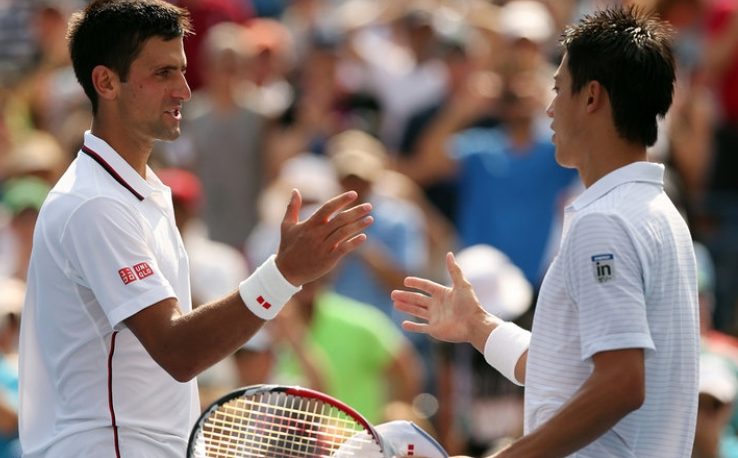

Photo Courtesy of http://www.sportfaktor.hu Novak Djokovic has not been playing his best tennis at the Rogers Cup this week, but that has not stopped him making big ATP finals before and this week is no different.
Neither Tomas Berdych or Gael Monfils were able to put another dent into Djokovic’s 2016 despite having their opportunities, particularly Berdych who held 3 set points in the first set tiebreaker, so how will Nishikori do if he gets his chances in the final?
Nishikori has not had to produce his best tennis this Rogers Cup either, but not peaking yet should work in his favor as peaking in the final versus Novak Djokovic, playing for his 30th ATP 1000 win, is when to do it.
Peaking in the final versus Djokovic, however, is hard to time, the Serbian being the world No.1 at negating his opponent’s strengths, and breaking them down no matter now well they have been playing going into the match.
Nishikori lost his last ATP 1000 final (this is his third) in Miami, to Djokovic as the Serbian eased through for a straight sets win, but the surface in Toronto is faster than Miami which suits Nishikori’s game better. The Rogers Cup third seed has as aggressive a baseline game as Djokovic and can, on his day, as he did at the 2014 US Open, outplay him from the back of the court. That, however has only happened all the way through a match on two occasions, with Djokovic dominating their head to head 9-2 as his greater defense and stamina demands too much aggression from the Japanese who stops out-hitting and over-hits, instead.
Djokovic goes into the final having out witted another master of the baseline game, a mastery achieved with a very different style, Gael Monfils. Courtesy of Monfils, the Serbian’s back-court game is well tested after a straight sets defeat of the Frenchman which may prove to be the match that finally got Djokovic’s game going this US hard court swing.
The Serbian needs it, too. His early Wimbledon loss to Sam Querrey has opened the door to Andy Murray a little when it comes to the world No.1 ranking, and with Cincinnati and the US Open coming up there is a good chance, if Djokovic cannot get himself into the kind of fast hard court form that has won him two US Opens and four Dubai titles, that door could open up large enough for Murray to squeeze through.
That kind of challenge is exactly what Djokovic needs at this stage of his career, a stage which sees him achieving the final feats missing from his resume, to keep him motivated. With Nishikori one of the players chasing Djokovic and next in line to all the trophies the Serb has been hoarding, this Rogers Cup final is timed perfectly for the world No.1 to let his rivals know he is not going anywhere and that they still have very far to go.
Prediction: Djokovic to win in straights, one close set, the other one straightforward.
-
Rogers Cup Preview Novak Djokovic Leads Dangerous Field Out to Upset No 1
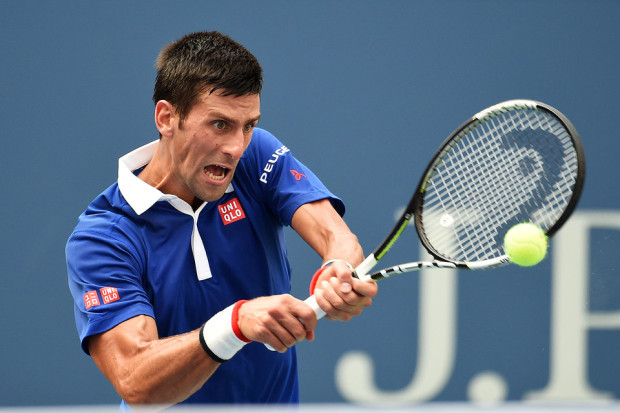
Photo courtesy of http://www.artefak.org Novak Djokovic‘s main hard court rivals’ absence from the 2016 Canadian Open draw with the Rio Olympics looming will be of little comfort to the No.1 seed who was reminded so emphatically by Sam Querrey at Wimbledon that anyone with the right game can take out the top seed if he is less than his very best.
Andy Murray, who beat him in last year’s final, and Roger Federer, who challenged him in 2015’s US Open final and beat him in Cincinnati a few weeks before, would have been likely contenders to inflict another defeat on the Serbian in his least successful hard court stretch of the season- of his 29 ATP 1000 titles, ‘only’ three have come from the US Open lead-in, the 2012, 2011, and 2007 Canadian Open titles, compared to 11 from the Indian Wells-Miami stretch– but Federer and Murray are not the only players capable of hurting the 12 time slam Champion.
In 2016, Djokovic’s main rivals such as Murray and Federer have not been the players who have troubled him most. Other than the loss to Murray in Rome, it is the lower ranked players of the ATP who have beaten the world No.1. Felciano Lopez may have benefitted from Djokovic’s eye infection in Dubai but the Spaniard was nevertheless the last man standing in an ATP match versus the world N0.1. Jiri Vesely shocked him in Monte Carlo when he was coming in off the back of another Indian Wells-Miami double, and Sam Querrey was few people’s bet to beat him in Wimbledon but managed to close out the win.
Life could get tough for Djokovic in his opening match with just the kind of players he struggles with on fast hard courts in the mix, big serving Gilles Muller or big hitting Dmitry Tursunov, who will face off in the opening round.
Djokovic leads Muller 2-0, but Muller is coming off a recent run to the Hall of Fame finals and has a big serve that could be tough for Djokovic in his first match back since that Wimbledon upset.
Tursunov and Djokovic have not played since the Paris Masters in 2008, and the Russian has not won an ATP match since Acapulco, but if Djokovic is a little rusty after winning just two ATP matches since Roland Garros, then Tursunov, ranked 259 but in the draw on a protected ranking after injuries, with both experience and sound tactical wits in his favor, a dangerous factor for Djokovic considering how hard the Russian can strike the ball, will be a much tougher rival than he looks on paper.
Benoit Paire is seeded to face the top seed in the last sixteen, and has the tricky game to unsettle Djokovic, but the Frenchman has an issue closing out matches and Djokovic would be favored to fight through that one. Paire is also likely to get upset considering his inconsistency so his first round opponent Radek Stepanek, a 2007 Canadian semi-finalist and with match fitness on the clock after qualifying into the main draw, could be the top seed’s third round obstacle.
In the last eight, Djokovic is seeded to meet Tomas Berdych (5). The Czech is capable of pushing the top seed in a close match, but Djokovic leads the head to head 24-2, and has won the last 11 matches.
John Isner (9) in the last eight would be a potentially tougher encounter, and the kind of match which if the world No.1 can win decisively could put the Wimbledon loss well and truly behind the top seed. Isner may not be the same player who beat Djokovic on hard courts at Indian Wells 2012 and in Cincinnati 2013, but he does still have a big weapon in his serve, and he can catch fire in the lead up to the US Open.
Watch Novak Djokovic practicing at the Canadian Open in the video below:
Milos Raonic (4) or Goffin (7) could await Djokovic in the semis. Raonic will be extra motivated to make a statement after his straights sets loss to Murray at Wimbledon, and what better way to do it than to get a win over Djokovic in front of your home crowd. Meanwhile Goffin has shown he can challenge the no.1, leading him 3-0 in the final set of their 2015 Cincinnati last 16 match and taking him to a first set tiebreak in their Miami semi-final earlier this season.
Gael Monfils (10), who just won his first ever ATP 500 title with victory at the Citi Open, could also carry that momentum over into Canada and face Djokovic in the last four. The tenth seed likes fast conditions, and took Djokovic to a third set tiebreaker when they met in Canada in 2014 in the second round. The world No.1 lost his next match to Jo-Wilfried Tsonga.
Sam Querrey is also in Djokovic’s half, and if he can upset David Goffin in round two, Monfils in the last sixteen, and Raonic in the last eight, we might, if Djokovic lives up to his seeding, get a Wimbledon rematch in the world No.1’s very next tournament.
Wawrinka is seeded to meet Djokovic in the final. Wawrinka is 10-9, however in Canada, though a previously poor record at a tournament has never stopped the Swiss making a deep run before and the Swiss is proving more consistent in 2016,
Nishikori is Wawrinka’s seeded opponent for the semi-finals. In Canada, the Japanese is 5-3, making the semis last year, and with the conditions favoring him over the Swiss, he is Djokovic’s likely final opponent.
Nishikori or Wawrinka, either will be a challenge for the world No.1 with both men among just a handful of players to get wins over Djokovic in Slams since the Australian Open 2014 (Wawrinka twice, Nishikori once- Nadal and Querrey are the other two).
Whoever Djokovic faces for the title, and Marin Cilic, Dominic Thiem, and Nick Kyrgios will all be faces to watch out for in the very open bottom half, the Serbian will not underestimate them. Right now, a rested Djokovic, who has had the family time he was craving after a busy 15 months, has his mind back on the job of winning tennis matches, and he will, after being reminded so brutally at Wimbledon how anyone with the right weapons and strategy can beat him if he is anything less than his best, be very prepared for a tournament he is the number seed to win, and the number one player to upset.
Come back for our Canadian Open final preview next Saturday.
-
Wimbledon Men’s Final Review Andy Murray Defeats Milos Raonic
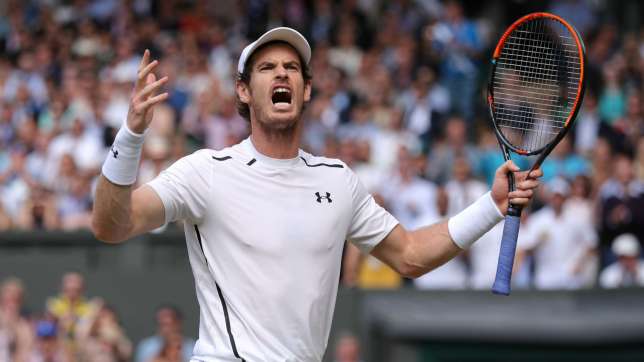
Photo courtesy of pulse.com.gh A Federer or Djokovic-less road to a Grand Slam title finally lay before Andy Murray at this season’s Wimbledon, and, defeating Milos Raonic (6) 6-4, 7-6, 7-6 in the final, he was only too happy to cruise along the highway.
After eight years of reaching, and contesting, slam finals, Murray’s eleventh final featured someone other than the Swiss or the Serbian, who had beaten him eight times in all (Federer three times, Djokovic five), and against whom he had only been successful on two occasions, against the Serbian at the US Open ’12 and Wimbledon ’13 (2-8 in slam finals looks crushing on the surface, but dig deeper and 2-8 versus the game’s number one and four all time slam haulers is a little more soothing.)
Up until deep in the fourth set of Federer’s Wimbledon semi-final versus Milos Raonic this year, it looked like Murray’s slam final history might be repeated.
Unfortunately for Federer, but fortunately for Murray, Raonic ended that era, and presented Murray with a slam final first-timer, and slam final debutantes tend to be undone by their inexperience, most particularly on the big points versus top players, as Murray can testify himself after losing to Federer in his first Slam final at the 2008 US Open in straight sets, 32 Grand Slam finals ago.
Murray was now the favorite, and in the final, he played like one. The 6-4, 7-6 (3), 7-6 (2) scoreline tells the truth of the match, one in which everything was clear on Murray’s side. The second seed’s strategy to keep his serve steady, run down every ball, keep his error count low, and his intensity high, never wavered, and he never faltered.
Raonic’s plan was less clear. The big serve was never in doubt- he was after all only broken once against as great a returner as Murray- but everything else was a little vague, and even just a little is too much in matches like these. He attacked, the right approach to the match and the only way he was going to break Murray down, but too often he came in on the wrong approaches, sending the ball into Murray’s hitting zone or into spots which the Scot could get to, and, with his counter-punching skills, pass the Canadian with typical precision.
Raonic’s play, especially in the tiebreaks, was never good enough in a match he was experiencing for the first time, but one which Murray had seen over and over again. This time, though, Murray was spared the deja-vu of Federer or Djokovic in the final. This time he was seeing it with new eyes.
Those eyes must have opened as wide as the draw did once Djokovic had been upset by Sam Querrey in the third round. Murray had already been blessed with a very kind draw, and with Djokovic’s absence, it was nothing less than indulgent – Nick Kyrgios, who Murray had beaten in three slams in 2015, in the fourth round, Jo-Wilfried Tsonga in the quarters, against whom he led 12-2, and Berdych in the semis, a man he had beaten in their previous 4 matches and won 9 consecutive sets against. The final act of generosity came with Federer’s defeat and a final opponent in the form of Raonic, whom he had beaten 6 of 9 times, including at this year’s Australian Open and at Queens.
Murray could not have envisioned a better draw himself, and while Tsonga did push him to five, Murray’s 6-1 final set win over the Frenchman tells us just how determined he was not to let this draw, an easy run to a slam compared to his past efforts, one he had earned the hard way, collapse before him.
Plenty of players have won slams in similar style draw-wise, that’s part of the luck of the draw, draws you have to stay in to win. While Nadal did not even start, Djokovic stumbled before the second week, and Federer let a winning match slip from his grasp, Murray was still there, riding into the final on his first straights sets slam semi-final win.
Murray was in the draw all the way to the finish line, sprinting across to win a third slam title three years after his last, with Ivan Lendl beside him as he had been then. Another slam title after a career threatening injury in 2014, and further potentially confidence-destroying slam final losses to Djokovic in Melbourne (2015, 2016) and Paris (2016). Another slam title which ranks him alongside Jan Kodes, Gustavo Kuerten and Arthur Ashe as three-time champions.
In slam winning shape, in an era in which the experienced, stamina-strong athlete can thrive in slow conditions which allow them to evade the more dynamic step of youth, Murray’s time has come at exactly the right moment for the Scot. On Sunday, he seized it, and the confidence and experience that comes with doing so, in a match he was favored, for the first time, to win, can only help him when slam final twelve comes along, Federer-Djokovic or no Federer-Djokovic on the other side of the net.
-
Wimbledon Final Milos Raonic Vs Andy Murray Fight of Firsts for Beau and Favorite
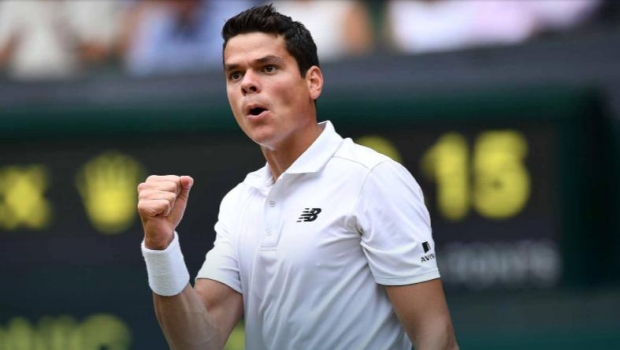
Photo courtesy of mytoba.ca The 2016 Men’s Wimbledon final between Milos Raonic (6) and Andy Murray (2) is one marked by differences in style, personality and experience but which will be defined by how each one handles the one thing they have in common- reaching a slam final in which both will experience something of a first.
For Raonic, the first is his first slam final, a major breakthrough for the 25 year old who has been touted as the next big thing for a few years now, a status injuries have kept out of his reach.
When it comes to firsts in slam finals, most players tend to make a mess of it. In recent history, Marat Safin, Lleyton Hewitt, Stan Wawrinka, and Juan Martin del Potro have been a rare breed of player who play their first slam final against a great with the authority of a Champion who has been there, done that.
Andy Murray, himself, struggled in his first slam final, losing to Roger Federer in the US Open 2008 in straight sets. Like Andre Agassi, Novak Djokovic, Carlos Moya, Goran Ivanisevic, and David Nalbandian, first time nerves got the better of him.
Will those inevitable nerves get to Raonic? Is he going to channel his inner Safin and click on all his strengths or will his inner Murray mean he gets overwhelmed by the occasion?
Raonic is a cool customer, and is not likely to get too hot and bothered by the opportunity before him, but of course there are going to be some butterflies fluttering, and healthily so, too. There is something of the practical dreamer about Raonic- not only does he dream big, and talks about those dreams, but he also works hard, a topic he also talks at length of, to make it happen, and the confidence that hard work will give him should keep the nerves born of those big dreams both alive and in check.
If anything is going to get in the way of Raonic’s big serve, highly effective inside out forehand, and volleying skills, it will either be his health, which gave up on him when he had the better of Murray in their Australian Semi-final this year, or it will be Murray, whose resilience, consistency, and fighting spirit earned him a comeback from behind win over an in-form Raonic in the recent AEGON championships final.
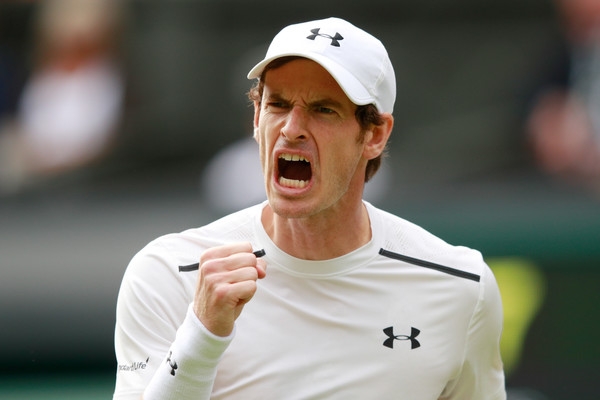
Photo courtesy of http://www.tarafdari.com That AEGON winning run put Murray as one of the favorites going into Wimbledon once more, a position he is used to as a former Champion and runner-up. That 2013 title was Murray’s second slam, his first coming at the US Open ’12, his fifth attempt to win a slam title.
There is a good reason Murray did not win his first slam final. As much as Murray was undone by nerves and inexperience in New York, those factors were exploited by Roger Federer, then the tour’s dominant player and at the peak of his hard court powers. No one will understand Raonic’s predicament of facing a multiple slam winner in his first final better than Murray. It is one the Scot has the experience to exploit, but he will have to adjust to his own predicament first, that of being the favorite in a slam final for the first time.
The moment Novak Djokovic was upset by Sam Querrey, Andy Murray was given the unenviable crown of favorite in a slam for the first time in his career. The pressure told in his quarter-final match when Jo-Wilfried Tsonga came back from 2 sets to love down, but Murray handled it with his signature expressiveness, screaming to his box at 1-1 in the fifth he was not going to lose the match, and a less typical clinical nature, winning the next five games.
How will the pressure tell on Murray in the final? Raonic will be putting plenty of it on Murray’s strengths- his big serve will challenge Murray’s return, his strokes, particularly that inside out forehand, will push Murray’s defense to the limits, and his willingness to come to the net will leave the Scot watching balls die in the service box.
There is little Murray will be able to do if Raonic’s strengths overwhelm him except ride it out and if, or when, Raonic has a letdown, let his own strengths come to the fore. The danger is though that Raonic’s strengths might eat at what is Murray’s main weakness- his mentality. If things do not go Murray’s way, he has a tendency to fall apart, and in a final he is expected to win, he may not be able to put himself together again that easily against an opponent who has proven to be very skilled at taking his chances this fortnight.
In Raonic’s quarter-final over Goffin, a come back from two sets to love down, and his semi-final over Roger Federer, in which he came back from two sets to one down and faced break points late in the fourth, the sixth seed proved that he can hang in there when not playing at his best, and find his game to come back and beat high quality opponents. This may be Raonic’s first slam final, but it will not be the first time he has come through in a high stakes match to get the win.
Whoever handles their respective first times in a slam final the better will take this match, and with both men having proven they have the games and minds to potentially handle both situations well, this first time slam final between Milos Raonic and Andy Murray, the two best grass courters in the game right now, could be one we want to see repeated in years to come.
Watch highlights of Raonic Vs Murray in the Australian Open Semi-Finals below:
-
Wimbledon Third Round Sam Querrey Defeats Novak Djokovic
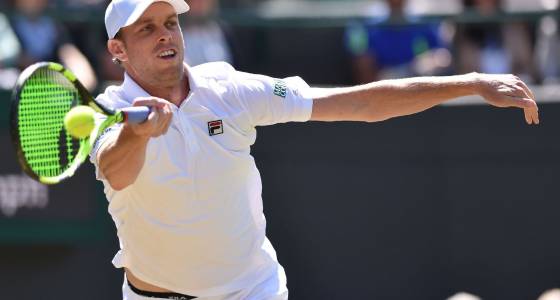
Photo courtesy of fxtribune.com Few saw Sam Querrey coming for Novak Djokovic in the Wimbledon third round, but the American saw his chance, and he took it.
Sam Querrey, the 28th seed at Wimbledon, was not on many lists of players likely to end Novak Djokovic’s Grand Slam winning run. The world no. 41 trailed Djokovic 8-1 in their head to head, (losing 6 ATP matches in straight sets, and winning a set in each of the two Davis Cup ones), had a reputation for not making the most of his chances, and was playing a man coming in off the back of winning his first Roland Garros title and looking to win his 31st consecutive Grand Slam match.
Despite all that history, the 28th seed got it done, inflicting a shock 7-6, 6-1, 3-6, 7-6 upset on the two time defending champ.
Querrey, ranked as high as 17 in early 2011, showed just how dangerous he was on grass as he put together one of the biggest upsets in Grand slam tennis history.
The American, who won Queen’s club in 2010, finished runner-up in Newport (2009) and Nottingham (2015), and reached the Wimbledon last sixteen once (2010), and the third round once (2012), was elevated from world No.41 to the 28th seed at SW19, and was one of the more dangerous players for the top seeds to meet in the third round.
The 6ft 6 inches tall American status as a grass-court threat has been earned mostly on the back of his serve, harder to break on grass than on any other surface. His first strike tennis also helps, too.
A big serve and aggressive mindset, that’s just the kind of game to trouble Novak Djokovic.
Querrey was also having a good season coming into Wimbledon, winning the title at Delray Beach,(his first since 2012), reaching the semis of the Ricoh Open (lost to Nicolas Mahut), and making the semis of Acapulco (lost to Dominic Thiem), beating Kei Nishikori on the way.
He was having a great Wimbledon, too. In his first round, he came back from two sets to love down versus Lukas Rosol, winning 12-10 in the fifth, and then beat Thomaz Bellucci in straights.
But it was not just Querrey’s game that was clicking for him, he had external factors in his favor, too.
One crucial one was that his match versus the top seed was scheduled for Court No.1. Djokovic does not like the faster conditions of Court No.1- he says he is not as comfortable there as he is on Centre- and has gone to five sets versus tall big servers the last two years playing there (in 2015 versus Kevin Anderson, and in 2014 versus Marin Cilic).
If Court 1 was not enough to throw Djokovic off his game completely then the rain sent him over the edge. The stop-start nature of the match meant Djokovic was unable to work his way into a rhythm, especially on his return, (he converted just 3 of 17 break points), and without his rhythm on his strength, the top seed really was in trouble versus a player with the weapon of Querrey.
In form, coming off a huge confidence making win, and in favorable conditions, why was Sam Querrey overlooked?
While the 28 year old has an enormous serve, it has been known to let him down when he needs it to hold a lead. Recently in Madrid, he led Nadal 4-0 in the first set only to lose 4-6, 2-6.
Things do not get much bigger in tennis right now than defeating Djokovic in a Slam, and Querrey’s chances of seeing the win through even if he got a lead were not highly regarded.
This time though the serve was what held up for Querrey. The American said he played the break points very well. Aces and service winners were what was needed to get past the best returner and fighter in the game, and Querrey delivered, (he hit 31 aces in total).
That Djokovic fight is usually displayed in at least one of Djokovic’s early round matches at slams. Kevin Anderson (Wimbledon 2015), Gilles Simon (Australian Open 2016), and Roberto Bautista Agut (Roland Garros 2016) have all had him on the ropes, but none were been able to finish him off.
Querrey, however, did.
At times it looked like Querrey wouldn’t, that Djokovic would find a way to win. When the players returned the day after rain forced them to leave the court with Querrey leading two sets to love, Djokovic led 5-0 before closing it out, after another rain delay, 6-3.
In the fourth set, Djokovic served for the set at 5-4, and led in the tiebreaker.
Querrey was the one, however, who came up with the big shots on the big points, and exposed Djokovic’s poor performance, not allowing the Serb to stay in and steal the match on the back of getting one more ball back into play.
But while few thought Querrey would be the man to end Djokovic’s run, Querrey, crucially, did not think about it too much. He just fired away with the weapons he had, and got it done, ending Djokovic’s history making run, and putting an end to his own history of not taking his chances.

Tennis from a fan's point of view
[
[
[
]
]
]
 thetennisreview