-
Miami Open Day 6 Preview: Monfils Vs Tsonga, Berdych vs Tomic
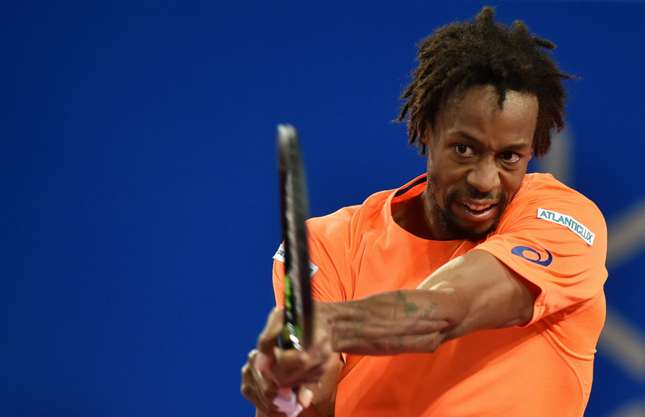
Photo courtesy of loopjamaica.com The third round of the Miami Open features Gael Monfils taking on fellow Frenchman Jo Wilfried-Tsonga and Tomas Berdych going up against Bernard Tomic. The Tennis Review previews the action and predicts the winner.
Gael Monfils (17) Vs Jo-Wilfried Tsonga (11)
This is easily the most attractive match of the day. Two of the game’s best shot-makers, best athletes and most passionate players going up against each other for a place in the last sixteen.
Monfils is having a strong 2015, finishing runner up in Marseilles and compiling a 10-4 win-loss record. His first round match against Filip Krajinovic was his first since the Open 13 event- he had to withdraw from Indian Wells with a chronic keen injury- and he won it in a third set tiebreaker.
Tsonga also comes into the contest after a tough three set win over Tim Smyczek in his first match of the year.
Tsonga leads the head to head 4-1, with all their matches played on hard. The only match that has gone the distance was Monfils’ sole win in Montpellier in 2010.
Tsonga will commit to an attacking game while Monfils will use his great athleticism to defend, and he will benefit from the extra time he will have to set up his shot-making.
It’s a clash of styles which is sure to provide many entertaining rallies and a few twists and turns. Expect both players to give 100 percent mentally, and with Tsonga being the dominant player in this head to head, the better outdoor hard player, and the better match player, this should go his way.
Prediction: Tsonga to win in three sets.
Tomas Berdych (8) Vs Bernard Tomic (25)
What makes this match up so intriguing is the clash of styles. Berdych is the game’s cleanest hitting ball-striker. Tomic, on the other hand, is all about touch, variety and court-smarts.
Berdych leads the head to head 3-0. Until now, they have only met at slams (Wimbledon 2013, 2014, Australian Open 2015), and Berdych has won each time, with the two Wimbledon clashes going four sets.
Both men are in good form. Berdych has been having a strong start to 2015 with new coach Daniel Vallverdu, and Tomic has re-committed himself to the game, making the last eight of Indian Wells last week, the furthest he has gone at an ATP 1000, and ranked 29, is two places below his career high ranking reached on 11.06.2012.
Tomic’s re-dedication to tennis is seeing him get good results outside of Wimbledon and Australia, and he is starting to consistently beat players ranked below him, and also those above him, such as his recent defeat in Indian Wells of no.8 David Ferrer.
This match will be on the slowest surface they have competed on yet, which slightly favors Berdych who has a 24-9 career record in Miami, and reached the final in 2010.
This will be a tough one for Berdych as Tomic’s variety of spins and slices will not give him any rhythm, but the Czech seems to have Tomic’s number in the head to head, has had great success in Miami and should be able to hit through the courts and impose his game.
Prediction: Berdych to win in straight sets.
Commentary by Christian Deverille
Follow the ATP Tour with The Tennis Review.
Who do you think will win? Please share your thoughts with us below.
-
Miami Open Day 5 Player of the Day Alexandr Dolgopolov
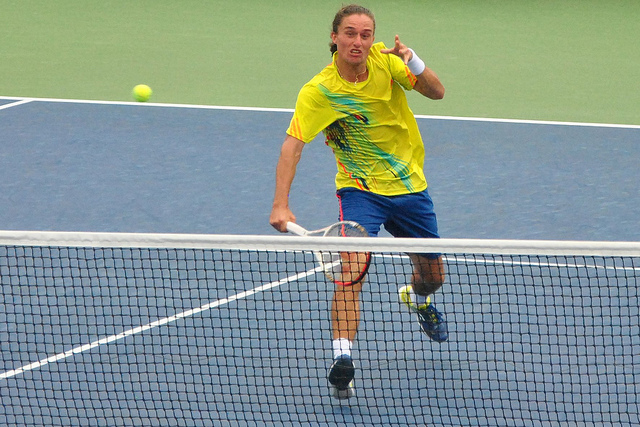
CC courtesy of Angela N at flickr. World no. 65 Alexandr Dolgopolov’s second round 6-7 (1), 6-3, 7-5 defeat of 16th seed Tommy Robredo at the Miami Open earns him the the title of Player of the day.
A year ago, the Ukrainian was ranked 23 coming into the Miami Open, and entered the event on the back of a run to the last four of Indian Wells where he knocked out then world no. 1 Rafael Nadal and Milos Raonic.
Dolgopolov broke into the top 20 in June and then peaked at 17 after Hamburg in mid-July. But an injury interrupted his rise up the rankings and he was out of the game until Tokyo in late September.
The Ukrainian would score only one win the rest of the season (a straight sets defeat of Gilles Simon in Valencia).
In 2015, Dolgopolov, one of tennis’ best shot-makers, has been getting his form back. He has now, including his Miami wins, won back to back matches in his last four events (Indian Wells, Acapulco and Delray Beach).
Robredo, ranked 18, is the first top 20 player Dolgopolov has beaten since Simon in Valencia. The Spaniard has no problems dealing with the game’s big shot-makers on slow courts- he beat Dimitrov at Indian Wells last week, and is one of the tour’s steadiest and smartest players, and was a difficult draw for Dolgopolov.
Robredo took a tight first set on a tiebreaker, running away with the breaker 7-1. The Ukrainian then took the second set 6-3.
In the final set, Robredo broke for a 2-0 lead and held for 2-1. The Ukrainian fought back to earn two break points and took the first when, on the run, he hit one of his greatest weapons, a sliced backhand, cross-court, that skimmed the line and forced a Robredo error.
Returning at 5-6, Dolgopolov was two game points down. A cross-court forehand on the run that passed Robredo and cleaned the line kept him in the game. On the next point, Dolgopolov’s reactions and talented hands were showcased as he returned a serve right into his backhand, getting his racket on the ball with lightning reactions and sending it cross-court, right at Robredo’s feet, forcing him into a forehand error and leveling the game at deuce.
Dolgopolov earned his third match point with a forehand cross-court taken on the rise followed by a forehand volley winner.
On match point, Dolgopolov got a look on the second serve. He rallied with Robredo for the first couple of shots before Robredo took charge, changing the direction of the ball and hitting a penetrating forehand down the line that pushed Dolgopolov behind the baseline.
The Ukrainian’s movement and footwork kept him in the point, and he hit a sliced backhand that drew Robredo in. With a sitting target at the net, Dolgopolov unleashed some pace as he struck a forehand passing shot at Robredo that forced the Spaniard to error on the volley and earned Dolgopolov a place in the last sixteen.
Shot-making, variety, touch, great hands, imagination footwork, technical skills- Dolgopolov has it all, and he was so close to putting it altogether as he rose up the rankings before injury last season. This win over Robredo might be a step back in that direction, a direction worth following for tennis fans.
Watch highlights of Dolgopolov’s win over Robredo below.
Commentary by Christian Deverille.
Follow the Miami Open and the ATP Tour with The Tennis Review
Do you agree with Dolgopolov as Player of the Day? Share your thoughts below.
-
Miami Open Day 3 Player of the Day Dominic Thiem
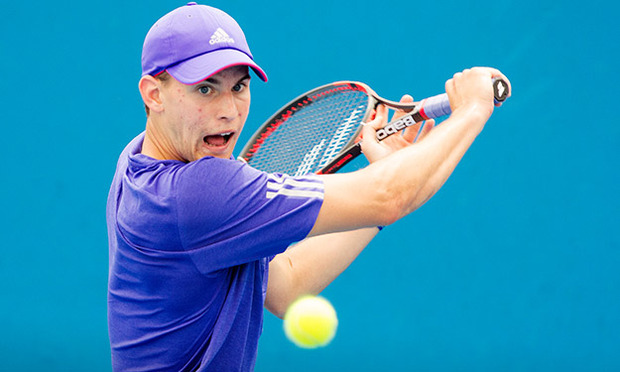
Photo courtesy of sportnet.at. Dominic Thiem’s 7-6, (4), 4-6, 6-3 upset of tenth seed Feliciano Lopez in the second round of the ATP 1000 Miami Open earns the 21 year old Austrian the title of Player of the Day.
The upset was an impressive one. Lopez was in good form coming into the event- last week in Indian Wells he knocked out world no. 5 Kei Nishikori on his way to the quarter-finals.
Thiem, meanwhile has been struggling in 2015 after a breakthrough 2014 in which he made the U.S Open fourth round, broke into the top 40 (achieved highest ranking of 36 on 08.09.14), and scored a win over then reigning Australian Open and Monte Carlo champion Stan Wawrinka at the Madrid Open.
A viral infection and military service over the off-season knocked the momentum out of Thiem though, and coming into Miami, the 52nd ranked player in the world was 3-6 on the ATP tour, and lost in the quarter-finals last week in Irving on the Challenger Tour.
Thiem, who beat Diego Schwartzman in the previous round, won back to back matches for only the second time in 2015 after beating Lopez. His previous back to back wins came in Marseilles, though he did not have to complete the second win over Goffin who retired 0-5 down in the second set.
Before the Lopez match, Thiem was 1-0 versus Lopez, beating the Spaniard in straight sets on his way to the U.S Open fourth round last year.
Thiem edged a close first set 7-6 (4). In the tiebreak, Thiem hit a winning lob to grab a crucial mini-break and lead 5-4.
At 6-4, serving, Thiem served out wide, stepped into the court and hit an aggressive forehand to the Lopez backhand side, forcing an error and sealing the set.
Thiem dropped the second set, but came back strong in the third, his more penetrating ground strokes, superior back court play, aggressive passing shots and willingness to move forward got the better off Lopez. Thiem scored an early break in the third and then held all the way to 5-3 when he served for the match.
The 21 year old reached match point with a winning smash. Lopez saved the first with a volley winner, but on the second match point, Thiem served down the middle and then hit his signature shot- a single handed backhand- cross-c0urt for a winner to move into the Miami Open third round.
Thiem’s fist pump and grin after winning the match point with a blistering winner was great to see. The 21 year old is one of the players to watch on the ATP Tour and this win could help him get back to the strong form he displayed in 2014.
Thiem has now defended his last 64 Miami points from 2014 and now faces either Fabio Fognini or Jack Sock in the last 32.
Watch highlights of Thiem’s win over Lopez below
Commentary by Christian Deverille
Follow the ATP Tour and the Miami Open with the Tennis Review.
Do you agree with Thiem as our choice of Player of the Day? Please share your opinions below.
-
Who Would Win Miami Without Djokovic, Murray and Nadal in the Draw?
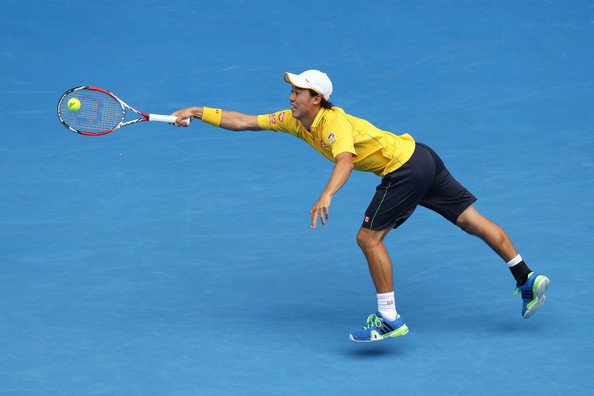
- Photo courtesy of zimbio.com
Novak Djokovic’s victory at the Miami Open looks a sure bet. The Serbian won the Indian Wells- Miami double last season, and after his win in Indian Wells last Weekend, it is hard to see him not repeating that feat this year.
But who would win if Djokovic was not in the draw? With Murray and Nadal both struggling, they are not safe bets to fill the gap Djokovic’s absence would leave, and, for the sake of this article, are removed from the draw.
With Federer missing from the draw, along with the other ‘Big Four’ members, the potential would be there for one of the current ‘young gun’ generation of Nishikori, Raonic and Dimitrov to break through.
A breakthrough the tennis world has been waiting for some time to happen. None of them have won an ATP 1000 yet. The closet they have got was when Nishikori led Nadal by a set and a break in the Madrid 2014 final before he was forced to retire injured. Raonic has also represented them in an ATP 1000 final when he beat Federer on his way to the Paris-Bercy final last year, but he was soundly beaten by Djokovic in the championship match.
Nishikori and Raonic are in the same quarter of the draw of the Miami Open, but with Djokovic ‘withdrawing’, we put Nishikori, the highest ranked player in the draw after Djokovic, Nadal and Murray, in the Serbian’s spot, and Raonic, ranked six, as the number two seed at the bottom of the draw.
Nishikori replacing Djokovic would be fitting. Nishikori and Djokovic, with their aggressive baseline games and athleticism, have a lot in common.
The Japanese would likely sail through Djokovic’s part of the draw, and meet Ferrer in the last eight. That match could go either way, in Nishikori’s current form. The Japanese recently lost to Ferrer in straight sets in the Acapulco final, despite being a nightmare match up for the Spaniard, the 2013 Miami runner-up.
Nishikori is the better player in this match up, however, and so, in this imaginary draw, goes through.
The Japense would face, in the ideal ‘ young gun generation’ scenario, Grigor Dimitrov in the last four. Nishikori leads that head to head 2-0, with both wins coming on hard in straight sets (Shanghai ’13, Miami ’14), and the Japanese, like Djokovic is a nightmare match up for Dimitrov.
Nishikori’s length from the baseline and variety of ground strokes keep Dimitrov beyond the baseline, running side to side and open up the court. As if that were not bad enough for Dimitrov, Nishikori’s speed and passing shots get the better of Dimitrov when he does get control of the ball and approaches the net. Nishikori has a fierce return, too, and if Dimitrov is off his serve, he is in trouble.
So, Nishikori would make the final, beating Dimitrov in straights.
In the bottom half, Raonic would face Berdych in the last eight. Raonic leads this head to head 3-1 with all their matches played on hard courts. Raonic’s serve trumps the Czech, he saves break points more easily, and the slow surface would allow him to return better, too, and go for winners on his ground-strokes. The Raonic-Berdych quarter-final would go three sets with the Canadian just edging the Czech.
In the semis, Raonic would face Wawrinka. Wawrinka leads him 4-0, and beat him in two tiebreak sets in Rotterdam this year. But just as Raonic overturned a 0-5 head to head deficit with Nadal in Indian Wells last week, he has a chance against Wawrinka who went out early in Indian Wells, has never made it past the last 16 in Miami and has a 6-6 career win-loss record at the event. Raonic meanwhile has already made a quarter-final, in 2014 when he took Nadal to three sets, and is 5-2 lifetime at the tournament.
In the final, Nishikori and Raonic would deliver a worthy contest. Nishikori leads the head to head 5-2, but each match has been close with three of the three setters going the distance, their 2014 U.S Open going five sets, and their recent Davis Cup match going five sets on hard.
Nishikori versus Raonic is an entertaining contest to catch. It is a classic clash of styles- Raonic’s big serve and risky, explosive ground strokes up against Nishikori’s baseline aggression and return game. It could very well be the final of the future, too, with these two ranked 5 and 6 and aged 25 (Nishikori) and 23 (Raonic).
Right now, Nishikori would most likely win on a slower surface like Miami where his return game could make the difference. Raonic tends to throw in the odd off service game now and then, and his own return game is still a work in progress.
The Japanese also has the greater variety which benefits him on a surface where he has plenty of time to select his shots.
Right now, though, with Djokovic and Federer still winning the majority of slams and ATP 1000s, Nishikori and Raonic are not regularly competing in big finals. With Djokovic not likely to decline anytime soon, and Federer maximizing his attacking game to save miles on the clock, Nishikori and Raonic will have to get past those two if they want to start competing for big titles.
That time will come when Raonic and Nishikori do contest each other for the game’s big titles, but it would sent a jolt through the tennis world if it happened sooner rather than later. With the winners of events currently a touch predictable, the sport could do with some breakthroughs like it had last year with Wawrinka and Cilic.
If Raonic and Nishikori can tap into something in the near future, that touch of inspiration that will get them through a big match against the big four in the later stages of big events,like Nishikori had against Djokovic at the U.S Open, their presence in the finals and on the winner’s podium would be, for the neutral spectators, a very welcome surprise.
Watch the Brisbane 2015 match between Kei Nishikori and Milos Raonic below.
Commentary by Christian Deverille
Follow the Miami Open with The Tennis Review
Who do you think would win the Miami Open without Djokovic, Nadal and Murray in the draw?
-
Borna Coric and Alexander Zverev into Miami Open Round 2.
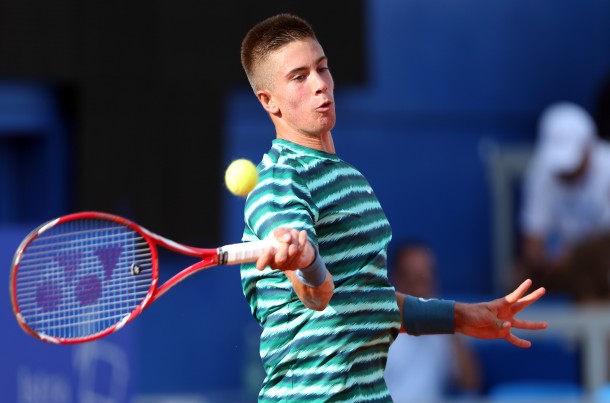
Photo courtesy of http://www.thetennisspace.com Borna Coric and Alexander Zverev won three set matches to make the second round of the Miami Open on their tournament debuts.
Zverev, 17, qualified for the main draw and was appearing in the main draw of an ATP 1000 event for the first time in his short ATP career. The German, ranked 29, beat 69th ranked Sam Groth 6-4, 6-7 (5), 7-5 and out-aced the Australian 22 aces to 17.
Groth led Zverev in all other serve stats, and return ones, too, and even won more overall points (99-90), but trailed in the most important stat of them all- break points won in the third set. Groth converted none of his three break points while Zverev won 1 of 2.
Zverev will now face 26th seed Lukas Rosol in the next round, a winnable match for the German who excels on slow surfaces and has a big enough serve to hold his own against the Czech.
Coric will face 18th seeded David Goffin. The Croatian 18 year old, ranked 59, beat Andreas Haider-Maurer for the second first round match in a row. Coric beat Maurer in the first round of Indian Wells over a week ago in straight sets, but this match was altogether different affair, Coric winning 1-6, 6-3, 7-6 (3).
After the two split sets, Maurer went up 3-0 in the third. Coric fought back though, despite an injury time-out, leveled the match, broke serve and then served for the match at 6-5. He could not do it, though, barely able to move at times.
In the deciding tie-breaker, Coric was the steadier of the two in some tentative, nervy rallies, grabbed an early mini-break and took the tiebreaker 7-3.
Coric has now won a match in his second consecutive ATP Tour event, and if he can recover from his injury by Saturday, he could have a chance in round two against a recently injured Goffin. The Belgian leads the head to head, winning their Basel semi-final last season, but that match went to three sets, and Coric will be more match fit than Goffin who has not played since the Davis Cup and has not won back to back since Chennai in January.
Commentary by Christian Deverille
Follow the ATP Tour with The Tennis Review
-
Miami Open Preview: Questions the Miami Open Will Answer about Nadal, Del Potro and Nishikori
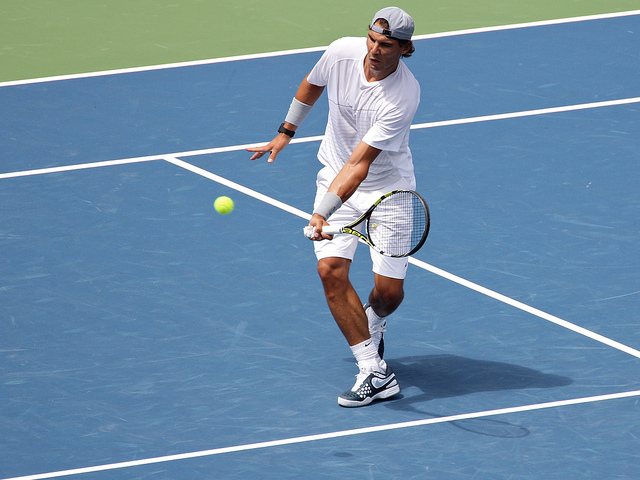
CC courtesy of Marianne Bevis at Flickr. The Miami Open, the season’s second ATP 1000 tournament kicks off today and will answer some questions for tennis fans about the state of Rafael Nadal, Juan Martin del Potro and Kei Nishikori’s games.
Can Rafael Nadal get back to the top?
Rafael Nadal’s fans must be feeling concerned about their favorite’s 2015 form. Miami, with it’s slow surface and high bounce, could be just the tournament, however, where he puts their minds at rest.
Nadal has never won in Miami, but has a great record there, finishing runner up four times (2005, 2008, 2011, 2013). The tournament is where Nadal first beat Federer, in 2004, and is, along with Paris, one of only two ATP 1000 titles he has not won.
Right now, Nadal, the king of comebacks, is struggling to reassert himself at the top of the game, eight tournaments into his comeback from a knee injury which kept him sidelined for three months after Wimbledon 2014.
Since coming back, he has won the ATP 250 Buenos Aries Open, made the last eight of the Australian Open, and was a semi-finalist in Indian Wells. Compare his results to his 2013 comeback, though when, after seven months out, he won Indian Wells four tournaments into his comeback, and at his eighth event, he won his sixth event since coming back in Rome.
But the injury might not be the sole reason Nadal is struggling recently.Before the injury, Nadal was struggling anway, losing to Ferrer and Amalgro on Clay, and though he won the French Open, he was not really convincing until the semi-finals.
The fact is, at 28, Nadal’s defensive style will be impossible for him to maintain for much longer as he loses a step and his already broken down body becomes more and more injury prone.
This last year could be part of a very natural decline for the Spaniard and he might never return to his 2013 form. However, the Spaniard should never be counted out, and Miami, with his impressive history there, will go some way to answering the question of if he can get back to the top.
Nadal might have to get past Gulbis, Berdych and Murray to make the final. He has a strong record against all those three, but, in his current form, and he must be lacking some confidence, they could get the better of him, just as Raonic did in Indian Wells.
If he can survive, and defend his finalist points, it would be just what he needs to get his comeback going, and right before the Clay season where he will try and win a historic tenth French Open.
Nadal will face Nicholas Amalgro in the second round.
Is Juan Martin Del Potro ready to return?
In 2010, Del Potro played the Australian Open with a wrist injury, and the 2009 U.S Open 2009 champion was subsequently sidelined from the tour, dropping to 485 in the rankings.
Del Potro, currently ranked 616, has been cautious not to return too quickly from the wrist surgery he had last year after his 2010 disaster. Del Potro has been off the tour, bar two matches in Sydney, since Dubai 2014.
He hoped to be back for the U.S Open 2014, but postponed his comeback until Sydney. In Sydney, he beat top seed Fabio Fognini on his way to the quarter-finals, despite struggling with his backhand, but withdrew, saying the wrist had not fully healed. Del Potro then announced he would come back for Indian Wells, but withdrew the day before the event started.
In the first round in Miami, he faces Vasek Pospisil and, if he wins that, he would face Grigor Dimitrov. If he is healed, he will do well to win that first round, but if he reports afterwards his wrist is fully recovered, his team and fans will be more than satisfied.
Can Kei Nishikori kickstart his 2015?
Kei Nishikori broke into the top five this season, the first Japanese man in history to do so, but has not had a top five worthy 2015. He was just edged by Raonic in Brisbane, overwhelmed by Wawrinka in Melbourne, beaten in straights by Ferrer in Acapulco, against whom he has a match-up advantage, and upset by Lopez in Indian Wells. His only tournament win came at the ATP 250 event in Memphis, but he did not beat anyone higher ranked than no.15 Kevin Anderson.
The feat of making the top five, and the reaction in Japan, may be something to do with his lack of firepower against his fellow top tenners this season. Perhaps it will take some time for him to get used to the status.
Miami could be a good place for him to start getting comfortable. The slow surface and high bounce suit his aggressive baseline game and he made the semi-finals there last season, beating in-form Roger Federer on the way. A scheduled last eight meeting with in-form Milos Raonic, against whom he seems to trade wins, would be a good time for the Japanese to get his first top ten win of the season, get some confidence going, and get 2015 back on track.
Commentary by Christian Deverille
Follow the Miami Open with The Tennis Review
-
Novak Djokovic Defeats Roger Federer in BNP Paribas Open Final
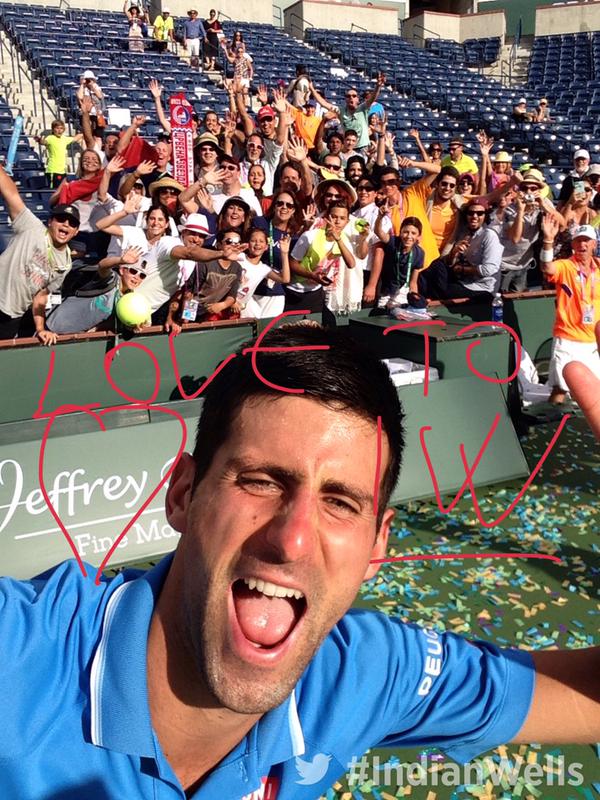
Novak Djokovic beat Roger Federer 6-3, 6-7 (5), 6-2 in the BNP Paribas Open final in Indian Wells. The Serb had to beat not just Federer, however. He also had to take on the crowd, and, at crucial moments, himself.
Djokovic won the first set in convincing fashion. The defending champion broke Federer at 3-2 as he forced an error from the Swiss at the net.
Djokovic went on to hold serve two more times and took the set 6-3, converting set point with a service winner.
The fast balls and afternoon heat were helping Djokovic’s service- the Serb won 100 percent of his first serve deliveries and dropped just four points on serve overall.
Djokovic was also benefiting from the slow surface which was giving him plenty of time to dictate points as he hit deep to the Swiss’ feet or took the pace off the ball and hit down the middle to an error-prone Federer.
The Second Set
The Serb continued his good form into the second set, going a break up at 1-1 to lead 2-1.
At 3-4 down, Federer hit a run of good form, his shot-making stepped up a level and he broke back with a huge forehand down the line that forced an error from the Serbian.
The world no.1 lost his grip on the match as Federer’s aggressive game and his impressive defense got the better off him in rallies, but held on to take the set went into a tiebreak.
Djokovic was also struggling with the crowd who, other than the Serbian contingent, were fully behind Federer.
Djokivic got back on his feet in the second set tiebreak, getting the mini-break to lead 5-3.
But at 5-4, with the match on his racket, on the verge of overcoming Federer and the crowd, the Serbian was confronted with another opponent- himself. Djokovic, the player with arguably the best second serve in the game, hit two double-faults to go set point down.
Federer converted the set point when Djokovic’s lob attempt went long and tied the match at a set all.
On the changeover, Djokovic was so nervous his hands shook as he held his drinks bottle and took a sip. The shock of letting his lead slip and his serve deserting him when he needed it most, and the prospect of having to go back up against Federer, the crowd and his own demons, seemed to be overwhelming him.
The Third Set.
In the third set, Djokovic showed great resistance to put the double faults behind him, calm his nerves and ignore the crowd. The three time Indian Wells champion survived break points as Federer did his best to grab the momentum, continuing to unbalance Djokovic with his range of shots. But Djokovic proved too solid, too patient, and ultimately, too resilient, and held serve for 1-0.
A revived Djokovic then broke Federer to lead 2-0. But the Serb was not in the clear as a fighting Federer fought back to break for 1-2 and held serve for 2-2.
At 3-2, Djokovic once more surged ahead. At deuce, he got a look at a second serve, and on his second strike hit a loopy forehand to the Federer forehand wing that forced an error.
Break point down, Federer missed his first service and would have to rely on his second serve, a shot that in the third set he had only been able to win 16 percent of points behind. Rather than be dictated to be Djokovic, Federer went for too much on the delivery and double faulted and Djokovic was 4-2 up.
That double fault was the beginning of the end for Federer. The Serb had broken the Swiss’ greatest weapon with his own and took control of the match. Djokovic held serve for 5-2, and, now, solid and assured, he held break point, and match point, on the Federer serve.
Federer went down swinging, over-hitting a short forehand, a compliment to Djokovic’s back-court game, and the Serbian sealed the final set 6-2, and the championship.
The Serb now ties Federer with most Indian Wells titles won. The defending champion won his fourth title at the ATP 1000 event and his 50th title overall, tying coach Boris Becker in the record books.
That, though, is for the history books. For now, Djokovic has greater things to take from the match- his ability to not just take on an in-form Federer, and his doting crowd, but also himself. The world no. 1 and eight time slam champion looked to have been on the verge of collapse at the start of the third, but he picked himself up, and with it, another title for his collection.
Watch highlights of the Djokovic-Federer Indian Wells 2015 final below.
Commentary by Christian Deverille
Follow the ATP Tour with The Tennis Review. Subscribe to our e-mail list to get the latest posts.
-
BNP Paribas Open Semi-Final Review Djokovic d. Murray, Federer d. Raonic
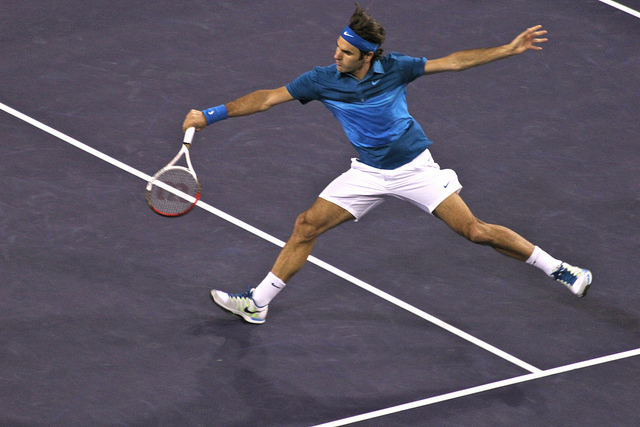
CC courtesy of Marianne Bevis at flickr. The BNP Paribas Semi-finals featured two of the ‘Big Four’ going head to head for the 25th time, and the Biggest of the ‘Big Four’ facing the challenger of gatecrasher Milos Raonic. The Tennis Review reviews the Indian Wells 2015 semi-finals.
Once Djokovic and Murray matches were competitive. Between 2008 and 2013, the rivalry went back and forth, the outcome was never assured. Those were the days of the ‘Big Four’, the ATP’s marketing golden ticket, when Federer, Nadal, Djokovic and Murray were the game’s big winners.
Today, those four are still the ATP’s top four players, but the Murray-Djokovic rivalry looks to be over. In their BNP Paribas Open semi-final Djokovic, who is world No.1 and the reigning Wimbledon and Australian Open Champion, played with the same consistent quality he has displayed since his first slam in 2008, while Murray was a shadow of the man who had beaten him in two slam finals and 3 ATP 1000 finals.
That Djokovic should win with such conviction was not really a surprise. Murray had been in poor form since his painful Australian Open defeat to Djokovic. Error-strewn losses to Coric in Dubai and Simon in Rotterdam were signs of a struggling game. And in Indian Wells, a tournament at which he has reached one final, which he lost badly to Nadal in 2009, he squeezed past Kohlschreiber, the slow courts making a weapon of his defense, and had too much consistency for Mannarino and Lopez.
Defense and consistency. Those work against the likes of those three on slow courts. But against Djokovic? The master of defense and consistency since 2011? The master of turning defense into offense and running away with a match as he did to Murray in Melbourne all those times?
You need to bring a little more to the table. Some attack, some flair, some risks. On the slower courts, putting up an inferior version of the Serbian’s game is only going to end badly.
For Murray, his match against Djokovic could not have started much worse. From the opening point of Murray’s first serve game at 0-1, the way this match would unfold was inevitable. Both men were like mirror images of one another, standing behind the baseline, sending topspin backhands and sliced backhands back and forth down the middle until someone changed the pattern or missed. It was Murray who missed first.
A few points later, Murray threw in a double fault and Djokovic had break point. Murray then did something odd. He did the right thing by getting in his first serve wide and getting a high short ball, and he did the right thing by moving forward, but then he moved back, beyond the baseline, to his comfort zone. There, he hit a forehand deep in the corner and had Djokovic on the run, and as Djokovic ran back to the middle, Murray hit another forehand back to the same spot, but was anything but comfortable on the shot, hitting the ball wide.
Once, that ball would have gone in and we would have had a match on our hands. Now, that shot was a sign of Murray’s lack of belief and was an ominous sign of things, or precisely lack of things contest-wise, to come.
Murray was 0-2 down and Djokovic had all the information he needed. Passive play, errors, double faults, retreating from mid-court. Murray would play Djokovic at his own game, was afraid of Djokovic’s game and was even more terrified of himself.
Djokovic took the match 6-2, 6-3, with matters improving marginally in the late second set for the Scot, But it was all over in the early stages of the match.
Overall, Murray hit 29 errors to 7 winners, made 47 percent of his first serves and won 50 percent of points behind that delivery. Djokovic also had a negative winner count, hitting 27 errors to 15 winners, but won 65 percent of his total serves.
Those stats are not great for Djokovic, but they did not have to be, they just had to be significantly better than Murray’s. That is how this match was played- not to win, but not to lose.
Djokovic though was fine with that. He had energy to conserve after all- he had a possible final to play with Roger Federer.
Federer stops Raonic gatecrashing again
The Swiss took on Milos Raonic who had gatecrashed what many were hoping was going to be a ‘Big Four’ reunion. The ATP’s beloved quartet has not filled up the last four of a tournament since the 2012 Australian Open when they produced two high quality encounters that for once justified the hype and hoopla.
Since then, injuries to different members, and dips in form, at different times, sometimes the same time, have prevented them from meeting up. At this year’s Indian Wells, a reunion looked like it might finally happen as Nadal, the final member to keep his part of the pact, held match points against Raonic in their quarter final. Raonic, though, overturned the match-points, and a 0-5 career head to head against the Spaniard, and spoiled the party.
Beating Federer in the semis would have been another piece of gatecrashing. Federer and Djokovic have been living up to their world no’s 1 and 2 billing now and then, and providing some great matches while they are it, Indian Wells 2014 being a good illustration of that.
The likelihood of Raonic surprising the ATP tour and fans with an appearance in the final was in doubt once Federer had broken him at 5-5 and went on to take the first set 7-5. It was almost impossible to imagine once Federer broke him early in the second.
Raonic did fight, though. The sole representative of the Nishikori-Tomic-Dimitrov generation is as eager to break through as many fans are for them to do so, and deep into the second set as the match seemed to reach its inevitable conclusion, Raonic took one last swing at bringing his generation back into contention.
With Federer serving at 5-4, Raonic won the opening point with a backhand passing shot on the run that hit Federer’s racket frame. Raonic’s back-court play is very much a work in progress, but his defense on this slow surface proved it was progressing in the right direction.
That defense seemed to worry Federer. On the next point, Federer served out wide again to the Raonic backhand, but he over-hit his forehand to the Raonic forehand side to go 0-30 down.
Federer was a little tentative on the next point, sensing Raonic’s chances to grab momentum, and stayed back, rallying with Raonic. When a Federer forehand hit the tape and sat up right in the hitting zone of the Raonic forehand, it looked like Federer would face three break points against a man who had saved match points the previous day on his way to one of his career best wins.
Luckily for Federer, Raonic’s inexperience at the very top of the game decided matters. The Canadian took the forehand on but he sent it well wide.
An over-hit return from Raonic and it was 30-30. Federer’s footwork and defensive skills then came into play- after a long rally the Swiss hit a laser-like forehand cross-court on the run that was too good for Raonic whose long arms could not reach the ball and he hit down the line too soon and into the net.
On match point, Federer took matters into his own hands, got Raonic on the run, opened up the court, and won the point with a forehand volley, a confident end to a match which he was very close to losing his grip on.
Raonic may not have spoiled the party again, but he had certainly shown his name might turn up on a few guest lists to the business end of big events soon. That though was small consolation to him as he shook hands with Federer- the disappointment on his face at his missed chances a promising sign of things to come.
Federer meanwhile had won the right to be guest of honor once again at Indian Wells- Federer has four titles and will play the final for a record fifth.
Commentary by Christian Deverille
Follow the ATP Tour with The Tennis Review. Sign up for our E-mail subscription and receive all the latest reviews, previews and articles.
-
BNP Paribas Open Final Preview Novak Djokovic Vs Roger Federer
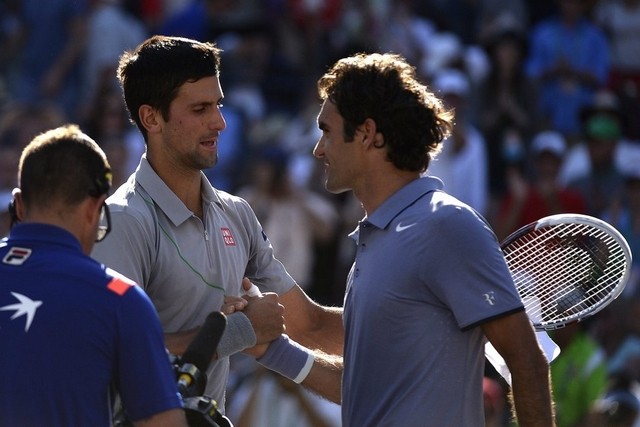
Photo courtesy of http://www.thenational.ae The BNP Paribas Open Final features top seed Novak Djokovic against second seed Roger Federer for the second year in a row. The Tennis Review previews the action and predicts the winner.
Head to head
Federer leads 20-17 overall. The Swiss also leads 15-9 on hard courts. At Indian Wells, Djokovic leads 2-0, (2014, 2011) winning each time in three sets.
Federer has won their last two hard court matches in straight sets, but those wins came on two of the ATP tour’s fastest courts in Shanghai and Dubai.
Match up
This is, on the surface, a classic contrast of styles- Federer is the attacking player and Djokovic is the aggressive-defensive baseliner. But both men are dynamic enough that they can play other styles, too. Federer defends well when forced to, and Djokovic is not afraid to come forward, which adds an element of unpredictability to their clashes.
History at IW
Federer has won four times, and Djokovic three. Federer is 52-10 in the desert, Djokovic is 40-6.
Conditions
The conditions suit both men in different ways. Federer benefits from the fast balls and, with this match played at 1pm, the heat, which will make them fly even quicker, ideal for his service and net game.
Djokovic benefits from the slow surface and the high bounce. He has the best return in the game, and will have a little extra time to get the return back, negating a little the help the fast balls give the Federer serve to hit through the court.
The world No. 1 also has the high bounce he likes, the time to get to the ball and set up his shots, and he will be striking deep and with top spin to the Federer backhand to force the error or open up the court.
Djokovic will make more errors than usual but so will Federer who will have to engage in more rallies than he did in his previous matches.
Djokovic also benefits from the fast ball on the serve as his serve is much improved and his second serve the best in the game.
Form
Djokovic made more errors than winners in his semi-final win against Murray (27 errors to 15 winners), but that win was more about tactics than prettiness. The Serb’s best match was against Isner, which shows how the surface suits his return game.
Federer was in top form against Berdych and performed well against Raonic though he dropped his level a little towards the end, and was often threatened from the back of the court only for Raonic to miss when he had an opening.
Federer will not get away with that against Djokovic who will construct points and execute his shots far more consistently than any of Federer’s opponents so far.
Who will win?
Djokovic in three. The surface favors his ground game, and his service game, too. His return is too good, helped by the surface, and Federer has not been tested by a good returner yet.
Federer is serving too well not to get a set, but once Djokovic finds his groove, the Serb should take control of the match and win his fourth Indian Wells title, tying Federer in that respect.
Watch highlights from the classic three set final Djokovic and Federer played last year below.
Commentary by Christian Deverille
Follow The ATP Tour with The Tennis Review. Sign up for our e-mail subscription and get the latest previews, reviews and articles.
Who do you think will win? Please share your opinions below.
-
Five Reasons to Look Forward to Juan Martin Del Potro’s Comeback in Miami
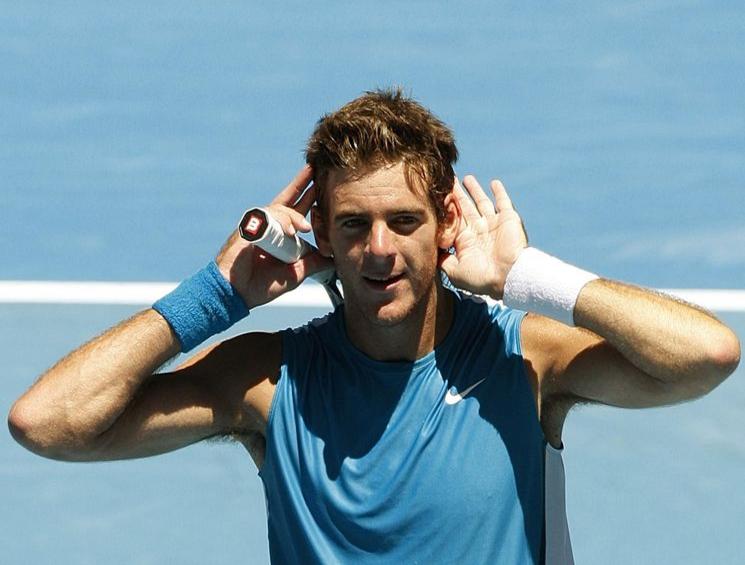
Photo courtesy of sportscelebs.blogspot.com Juan Martin Del Potro makes his second comeback attempt after his 2014 wrist surgery at the 2015 Miami Open. The Tennis Review is looking forward to the Argentine’s return for good reasons.
1. That forehand.
Del Potro executes the forehand with his trademark relaxed style making the powerful stroke he unleashes even more electrifying to watch.
The Argentine gradually uncoils from the hip to his shoulders, and when he has the ball he wants, he hits one of the most powerful and quick forehands on the ATP Tour, reaching speeds of up to 188 kmh.
Watch the video below to see the beauty that is the Del Potro forehand when he has time to set up the shot.
But, Del Potro does not only hit forehands to make you gasp when he is in control of the point. Del Potro’s long legs and long arms means he has a stronger forehand on the stretch than most players.
Watch the hot shot below to see Del Potro hit a winning forehand on the run down the line.
Del Potro is one of the few ATP players to hit his forehand with an Eastern grip. Roger Federer is another one and a player Del Potro challenges for the title of best forehand on the ATP Tour.
2. Del Potro’s battles with Federer.
Del Potro made his name when he beat Federer in a topsy-turvy, fiery final to win the U.S Open 2009 title, a match preceded by their tense five setter that same year at Roland Garros.
See highlights of the classic U.S Open 2009 final between del Potro and Federer below.
The biggest ATP forehands firing away against each other have produced ten matches going the distance out of twenty played. Federer leads the head to head 15-5, but Del Potro has won most of their biggest clashes, winning three of their four finals- the 2009 U.S Open final, and the finals in Federer’s hometown of Basel (2012, 2013).
3. Gentle Giant qualities
The soft voice with which Del Potro politely answers journalist’s questions, the absence of tantrums, the tweets and facebook updates about how much he loves his family, friends, fans and home, all are the characteristics of a gentle giant.
There is nothing flashy or divaish about Del Potro- he is all gentleman, a rare characteristic in the sport, and tennis is all the better for having him.
4. Champion’s mindset and heart.

Photo courtesy of www. telegraph.co.uk Del Potro won the U.S Open 2009 as a dark horse, beating Rafael Nadal and Roger Federer back to back to win the title, becoming the first man to do so on the way to a slam title.
That fearlessness and self-belief are what separates a slam champion from the rest. Del Potro has another crucial element, too- heart. The Argentine’s 2013 Wimbledon semi-final against Novak Djokovic, showed how prepared he was to fight in a tennis match, as did his 2012 Olympic semi-final against Roger Federer, in which he gave everything he had as he went down 19-17 in the decisive set.
Del Potro’s reactions to his straight sets defeat of Djokovic the next day and his tearful acceptance of his bronze medal showed just how much tennis meant to him and how much heart the Argentine has for the sport.
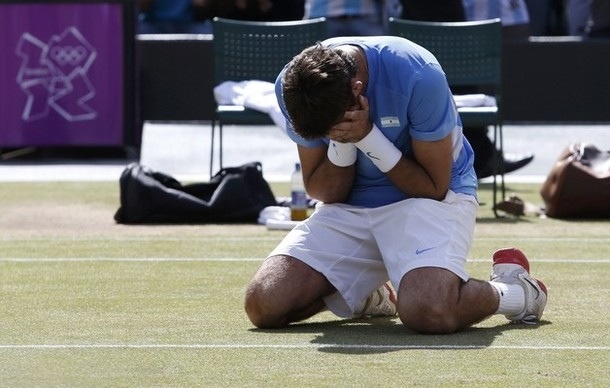
Photo courtesy of the-slice.com 5. Charm.

Photo courtesy of http://www.celebrityemotion.com When Del Potro smiles, hearts melt, but wait til he speaks- icebergs thaw.
Watch his U.S Open 2009 winner’s speech (4.19) below to see his charm in action.
Commentary by Christian Deverille
Follow ATP Tennis with The Tennis Review
Are you excited about Del Potro’s return to tennis in Miami Please leave a comment below.

Tennis from a fan's point of view
[
[
[
]
]
]

 thetennisreview